

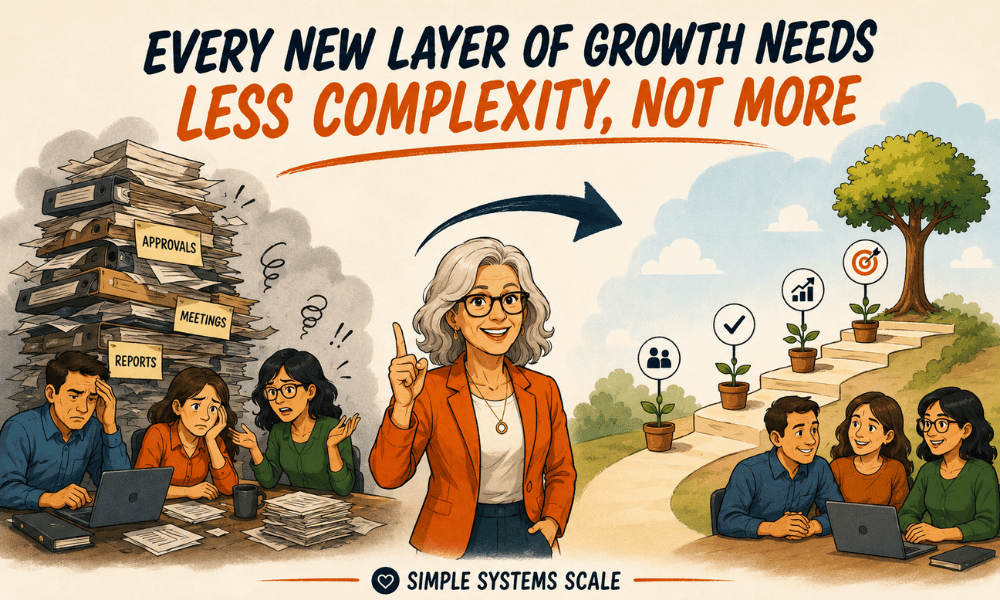
One of the biggest myths in business is that growth demands more complexity.
More management layers. More meetings. More reports. More approvals. More policies.
It sounds logical. If the business doubles in size, surely the systems around it need to double as well?
Not necessarily.
In fact, I have found the opposite is often true.
The businesses that scale well are not usually the ones with the most complicated structures or the largest collection of processes. They are the ones that work relentlessly to keep decision-making, accountability & communication as simple as possible.
Growth will create enough complexity on its own. A leadership team does not need to add unnecessary layers on top of it.
Growth Naturally Creates Complexity
Every new customer, employee, location, product or service changes the way a business operates.
There are more people to communicate with, more decisions to make, more work to coordinate & more opportunities for something to fall between the cracks.
That is normal.
Complexity is a natural by-product of growth. The mistake is assuming every new challenge needs another process, meeting, report or approval.
Over time, these additions begin to accumulate.
A weekly meeting is added to solve a communication problem. A new report is introduced because somebody missed a number. Another approval step appears after one poor decision. A policy is written to manage an issue that happened once.
Individually, each response may seem reasonable.
Collectively, they can create a business that is much harder to navigate than it needs to be.
Before long, people are spending more time managing the machinery of the business than serving customers, solving problems or creating growth.
Complexity Does Not Always Look Complicated
When people think about complexity, they often picture enormous policy manuals, complicated software or overly technical systems.
Sometimes complexity is obvious.
More often, it appears as everyday friction.
People are unsure who has the authority to make a decision. A simple project requires three meetings before anyone starts. Two teams complete the same work because responsibilities overlap. Issues move from department to department because nobody clearly owns the solution.
The business may still look organised from the outside, but inside it feels slow, frustrating & unnecessarily difficult.
Nobody deliberately designed it that way.
Complexity usually accumulates quietly, one reasonable-looking addition at a time.
The Real Cost of Unnecessary Layers
As unnecessary complexity grows, speed disappears.
Decisions take longer because more people need to be consulted or asked for approval. Accountability becomes blurred because responsibility is spread across too many roles. Communication becomes noisier because everyone is copied into everything, just in case.
People spend more time explaining, reporting & seeking permission than using their judgement.
Eventually, leaders start asking:
“Why does everything take so long now?”
The answer is rarely that the team has become less capable.
More often, the business has become harder to understand.
People are not moving slowly because they lack commitment. They are moving slowly because the path from decision to action has become cluttered.
Growing Businesses Need Better Systems, Not Bigger Ones
A larger business does need structure.
It needs clear roles, dependable communication, visible priorities, useful measurables & consistent ways of solving problems.
But structure is not the same as complexity.
A good system should make the business easier to run. People should be able to understand it, follow it & explain it without needing a translator, a flowchart & a quiet lie-down afterwards.
The strongest systems tend to do a few simple things well:
They clarify who owns what.
They help people make decisions at the right level.
They keep the team focused on a small number of important priorities.
They make useful information visible without burying leaders in reports.
They create a reliable rhythm for communication & problem-solving.
None of that requires unnecessary bureaucracy.
The goal is not to eliminate systems. It is to eliminate systems that create more work than value.
Family Businesses Can Feel Complexity More Deeply
Family businesses often carry layers of complexity that do not appear on an organisational chart.
There may be long-standing habits, informal decision-making, historical relationships & conversations happening outside formal meetings.
A family member may influence a decision without holding a formal role. One person may speak as an owner in one conversation, a family member in another & an operational leader in the next.
This is where the family, ownership & business circles begin to overlap.
Those overlaps are not automatically a problem. They become a problem when nobody is clear which role they are speaking from or who has the authority to make the final decision.
As the business grows, informal arrangements that once worked can begin to create confusion.
Employees may receive different messages from different family members. Decisions may slow down because ownership concerns, family relationships & operational responsibilities are being mixed together. Important conversations may be avoided because nobody wants to create tension around the dinner table.
Simple, visible structure does not remove the human side of a family business.
It protects it.
Clear roles, agreed decision rights & separate forums for family, ownership & business discussions reduce confusion without pretending the relationships do not matter.
Simplicity Requires Discipline
Keeping a business simple is not the easy option.
It takes discipline to resist the temptation to solve every problem by adding something.
- Another meeting.
- Another report.
- Another policy.
- Another approval.
- Another person copied into every email.
Sometimes an additional layer is necessary. Often, it is simply the fastest response to a problem that has not been properly understood.
Before adding anything new, leadership teams should ask:
- “Does this make the business easier to run or harder?”
- “Which problem is this solving?”
- “Could we solve the problem by clarifying ownership instead?”
- “What could we remove or replace?”
Every new system creates maintenance. Someone has to run it, monitor it, explain it & make sure people follow it.
That means every addition should earn its place.
What Leadership Teams Often Get Wrong
Many leaders assume growth means building bigger systems.
Often, it means building better ones.
A better system is easier to understand, easier to follow, easier to measure & easier to improve.
It gives people enough structure to work confidently without creating layers of unnecessary control.
The goal is not to make every decision at the top. It is to make it clear where each decision belongs.
The goal is not to create more reports. It is to identify the small number of measurables that help the team act earlier.
The goal is not to hold more meetings. It is to make sure the meetings you do hold have a clear purpose, the right people & a useful outcome.
The goal is not fewer systems at any cost.
It is fewer unnecessary systems.
Practical Ways to Reduce Complexity
Simplification does not require a dramatic restructure. It usually begins with a series of practical questions.
Start by reviewing where decisions are getting stuck. Which decisions repeatedly move upwards because people are unsure who has authority?
Look at the meetings in the calendar. Which ones genuinely help the business make decisions, solve issues or stay aligned? Which ones exist mainly because they have always existed?
Review your reporting. Which numbers help the leadership team take action? Which reports are produced but rarely discussed or used?
Clarify ownership. Where are two people assuming the other person is responsible? Where are too many people jointly accountable for an outcome?
Examine recurring frustrations. Every repeated workaround, duplicated task or approval bottleneck is a clue that something could be simplified.
Do not ask only, “What do we need to add?”
Ask, “What can we remove, combine, clarify or stop?”
That question often produces far more valuable answers.
Frequently asked questions
1. Why does growth naturally create complexity?
Every new person, customer, location, product or service adds communication, coordination & decision-making requirements. Some additional structure is necessary, but unnecessary layers often accumulate when businesses respond to each challenge in isolation.
2. Does a larger business need more systems?
Usually, yes. The systems should remain clear, useful & easy to follow. A larger business needs more structure, but that structure should reduce confusion rather than create bureaucracy.
3. Why do businesses often become slower as they grow?
Ownership becomes less clear, communication increases & more approval layers are added. As responsibilities overlap, people spend more time checking, explaining & waiting before taking action.
4. How can leaders keep a growing business simple?
Regularly review processes, meetings, reports & decision rights. Remove unnecessary approvals, clarify ownership, reduce duplication & focus the team on the work that creates the greatest value.
5. How can family businesses reduce complexity?
Begin by clarifying the difference between family, ownership & business roles. Agree on who decides what, create the right forums for different conversations & avoid relying on informal influence or historical assumptions.
Final Thought
Growth does not have to make your business heavier.
Some complexity is unavoidable, but bureaucracy is not.
The best businesses do not respond to every new challenge by adding another layer. They create enough structure to provide clarity, then keep simplifying as the business evolves.
Because the businesses that scale best are rarely the ones with the biggest systems.
They are the ones with the clearest.
Written by Debra Chantry-Taylor, FBA Accredited Family Business Advisor, Certified EOS Implementer & Founder of Business Action.
Business Action is focused on helping Entrepreneurs lead better lives, through creating a better business. We have a small team of accredited family business advisors, EOS Implementers & Leadership coaches, as well as access to a huge range of advisors through our Trusted Partners Network.