
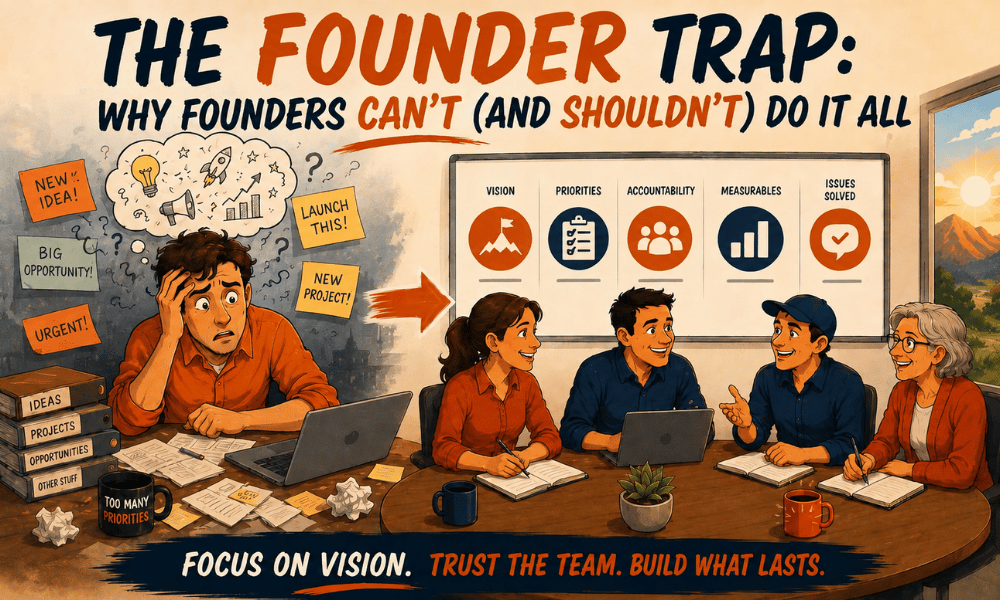
One of the biggest myths in entrepreneurship is that the founder should stay at the centre of everything.
Every decision. Every opportunity. Every customer relationship. Every new idea.
After all, you built the business. Who could possibly understand it better than you?
That thinking makes sense in the early days.
It can also become one of the biggest growth ceilings in the business.
I’ve worked with founders across Australia & New Zealand, & I see the same pattern over & over again. The very strengths that helped build the business eventually become the things that start holding it back.
I think of it as the Founder Trap.
The Founder With 100 Ideas a Week
I once worked with a founder who could probably generate 100 new business ideas in a week.
They were smart, passionate, creative & incredibly driven. Exactly the sort of person you would want pushing a business forward.
They could inspire an entire leadership team with a new opportunity in one conversation, then completely derail the team’s focus with another brilliant idea three days later.
At one point, someone on the leadership team looked across the table & said:
“Can we please finish the last three things you started before we launch a fourth?”
Everyone laughed.
Mostly because everyone knew it was true.
Including the founder.
The ideas were not the problem.
The timing was.
When the Strength Becomes the Weakness
Founders are often very good at seeing what other people cannot see yet.
They spot opportunities. Connect ideas. Build relationships. Challenge assumptions. Create energy. Take risks other people would avoid.
Without those qualities, many successful businesses would never have existed.
But every strength has a shadow.
The same founder who can see ten opportunities may struggle to choose one.
The person who can solve almost any problem may keep stepping in before other people have the chance to solve it themselves.
The founder who cares deeply about the customer may stay involved in every major relationship long after that has stopped being healthy for the business.
The person who built the company by doing whatever needed to be done may find it incredibly difficult to stop doing exactly that.
That is where the Founder Trap begins.
Great Ideas Can Become Expensive
I often tell founders that their next idea is probably not the problem.
Introducing it at the wrong time might be.
Every new initiative costs the business something.
It takes attention away from existing priorities. It creates more decisions. It requires people, time, money & energy. It may cause a team to stop work already underway so they can chase something new.
Even brilliant ideas can damage momentum when they arrive too often.
I have watched leadership teams spend months working towards an important priority, only to abandon it halfway because another exciting opportunity appeared.
Everyone stays busy.
Very little gets finished.
The business starts confusing activity with progress.
That is exhausting for the team & expensive for the business.
When the Founder Becomes the Bottleneck
Many founders believe they are accelerating the business because they stay involved in everything.
Often, they are doing the opposite.
Not intentionally.
It happens because every important decision still finds its way back to them.
- Every approval.
- Every senior hire.
- Every major customer issue.
- Every product change.
- Every difficult conversation.
- Every unexpected problem.
The business becomes dependent on one person, & that person is usually already carrying too much.
Eventually, things begin to slow down.
Decisions wait.
People hesitate.
Leaders stop taking ownership because they have learnt that the founder will eventually step in.
The founder becomes frustrated because “nobody takes initiative”, while the leadership team becomes frustrated because every significant decision is still being second-guessed.
Nobody designed it that way.
But that is how founder dependency grows.
Ironically, the person trying hardest to grow the business can become one of the biggest constraints on its growth.
The Founder Does Not Need to Become Someone Else
This is where founders often get nervous.
They hear “let go” & assume they are being asked to become less involved, less creative or less important.
That is not the goal.
A founder should not be forced into becoming an operational manager if that is not where they create the greatest value.
The goal is not to make the founder less entrepreneurial.
It is to make sure their entrepreneurial energy helps the business rather than constantly disrupting it.
A founder may create enormous value through customer relationships, partnerships, innovation, market opportunities, culture or thinking about what comes next.
That work matters.
The challenge is creating enough structure around the founder so those strengths can flourish without the whole business having to change direction every time a new idea appears.
Someone Who Can Turn Ideas Into Execution
As businesses grow, founders usually need strong people around them who think differently.
- Someone needs to translate ideas into action.
- Someone needs to ask, “What will this require?”
- Someone needs to protect the priorities already underway.
- Someone needs to hold the leadership team accountable for delivering what has been agreed.
- Someone needs to make sure the business does not chase every interesting opportunity simply because the founder became excited about it on Tuesday morning.
That person does not need to suppress the founder.
They need enough trust & authority to challenge them.
The founder asks:
“What is possible?”
A strong operational leader asks:
“What should we actually do?”
The founder may naturally accelerate.
Someone else needs to help steer.
Both matter.
A Client Story
I worked with a design-led business in New Zealand that felt as though it was constantly dropping the ball.
The founder was exceptional.
Clients loved them. Their creativity, energy & relationships were a huge part of why the business had grown.
Internally, though, things were becoming increasingly difficult.
Meetings regularly changed direction.
Priorities shifted.
The leadership team would begin working on one initiative, then another idea would arrive before the first one was complete.
People were working incredibly hard, but the business still felt chaotic.
One of the senior leaders was doing their best to translate the founder’s ideas into execution, but without enough authority or clarity to make decisions stick.
The problem was not talent.
It was not commitment.
It was not a lack of ideas.
There were far too many ideas.
The problem was structure.
Creating Clarity Around the Founder
We started by getting much clearer about roles.
- Which decisions genuinely belonged with the founder?
- Which decisions should sit with the leadership team?
- Who owned the day-to-day running of the business?
- Which priorities had already been agreed & needed to be protected from distraction?
We also became much more disciplined about what happened to new ideas.
They did not disappear.
They simply stopped automatically becoming immediate priorities.
That mattered enormously.
The founder could continue doing what they did brilliantly: building relationships, exploring opportunities, thinking about the future & contributing creatively.
The leadership team could focus on executing what had already been agreed.
Most importantly, people knew where decisions belonged.
The business started to feel calmer.
Not slower.
Calmer.
There is a big difference.
What Happened Next
Over the following months, projects began finishing.
Decision-making improved.
The leadership team became more confident.
Customers experienced greater consistency.
The business grew without feeling as though everything had to pass through one person.
Perhaps the biggest shift was that the founder finally had room to think again.
They were no longer spending every day solving operational problems that someone else was capable of handling.
That created space for the work only they could do.
And that is often the real opportunity for founders.
Not doing less for the sake of it.
Doing less of the work that somebody else can do, so you can do more of the work where you create disproportionate value.
The Hardest Conversation
Founders sometimes tell me:
“But I built this business.”
They are right.
They did.
Then comes the next sentence:
“No one can drive it like I can.”
That may also be true.
Today.
But if it remains true forever, the business has a problem.
Because a business that depends entirely on one person does not really scale.
It simply becomes a larger, more complicated extension of that person.
Eventually, the founder becomes stretched too thin.
Decisions slow down.
Other leaders stop developing.
The business hits a ceiling.
And the founder begins wondering why growth has become so bloody hard.
Letting Go Does Not Mean Losing Control
This is one of the biggest fears I hear from founders.
“If I step back, how do I know things will still be done properly?”
It is a fair question.
The answer is not blind trust.
It is better structure.
Clear roles.
Clear decision rights.
Clear expectations.
Useful information.
Regular communication.
Strong accountability.
When those things are in place, founders do not need to be involved in every detail to know what is happening.
In fact, trying to stay involved in everything often creates less control because the founder becomes so overloaded that important things begin slipping through the cracks.
Real control does not come from touching every decision.
It comes from knowing the right decisions are being made by the right people, with the right information.
Family Businesses Make This Harder
Founder dependency can be particularly complicated in family businesses because the founder may occupy several roles at once.
They may be a parent, shareholder, director & operational leader.
Those roles can become tangled very easily.
A family member may hesitate to challenge the founder because they are not only speaking to the CEO. They are speaking to Mum, Dad, an older sibling or the person who still owns most of the company.
That changes the dynamic.
It can also make succession harder.
The founder may believe they are empowering the next generation while still making every important decision.
The next generation may say they want more responsibility while continuing to look to the founder whenever something becomes difficult.
This is where it becomes important to separate the family, ownership & business roles.
- Who gets a say because they are family?
- Who has authority because they are an owner?
- Who has decision-making responsibility because of the role they hold in the business?
Those are three very different questions.
When they are blurred together, founder dependency becomes much harder to unwind.
The Question Is Not “How Do I Become Less Important?”
That framing is wrong.
The better question is:
“Where do I create the greatest value now?”
The answer at 20 employees may be very different from the answer at 100.
The work that built the business is not always the work that will take it to the next stage.
That can be confronting for founders because so much of their identity is tied to being the person who knows, fixes, decides & rescues.
But growth often requires a different kind of leadership.
Less rescuing.
More trusting.
Less jumping in.
More creating clarity.
Less solving today’s problem.
More thinking about tomorrow’s opportunity.
That transition is not always comfortable.
But it is often the difference between owning a business that depends on you & building one that can genuinely grow beyond you.
Final Thought
If you are the founder of your business, here is a question worth asking:
Are you leading the business forward, or have you accidentally become the person everything has to go through?
The answer is not working harder.
It is not having fewer ideas.
And it is certainly not becoming less entrepreneurial.
It is creating the structure, leadership capability & trust that allow the business to keep moving without you being involved in every decision.
Because businesses do not scale when founders simply do more.
They scale when founders become clearer about what only they should be doing, then build a team capable of owning the rest.
Ready to Stop Carrying the Operational Load Alone?
If your business is growing but too much still depends on you, Sherwood Foundry is designed for exactly this stage.
Sherwood Foundry works with founder-led businesses that need stronger operational leadership, clearer accountability, better execution & healthier business rhythms, so founders can stop carrying every decision, every issue & every operational responsibility alone.
The goal is not to remove you from the business or make you less important.
It is to build the leadership capability & operating structure that allow you to focus on where you create the greatest value, while the business becomes stronger around you.
If you are ready to build a business that can scale without everything constantly coming back to you, explore Sherwood Foundry.
Written by Debra Chantry-Taylor, FBA Accredited Family Business Advisor, Certified EOS Implementer & Founder of Business Action.
Business Action is focused on helping Entrepreneurs lead better lives, through creating a better business. We have a small team of accredited family business advisors, EOS Implementers & Leadership coaches, as well as access to a huge range of advisors through our Trusted Partners Network.