Most founders and leaders become the “go-to person” because they’re capable.
They solve problems quickly. They make fast decisions. They know the business better than anyone else.
In the early stages, this is often a strength.
The business grows because of their drive, experience & ability to step in when needed.
But over time, something shifts.
The business becomes more dependent on them instead of less.
And what once felt helpful starts becoming expensive.
The Go-To Person Trap
At first, being the go-to person feels efficient.
People come to you because:
- You have the answers.
- You move quickly.
- You know the history.
- You can fix things faster than anyone else.
So leaders step in.
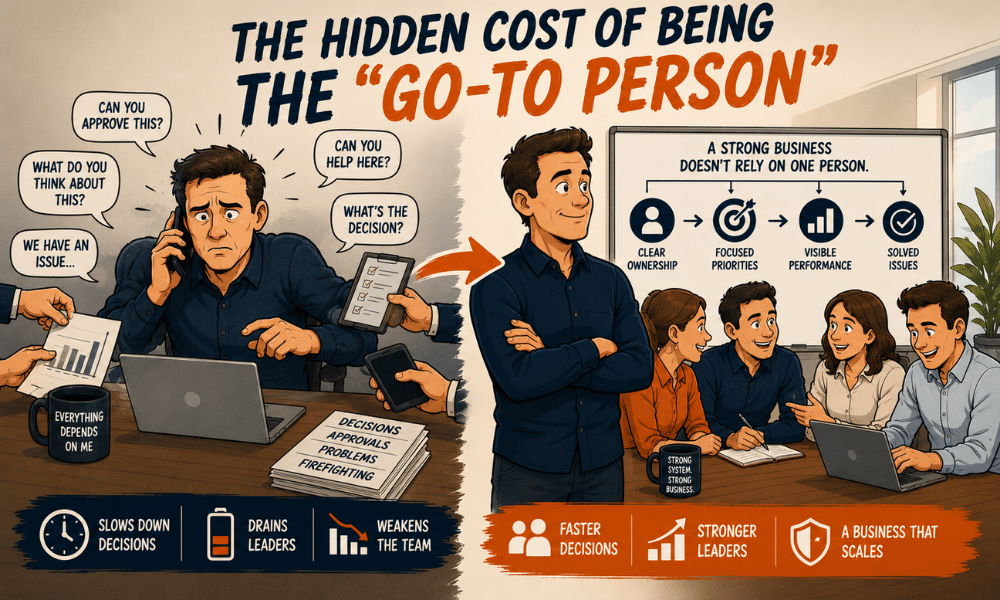
They approve decisions. They answer every question. They solve issues before the team even tries.
In the short term, this keeps momentum moving.
In the long term, it quietly trains the business to rely on one person.
The Hidden Costs Most Leaders Don’t See
The impact isn’t always obvious immediately.
But over time, the costs compound.
Decision-Making Slows Down
When everything flows through one person, the business loses speed.
People wait for approval. Teams hesitate before acting. Issues sit longer than they should.
Even highly capable people stop making decisions confidently because they’ve learned the safest option is escalation.
Leaders Become Exhausted
Being the go-to person creates constant interruption.
Questions.
Approvals.
Problem-solving.
Firefighting.
Leaders often describe feeling mentally overloaded, even when the business is performing well.
Not because the business is failing.
Because too much still depends on them personally.
Team Capability Weakens
This is the part most leaders don’t intend.
When leaders constantly step in, the team gets fewer opportunities to think, solve & own outcomes themselves.
Over time:
- Confidence drops.
- Initiative reduces.
- Dependency increases.
The leader becomes stronger.
The system becomes weaker.
Why Leaders Struggle to Let Go
This usually isn’t about ego.
It’s about trust & certainty.
Leaders step in because, they care deeply, they want things done well, & they believe they’re helping.
And often, they genuinely can do it faster.
But faster is not always better for long-term growth.
Because every time the leader rescues the situation, the business loses a chance to strengthen its structure.
Growth Makes the Problem Worse
As businesses grow, founder dependency becomes heavier.
More people means more decisions. More clients means more variability. More complexity means more pressure.
What worked at 10 people starts breaking at 50.
The founder becomes the bottleneck, not because they lack capability, but because the business still revolves around them.
That’s usually when growth starts feeling exhausting instead of energising.
Where EOS® Changes the Dynamic
EOS® provides a practical framework that helps leadership teams reduce founder dependency by creating greater clarity, accountability & consistency across the business.
The Accountability Chart® clarifies who truly owns what.
Not shared ownership. Not implied ownership.
Clear ownership.
Rocks® create focus so leaders stop getting dragged into every opportunity or distraction.
The Scorecard® gives visibility into performance without leaders needing to personally monitor everything.
And Level 10 Meetings® ensure issues are solved consistently instead of escalating informally.
The goal isn’t for leaders to care less.
It’s for the business to function effectively without requiring them to be involved in every decision.
Family Businesses Feel This More Intensely
In family businesses, the go-to person dynamic can become deeply ingrained because ownership, family relationships & business leadership often overlap.
Decisions that appear to be business decisions may also carry family expectations, ownership concerns or legacy considerations.
Over time, one family member can become the centre of all three circles, creating significant dependency throughout the organisation.
People defer to them automatically.
Approval pathways become informal.
Authority sits with the individual instead of the structure.
As the business grows, this creates pressure on everyone.
The leader feels overwhelmed.
The next generation struggles to step up.
Teams hesitate without approval.
Clear structure helps transfer confidence from the individual to the business itself.
What Leaders Often Get Wrong
Many leaders think letting go means stepping back completely.
It doesn’t. It means creating clarity around:
- Who owns what.
- What decisions sit where.
- How accountability works.
Strong leadership is not about solving every issue personally.
It’s about building a business where problems can be solved without constant escalation.
Frequently Asked Questions
1. What is a “go-to person” in a business?
It’s the person everyone relies on for decisions, approvals or problem-solving, often the founder or senior leader.
2. Why does this become a problem as businesses grow?
Because decision-making slows, dependency increases & leaders become bottlenecks.
3. Is this a trust issue?
Partly. Leaders often step in because they care deeply & want certainty around outcomes.
4. How can EOS® help reduce founder dependency?
By creating greater accountability, focused priorities & structured issue-solving processes that help leadership teams operate more effectively.
5. How can leaders stop being the bottleneck?
By clarifying ownership, resisting unnecessary escalation & allowing the team to build confidence through responsibility.
Final Thought
Being the go-to person can help build a business.
But eventually, it can also limit it.
Real scale happens when accountability lives within the structure, decisions are made at the right level, & the business can continue to grow without relying on one person to hold everything together.
Written by Debra Chantry-Taylor, FBA Accredited Family Business Advisor, Certified EOS Implementer & Founder of Business Action.
Business Action is focused on helping Entrepreneurs lead better lives, through creating a better business. We have a small team of accredited family business advisors, EOS Implementers & Leadership coaches, as well as access to a huge range of advisors through our Trusted Partners Network.