
Most businesses are built on a certain amount of heroics.
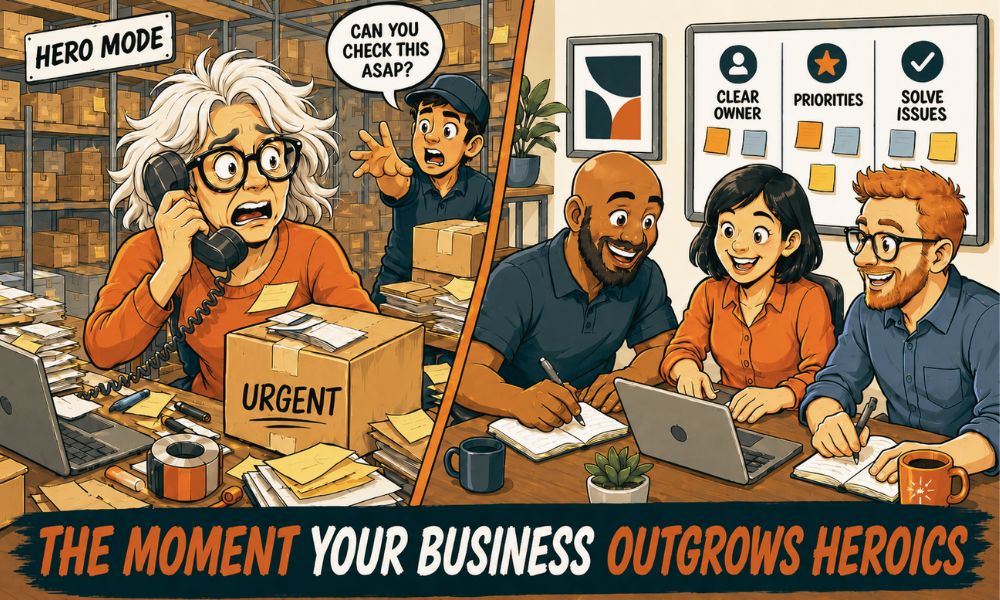
The founder stays late to finish something that cannot wait. A leader steps in to rescue a project that has gone off track. Someone works through the weekend to meet an important customer deadline. A key employee quietly fixes a problem nobody else even knew existed.
In the early days, that willingness to do whatever it takes can be one of the reasons a business survives. Resources are limited, roles overlap & everyone needs to pitch in. Many successful businesses exist because someone cared enough to go above & beyond when it mattered.
The problem begins when going above & beyond becomes the normal way the business operates.
There comes a point when heroics stop being a strength & start becoming a liability.
Why Heroics Feel So Valuable
Heroics usually produce an immediate result. The customer is looked after, the problem disappears, the deadline is met & everyone breathes a sigh of relief.
The person who stepped in is praised for saving the day, while the business carries on as though the problem has been solved.
That immediate relief is exactly why heroics can become addictive. They feel productive. They make leaders feel useful. They create visible results & can easily be mistaken for strong leadership.
However, a successful rescue does not necessarily mean the underlying problem has been addressed. Quite often, it simply means the symptoms have been dealt with quickly enough for everyone to move on.
What Heroics Are Really Telling You
Repeated heroics are rarely random. They are usually a signal that something in the business is not working as well as it should.
When the founder constantly needs to step in, it is worth asking why. When the same person repeatedly saves projects, resolves customer issues or makes every difficult decision, there is probably a gap in ownership, capability, communication or accountability.
The individual doing the rescuing is not necessarily the problem. In many cases, they are highly capable, committed & genuinely trying to help.
The real problem is that the business has become dependent on them.
That dependency can develop so gradually that nobody notices it happening. The hero becomes the person everyone trusts to sort things out, while the rest of the team becomes increasingly comfortable passing problems upwards.
The Hidden Cost of Constant Rescue
At first, heroics can appear efficient. The fastest person solves the issue, everyone gets back to work & the business keeps moving.
Over time, however, that approach becomes expensive.
Leaders Become Bottlenecks
When leaders continually step in to solve problems, the team learns to escalate rather than think.
Decisions start travelling upwards. Initiative drops. People wait for approval because they know the leader will eventually take over or provide the answer.
The leader may feel indispensable, but the business is becoming increasingly dependent on one person’s time, energy & judgement. That is not a sign of strength. It is a bottleneck with good intentions.
The Team Stops Developing
People build confidence by making decisions, owning outcomes & learning from the consequences. They need the opportunity to work through challenges rather than being rescued the moment something becomes uncomfortable.
When a leader repeatedly takes over, the team misses those opportunities. The hero becomes more experienced, while everyone else becomes less confident about acting without them.
The individual grows stronger, but the organisation grows weaker.
The Business Becomes Fragile
A business built around a few heroic individuals is difficult to scale because too much knowledge, authority & responsibility sits with too few people.
What happens when the hero goes on holiday, becomes unwell, burns out or leaves the business? What happens when the company grows beyond the number of problems that one person can personally resolve?
When performance depends on individuals continually rescuing the business, the business is carrying more risk than it may realise.
The Growth Trap
Most growing businesses eventually reach a point where heroics simply stop working.
There are more customers, more employees, more decisions & more moving parts. The issues become more complex, while the consequences of getting things wrong become greater.
The founder can no longer personally oversee every detail or jump into every problem. Yet many founders continue trying because that is the approach that helped them build the business in the first place.
This is often when growth starts to feel unnecessarily heavy. The business may be performing well on paper, but the founder feels more overwhelmed than ever.
That does not necessarily mean the business is failing. It usually means the old way of operating no longer suits the size or complexity of the organisation.
The business has outgrown heroics, but its leaders have not yet replaced them with a better way of working.
How EOS® Helps Replace Heroics With Structure
This is one of the areas where the Entrepreneurial Operating System® can make a significant difference.
EOS® helps leadership teams replace informal rescue missions with clear ownership, consistent disciplines & a structured way of addressing issues.
The Accountability Chart® clarifies who owns each major function & what they are accountable for delivering. Instead of every problem automatically finding its way back to the founder, it can be directed to the person sitting in the appropriate seat.
Rocks help the team agree on the most important priorities for the next 90 days, reducing the confusion that often leads to last-minute emergencies.
The Scorecard provides visibility into a small number of meaningful weekly measurables, helping leaders identify when something is moving off track before it becomes a full-blown crisis.
The Level 10 Meeting® creates a consistent rhythm for reviewing progress, raising issues & solving them at their root rather than repeatedly treating the symptoms.
The aim is not to create a business with no problems. That would be lovely, but also slightly delusional.
The aim is to build a business that solves problems properly, without relying on the same people to keep saving the day.
Why Family Businesses Can Be Particularly Vulnerable
Heroics are especially common in family businesses because responsibility is often shaped by history, loyalty & family expectations as much as formal roles.
There may be a family member who has always been the fixer. They know the customers, understand the history, remember why certain decisions were made & can resolve almost any issue through experience or personal relationships.
Everyone trusts them because they have always made things happen.
Over time, the business can begin revolving around that person. Decisions wait for them. Information flows through them. Other family members or employees hesitate to act because they do not want to overstep or get it wrong.
Using the Harvard Three-Circle Model, this dependency often becomes more complicated because the individual may hold influence across the family, ownership & business circles. Their authority does not come from one position alone. It may come from being a parent, shareholder, founder, director & operational leader all at once.
That makes it harder for future leaders to step up, because they are not simply taking on a role. They may also be challenging long-established family dynamics.
What appears to be loyalty can quietly become dependency. What looks like commitment can become a succession risk.
A healthy transition requires the family & leadership team to separate the needs of the business from the habits that have developed around particular individuals.
Leadership Is Not the Same as Heroics
Many leaders confuse being helpful with being responsible for every outcome.
Strong leadership does not mean abandoning the team or refusing to help. It means recognising the difference between coaching someone through a problem & taking the problem away from them.
Great leaders provide context, clarify expectations, ask useful questions & hold people accountable. They make sure the right people have the authority, information & support required to succeed.
What they do not do is become the automatic answer to every difficult situation.
Leadership builds capability throughout the business. Heroics concentrate capability in one person.
Leadership creates confidence. Heroics create dependency.
Leadership strengthens the system. Heroics compensate for weaknesses within it.
As a business grows, that distinction becomes increasingly important.
Moving From Rescue to Responsibility
Leaders who want to reduce heroics do not need to stop caring or helping. They need to change how they respond when problems appear.
Before stepping in, ask who owns the outcome. Clarify whether the issue exists because responsibility is unclear, the process is weak or the person needs more coaching. Give the owner the opportunity to propose a solution rather than immediately supplying one.
There will still be moments when leaders need to roll up their sleeves. Genuine emergencies happen, particularly in growing businesses.
The difference is that the rescue should be followed by a proper conversation about why it was necessary & what needs to change so it does not become the standard operating procedure.
Because every growing business eventually reaches the same moment.
The moment it outgrows heroics.
Frequently Asked Questions
1. What are heroics in a business?
Heroics occur when individuals repeatedly step in to rescue projects, solve urgent problems, make decisions for others or keep the business functioning through personal effort.
An occasional extraordinary effort is not necessarily a concern. The problem arises when extraordinary effort becomes an ordinary expectation.
2. Why do heroics become a problem?
Repeated heroics create dependency, weaken accountability & prevent the team from developing the confidence to solve problems independently.
They also make the business more difficult to scale because too much knowledge, authority & responsibility remains concentrated in a small number of people.
3. Are heroics always bad?
No. Heroics can be necessary in the early stages of a business or during a genuine crisis.
The risk appears when leaders continue operating that way after the business has grown, or when rescue becomes the organisation’s default response to poor planning, unclear ownership or recurring issues.
4. How does EOS® help reduce heroics?
EOS® helps leadership teams establish clear accountability, agree on priorities, track weekly measurables & solve issues through a consistent meeting rhythm.
These disciplines make it easier to identify problems early, direct them to the right person & address the root cause rather than relying on repeated rescue missions.
5. How can leaders stop being the hero?
Leaders can start by coaching rather than taking over, clarifying who owns the outcome & resisting the urge to provide every answer.
They should also examine why the same problems keep returning. The goal is not simply to step back. It is to build a team & a business that are capable of stepping forward.
Final Thought
Heroics can help build a business, but they rarely help scale one.
Sustainable businesses are not built around constant rescue missions or a few indispensable people. They are built on clear ownership, strong accountability, capable leaders & consistent ways of working.
Eventually, the founder who once saved the business must build a business that no longer needs saving.
Written by Debra Chantry-Taylor, FBA Accredited Family Business Advisor, Certified EOS Implementer & Founder of Business Action.
Business Action is focused on helping Entrepreneurs lead better lives, through creating a better business. We have a small team of accredited family business advisors, EOS Implementers & Leadership coaches, as well as access to a huge range of advisors through our Trusted Partners Network.