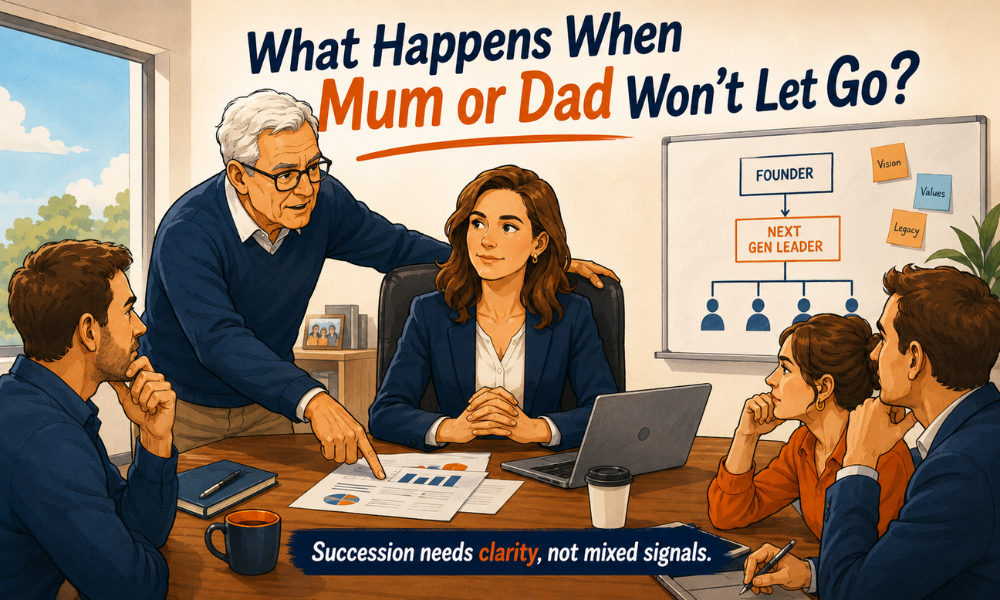
Succession in a family business sounds wonderfully straightforward when you put it into a plan. Mum or Dad builds the business, the next generation joins, learns the ropes & eventually takes over.
Lovely in theory.
In reality, family businesses do not generally behave like neat succession diagrams. I have seen founders talk about stepping back for years while still approving every major decision, speaking directly to employees, overriding the leadership team & quietly keeping one hand firmly attached to the steering wheel.
Technically, they have handed over. In practice, they have not really let go.
And that is where succession can get very messy.
“But I’ve Spent 30 Years Building This”
Before we start blaming Mum or Dad, it is worth looking at what we are actually asking them to do.
Imagine spending 20, 30 or 40 years building something. You may have sacrificed weekends, holidays, sleep & quite possibly a reasonable amount of your sanity along the way. The business is not simply where you work. It may be where much of your identity sits.
You are the person people come to for answers. Your name may be on the building. Customers know you. Suppliers call you. Employees who have been there for decades trust you.
Then one day everyone starts talking about “succession” as though you are supposed to hand over the keys, buy a set of golf clubs & disappear.
Of course that is difficult.
The problem is that understanding why a founder struggles to let go does not remove the consequences when they do not.
The Next Generation Cannot Lead From the Passenger Seat
This is where frustration usually starts building.
The next generation may have been told, “It’s your business now,” but every important decision still goes back to Mum or Dad.
They hire someone & Dad questions the decision. They change a process & Mum tells the team to keep doing it the old way. They set a direction & the founder has a quiet conversation with a long-standing employee that leaves everyone confused about who is actually in charge.
You cannot ask someone to lead while continually taking the steering wheel back from them.
Eventually, one of two things tends to happen. The next generation stops trying to lead, or they leave.
Neither is a particularly clever succession plan.
Succession Is Several Different Conversations
This is where the Harvard Three-Circle Model becomes incredibly useful because it helps separate what is often getting muddled together.
In a family business, three systems are operating at the same time: family, ownership & business. One person can sit in all three, which is why “stepping back” is not one simple decision.
Mum might step out of the CEO role but remain an owner. Dad might stop working five days a week but still be a director. A daughter might become Managing Director while also being a shareholder & daughter.
Those are completely different hats.
The trouble starts when nobody knows which hat they are wearing.
A founder may say, “As your father, I think…” and that is a family conversation. They may say, “As a shareholder, I’m concerned about…” and that is an ownership conversation.
But if they say, “I’ve decided the sales team should…” after operational leadership has already been handed to the next generation, that is where things can go badly wrong.
The issue is not that the founder still has a voice. It is that the boundaries between family, ownership & business authority are unclear.
Ownership Does Not Automatically Mean Operational Control
This distinction is one of the most important in family business succession.
You can own a business without running it. Thousands of businesses operate that way every day.
But in family businesses, ownership & management often become so intertwined that separating them can feel unnatural. A founder may genuinely think, “It’s still my business. Of course I should have a say.”
And they are right.
As an owner, they should have a say in the things owners should have a say in.
That does not necessarily mean deciding which CRM the sales team uses, approving annual leave or stepping into day-to-day staffing decisions.
Clear governance matters because it answers a very practical question: who gets to decide what?
Without that clarity, succession turns into an endless tug-of-war.
The Shadow Leader Problem
Another problem appears when founders step back formally but not behaviourally.
The business develops a shadow leadership structure.
The organisational chart says one thing, but everybody knows reality is different. Employees quickly work out where the real authority sits.
If they do not like the new leader’s answer, they go to Mum. If Dad has always solved their problems, they keep going to Dad. If the founder overturns even one or two decisions, the message spreads quickly.
“Don’t worry about what the new CEO says. Check with the founder.”
At that point, the next generation has not really been given leadership. They have been given the title.
That is a very different thing.
Structure Matters More During Succession
Succession usually needs more structure, not less.
The clearer the roles, responsibilities & decision rights are, the easier it becomes to separate family influence from business authority.
The family needs to understand where family matters are discussed. Owners need clarity on which decisions belong to them. The leadership team needs to know where operational authority sits. The next generation needs to understand where they genuinely have freedom to lead.
Without that structure, the business keeps relying on history, relationships & informal influence.
That may work while the founder is still clearly in charge. It becomes much more fragile once leadership is supposed to be transferring.
Letting Go Does Not Mean Disappearing
This is probably one of the biggest misconceptions about succession.
Nobody is saying the founder has to vanish.
Their experience can be enormously valuable. Their relationships matter. Their knowledge matters. Their history matters.
But their role needs to evolve.
Maybe they become Chair. Maybe they remain an active owner. Maybe they mentor the next generation. Maybe they focus on a small number of important relationships or projects where their experience creates genuine value.
There are plenty of options.
What does not work particularly well is pretending they have stepped back while they continue running the business from the sidelines.
The Next Generation Has Responsibilities Too
And let’s be fair.
Sometimes Mum or Dad will not let go because the next generation has not given them much reason to.
If you want authority, you also need to demonstrate accountability. You need to make decisions, own mistakes, deliver results, have difficult conversations, understand the numbers & earn the confidence of the team.
Succession is not simply the older generation learning to let go.
It is also the next generation learning to step up.
Both sides have work to do.
The Conversation Family Businesses Actually Need to Have
Instead of asking, “When is Mum retiring?”, family businesses need to ask much better questions.
What role does Mum actually want in three years? What does Dad want his life to look like outside the business? Who will own the business? Who will lead it? Which decisions belong to owners & which belong to the leadership team?
The family also needs to be clear about what the next generation must demonstrate before taking on greater responsibility.
And perhaps the most important question of all is this:
What does letting go actually mean in this family?
Because unless that is defined, everyone will have a different interpretation.
For one person, stepping back might mean working three days a week. For another, it means no longer being involved in operational decisions. For someone else, it might mean leaving management completely but staying active as an owner.
There is no single right answer.
There does need to be a shared one.
Five Frequently Asked Questions About Family Business Succession
Why do founders struggle to let go of family businesses?
Because the business often represents far more than employment. It can be tied to identity, purpose, relationships, financial security & decades of personal sacrifice. Stepping back can feel like losing relevance as much as changing roles.
Can a founder remain an owner after stepping down?
Absolutely. Ownership & operational leadership are different roles. A founder can remain a shareholder without continuing to run the day-to-day business.
What is the biggest mistake families make during succession?
Treating succession as one handover rather than separating the family, ownership & business conversations. Each requires different decisions, different responsibilities & often different people in the room.
How can better governance help succession?
Good governance creates clarity around decision-making, roles, authority & communication. It reduces the confusion that happens when family, ownership & business responsibilities become blurred.
What if the next generation is not ready?
Then do not pretend they are. Define what readiness looks like, identify the gaps & create a genuine development plan. A surname is not a leadership qualification.
Final Thought
Successful succession is not Mum or Dad disappearing, and it is not the next generation simply inheriting a title.
It is creating enough clarity that everyone understands where the founder fits, where the next generation fits & who has the authority to make which decisions.
Mum or Dad can still be incredibly important to the business without being involved in everything.
At some point, building the next generation of leaders has to become more important than proving you can still do the job yourself.
Sometimes the greatest act of leadership is not holding on. It is creating something strong enough that you can finally let go.
If succession is becoming the conversation everyone in your family business knows you need to have, but nobody quite knows how to start, let’s talk.
The family moments often cannot.
Because when the kitchen table is allowed to be a kitchen table again, everyone benefits.
Written by Debra Chantry-Taylor, FBA Accredited Family Business Advisor, Certified EOS Implementer & Founder of Business Action.
Business Action is focused on helping Entrepreneurs lead better lives, through creating a better business. We have a small team of accredited family business advisors, EOS Implementers & Leadership coaches, as well as access to a huge range of advisors through our Trusted Partners Network.