

Experience is one of the most valuable things you can bring to a business.
Over the years, you see downturns, difficult employees, demanding customers, failed ideas, unexpected wins & more than a few expensive mistakes. You learn to recognise patterns. You develop instincts. You can often spot trouble long before someone with less experience even realises there is a problem.
That knowledge matters.
But experience can also become dangerous when it starts convincing us that because we have seen something before, we already know the answer.
“I’ve seen this before.”
Can quietly become:
“So I already know what we should do.”
Or:
“We’ve been doing this for 20 years.”
Becomes the reason nobody is allowed to question whether you should still be doing it at all.
Experience should make us better at navigating change.
It should not become our excuse for avoiding it.
What Worked Before May Not Be What Works Next
When something has worked successfully for years, it is perfectly reasonable to trust it.
The problem is that the environment around the business keeps moving.
Customers change. Technology changes. Employees expect different things. Competitors appear. New ways of buying, communicating & working become normal remarkably quickly.
What made your business successful ten years ago may still be exactly the right thing today.
But it may not be.
The important question is whether you are continuing with an approach because it is genuinely still effective, or because it is familiar.
Those are not the same thing.
A process should earn its place because it works now, not because it worked brilliantly in 2015.
Experience Can Make Us Stop Asking Questions
One of the odd things about becoming experienced is that we get very good at recognising patterns.
Usually, that is enormously helpful.
You have seen this type of customer before. You remember what happened the last time you hired somebody like this. You know what happened when the business tried a similar idea five years ago.
Your brain starts filling in the blanks very quickly.
The danger is that you can jump from “This looks familiar” to “I already know how this ends” without stopping to look at what might be different this time.
A younger employee suggests a new approach & you immediately see the problems.
Someone proposes new technology & you remember the last disastrous implementation.
A long-standing process gets challenged & you can immediately explain all the reasons it exists.
You may be right.
But if every new idea gets greeted with a history lesson about why it will not work, people eventually stop bringing ideas.
That is when experience stops protecting the business & starts limiting it.
“We Tried That Before” Is Not the End of the Conversation
Few phrases shut down a conversation faster than:
“We tried that before.”
Fair enough.
But when?
Who was involved?
Why did it fail?
What did customers want at the time?
What technology was available?
What has changed since then?
Sometimes there is an excellent reason not to try something again.
But the fact that an idea failed once does not automatically make it a bad idea forever.
Failure gives you information.
It should make the next decision better.
It should not necessarily become a permanent veto.
The more useful question is:
What would be different this time?
If the answer is “nothing”, perhaps leave it alone.
But if the conditions have changed significantly, it may deserve another look.
Family Businesses Feel This Tension Very Clearly
This tension becomes particularly visible in family businesses.
A founder may have 30 or 40 years of experience, deep customer relationships & an extraordinary understanding of how the business really works.
That knowledge deserves respect.
Then the next generation arrives with different experiences, skills & expectations.
They may want to introduce new technology, change how people are managed, reconsider an old product line or question how decisions get made.
Sometimes the response is:
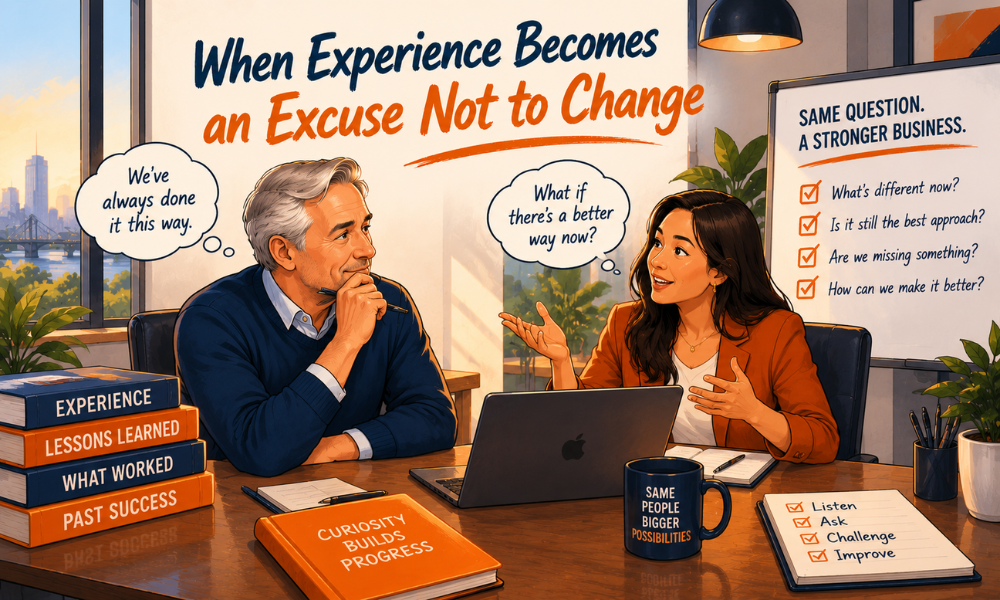
“You don’t understand. We’ve always done it this way.”
Perhaps the next generation does not understand all the history.
That is worth explaining.
But history should provide context, not automatically close the conversation.
Equally, being younger or enthusiastic about change does not automatically make the next generation right either.
The real opportunity is to combine the two.
Founder experience can explain why things evolved the way they did.
The next generation can ask whether those reasons are still relevant.
That is far more useful than turning the conversation into old versus new.
Past Success Can Be One of the Hardest Things to Challenge
Successful businesses can be particularly vulnerable to this because success creates evidence.
“But this is what got us here.”
Absolutely.
Respect it. Celebrate it. Learn from it.
But do not automatically assume it will get you where you want to go next.
The leadership structure that worked beautifully with 15 employees may struggle with 80.
The sales approach that built the first $5 million may not be capable of producing the next $20 million.
The founder personally approving every important decision might once have helped the business move quickly & protect quality.
At a certain size, exactly the same behaviour can slow everything down.
Growth changes what the business needs.
Sometimes reaching the next stage is less about learning something completely new & more about recognising that something which used to work brilliantly has reached the end of its useful life.
That can be surprisingly difficult to admit.
Good Leaders Stay Curious
I think curiosity becomes more important, not less, as leaders gain experience.
It is easy to challenge something when you know very little.
It takes considerably more discipline to challenge something you are convinced you already understand.
Instead of saying:
“That won’t work.”
Try:
“What would need to be true for that to work?”
Instead of:
“We tried that.”
Ask:
“What is different now?”
Instead of:
“That’s not how we do things.”
Ask:
“Why do we do it this way?”
You may still reach exactly the same conclusion.
That is fine.
The difference is that you tested the assumption rather than automatically defending it.
That is where experience becomes genuinely valuable.
Not because it gives you every answer, but because it gives you better context for asking the right questions.
Keep the Lessons, but Question the Rules
Every established business develops its own collection of unwritten rules.
“We don’t work with those types of customers.”
“We always promote internally.”
“Our customers won’t pay more than that.”
“That role has to be based in the office.”
“We tried outsourcing. It doesn’t work.”
“We don’t need that technology.”
Some of those rules may be based on hard-earned lessons & still be completely valid.
Others may be assumptions that have survived long after the conditions that created them disappeared.
Every now & then, it is worth asking:
- Who decided this?
- When was it decided?
- What was true at the time?
- Is it still true now?
You do not need to throw out everything old simply because something newer exists.
That would be just as foolish as refusing to change anything because it is familiar.
The challenge is knowing the difference between a principle worth protecting & a habit that has simply survived for a long time.
Experience Should Make Change Better, Not Impossible
There is enormous value in having people around the table who have been through difficult situations before.
They can see consequences others may miss. They know where things have gone wrong historically. They bring context that cannot be downloaded from a textbook or picked up in a weekend course.
But the best experienced leaders do not use that knowledge to dominate every conversation.
They use it to improve the quality of the decision.
They can say:
“Here’s what happened last time, here’s what I think we learned from it & here’s what I’d want us to consider before we try this.”
That is very different from:
“No. We tried it once.”
One shares wisdom.
The other shuts the door.
Final Thought
Experience should give you wisdom.
It should not give you certainty that you are always right.
Some of the lessons you have learned over 20 or 30 years in business will remain valuable for the rest of your career.
Others belonged to a different business, a different market & a different time.
The challenge is knowing which is which.
So when someone challenges the way you have always done something, resist the instinct to immediately explain why they are wrong.
Get curious first.
Ask what has changed, what you might not be seeing & whether the old rule still deserves to be a rule.
You may decide not to change a thing.
But at least you will be making that decision based on where the business is going, rather than simply where it has been.
Written by Debra Chantry-Taylor, FBA Accredited Family Business Advisor, Certified EOS Implementer & Founder of Business Action.
Business Action is focused on helping Entrepreneurs lead better lives, through creating a better business. We have a small team of accredited family business advisors, EOS Implementers & Leadership coaches, as well as access to a huge range of advisors through our Trusted Partners Network.