
There are few sentences that make a business owner’s stomach drop faster than:
“I’ve decided to resign.”
Especially when it comes from one of your best people.
You know the person. They have been with you for years. They know the important clients, understand the strange little quirks in your systems, remember why decisions were made five years ago & somehow always seem to know what to do when something goes wrong.
So when they tell you they are leaving, your first thought is probably:
“We’re screwed.”
I understand why.
But after more than 20 years of building, running & coaching businesses, I have learned something that can initially sound a little brutal.
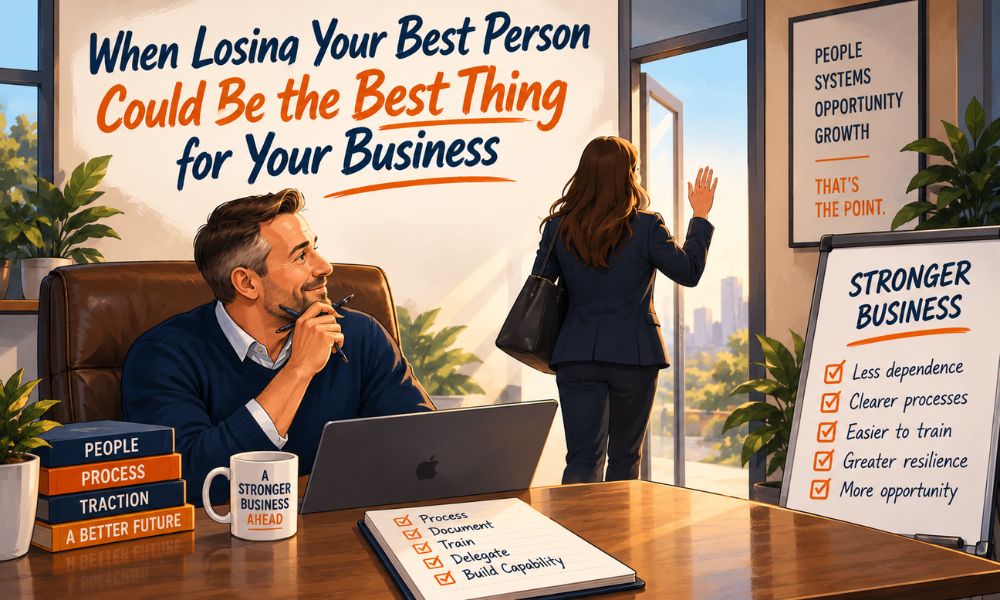
Sometimes losing the person you thought was irreplaceable is one of the best things that can happen to your business.
Not because losing good people is desirable. It is not.
But because their departure can expose a weakness you should probably have dealt with years ago.
You may not have had an irreplaceable employee.
You may have had an irreplaceable amount of business knowledge sitting inside one person’s head.
And those are two very different things.
The Myth of the Hero Employee
Almost every established business has at least one hero.
They are the person everybody calls when something goes wrong.
A customer has an unusual problem? Ask Sarah.
Nobody knows how the old system works? Ask James.
A complicated order comes through? Give it to Bob. He will know what to do.
People like this become incredibly valuable.
But slowly, often without anybody noticing, the organisation can start building itself around them.
Processes do not get documented because Sarah already knows them. Training stays informal because James can show the new person. Decisions are never properly delegated because Bob has always handled them.
The hero becomes the workaround for weaknesses in the business.
And because they are so capable, the weakness remains hidden.
Until they leave.
“These People Are the Business”
I once came across a manufacturing business turning over around $2 million that experienced exactly this.
Within eight weeks, it lost three people the owner considered absolutely critical.
The sales director held most of the important customer relationships in his head. The operations manager was effectively a walking encyclopaedia of how the business worked. The quality control lead could look at something & instinctively know whether it was right.
Three departures in eight weeks.
The owner was convinced the business was finished.
“We’re dead. These people are the business.”
Except they were not.
They had become the business’s operating system because there was not enough of an operating system underneath them.
Once the leadership team started looking properly under the hood, the problem became obvious.
There were almost no documented processes. Training was inconsistent. Critical knowledge lived inside individual people. Important decisions depended on experience rather than clear standards.
If somebody did not know what to do, they simply found the person who did.
That worked.
Until suddenly it did not.
Do Not Just Replace the Person. Fix the Dependency.
When somebody critical resigns, the instinctive response is usually:
“We need to find another one immediately.”
Sometimes you do.
But before rushing to replace the person, there is a much more valuable question to ask:
Why did losing one person create this much risk?
That question changes everything.
Instead of recreating the same dependency with somebody new, you can start fixing the dependency itself.
That is what this manufacturing business did.
Rather than desperately trying to find three new heroes, they started building the capability into the organisation.
They documented how the work was actually done. They created clearer training. They defined how important decisions were made. They captured knowledge that had previously existed only through experience. They made quality more teachable rather than relying entirely on instinct.
Six months later, their core processes were documented & much easier to teach. New employees became productive in weeks rather than months. Quality became more consistent & the business was far less dependent on individual personalities.
Eighteen months later, revenue had more than doubled.
Losing those three people felt catastrophic at the time.
In reality, it forced the company to build the business it should have built years earlier.
Great People & Great Processes Are Not Opposites
When an important employee leaves & everything falls apart, we often call it a people problem.
Sometimes it is.
But just as often, it is also a process problem.
You absolutely need capable people who fit the culture, take ownership & can excel in their roles.
But great people need strong systems around them.
Your core processes should be clear enough that important work does not depend entirely on one person’s memory, experience or instinct. People need to understand how work is done, what good looks like & where responsibility sits.
Great people & great processes are not alternatives.
You need both.
Because when great people operate inside weak systems for long enough, they eventually become the system themselves.
That is where the risk begins.
Knowledge Should Belong to the Business
Think about your own company for a moment.
What happens if your best salesperson leaves tomorrow? Do the customer relationships leave too?
What happens if your operations leader is away for three months? Does anybody else know how the key decisions are made?
What happens when a long-serving employee retires? Does 20 years of organisational knowledge walk out of the building with them?
Those questions can be uncomfortable.
They should be.
Key-person dependency is easy to ignore because nothing appears to be wrong while the key person is still there.
But the risk already exists.
You simply have not experienced the consequence yet.
Strong businesses deliberately transfer important knowledge out of individual heads & into the organisation.
That does not mean documenting every conversation or creating an enormous instruction manual.
It means making sure the business knows what it needs to know even when a particular person is unavailable.
Process Does Not Mean a 200-Page Manual
This is where businesses sometimes go too far in the other direction.
I say, “Document your processes,” & somebody immediately imagines a giant operations manual gathering dust on a shelf.
That is not particularly useful either.
The objective is not to document every mouse click, conversation & possible exception.
It is to identify the core processes that make the business work & capture the major steps that consistently produce the right result.
Enough that people understand how things are supposed to work.
Enough that you can train somebody properly.
Enough that quality does not rely entirely on tribal knowledge.
Enough that the business can keep moving when somebody is away.
Simple, practical & used.
A beautifully documented process nobody follows is no better than one sitting inside somebody’s head.
Great People Should Multiply Capability
There is another distinction I think leaders need to understand.
Valuable is not the same as indispensable.
You absolutely want exceptional people. People who know their craft, take ownership & make the business better.
But the very best people do not hoard capability.
They multiply it.
They teach other people. They improve processes. They document what they learn. They build stronger people around them & create ways of working that continue even when they are not there.
That does not make them less valuable.
It makes them more valuable.
If somebody’s importance depends on nobody else knowing how to do their job, you have a vulnerability.
If their value comes from making the whole organisation more capable, you have an asset.
That distinction matters enormously as businesses grow.
Hero Culture Eventually Creates Bottlenecks
Hero employees usually emerge for perfectly understandable reasons.
The business grows quickly. Processes lag behind. Somebody competent steps in & solves the problem.
Everyone is relieved.
The next time the problem appears, everybody goes back to that person.
Soon, dozens of decisions flow through them.
They become indispensable.
But eventually the business hits a ceiling.
People wait for their answer. Junior employees stop developing judgement because it is easier to ask the expert. The hero becomes overloaded & the owner becomes terrified of losing them.
The business can only move as fast as that one person can.
That is not scalability.
It is a bottleneck disguised as high performance.
Ask What the Departure Exposed
None of this means you should celebrate when a brilliant employee resigns.
Losing good people hurts.
You may feel disappointed, worried, angry or simply exhausted by the thought of rebuilding. In founder-led & family businesses, long-serving employees can become so closely connected to the business that their departure feels deeply personal.
Those feelings are real.
But once the initial emotion settles, there is an opportunity.
Instead of only asking:
“How do we replace them?”
Ask:
“What did this departure expose?”
What knowledge was never documented?
Which relationships were concentrated in one person?
Which decisions did not have clear ownership?
Where was training too dependent on informal handover?
Which processes existed only through habit?
Those answers tell you where the business needs strengthening.
The Same Rule Applies to the Founder
And now for the uncomfortable bit.
Sometimes the biggest hero employee in the business is the founder.
Every major decision comes through you. You own the important customer relationships. You approve spending. You solve the difficult problems. You know how everything works.
Everybody says:
“Ask Debra.”
Or Mark.
Or Sarah.
Or whoever built the company.
That might feel reassuring.
It may even feel important.
But if the business cannot function properly without you, you have created exactly the same dependency you worry about with your best employee.
Building a stronger business means gradually reducing those dependencies.
Not removing great people.
Removing the need for heroics.
What Strong Businesses Do Differently
Strong businesses still have exceptional people.
The difference is that those people sit inside a stronger organisation.
Roles are clear. Accountability is clear. Core processes are documented. Knowledge is shared. Training is repeatable. Important numbers are visible.
People can take holidays without everything falling apart.
New hires can become productive without spending six months learning through osmosis.
And when somebody leaves, it may hurt, but the business does not stop.
That is when growth becomes far more scalable.
Capability belongs to the organisation rather than a handful of individuals.
Losing Someone Can Reveal Your Next Stage of Growth
Sometimes disruption is what finally forces change.
Nobody enjoys it.
Nobody would deliberately choose it.
But it can expose weaknesses that success allowed you to ignore.
The manufacturing business I mentioned earlier thought losing three key employees was going to destroy it.
Instead, the disruption forced the leadership team to create better processes, capture knowledge & build capability across the team.
The business became stronger, more scalable & less fragile.
The people leaving did not create that growth.
The leadership team’s response did.
That distinction matters.
Final Thought
You should absolutely fight to retain great people.
Create a workplace they want to be part of. Develop them. Reward them. Give them meaningful responsibility.
But do not build a business that cannot survive without them.
Great people should strengthen your organisation.
They should not become your organisation.
If losing one employee tomorrow would cause genuine chaos, do not wait for the resignation letter to discover how vulnerable you are.
Look at the dependency now.
Ask what knowledge needs to be captured, where processes need strengthening, who else needs developing & where capability still sits too heavily with one person.
The goal is not to create a company full of interchangeable people.
It is to create a company where great people can do exceptional work without the entire business depending on any one of them.
That is how you build something stronger than a collection of jobs.
You build a business that can genuinely scale.
Written by Debra Chantry-Taylor, FBA Accredited Family Business Advisor, Certified EOS Implementer & Founder of Business Action.
Business Action is focused on helping Entrepreneurs lead better lives, through creating a better business. We have a small team of accredited family business advisors, EOS Implementers & Leadership coaches, as well as access to a huge range of advisors through our Trusted Partners Network.