One of the things I admire most about family businesses is the passion they bring.
The business is rarely just a job. It often represents years, sometimes generations, of hard work, sacrifice, identity & shared purpose.
That passion creates enormous commitment.
But it can also make it very difficult to switch off.
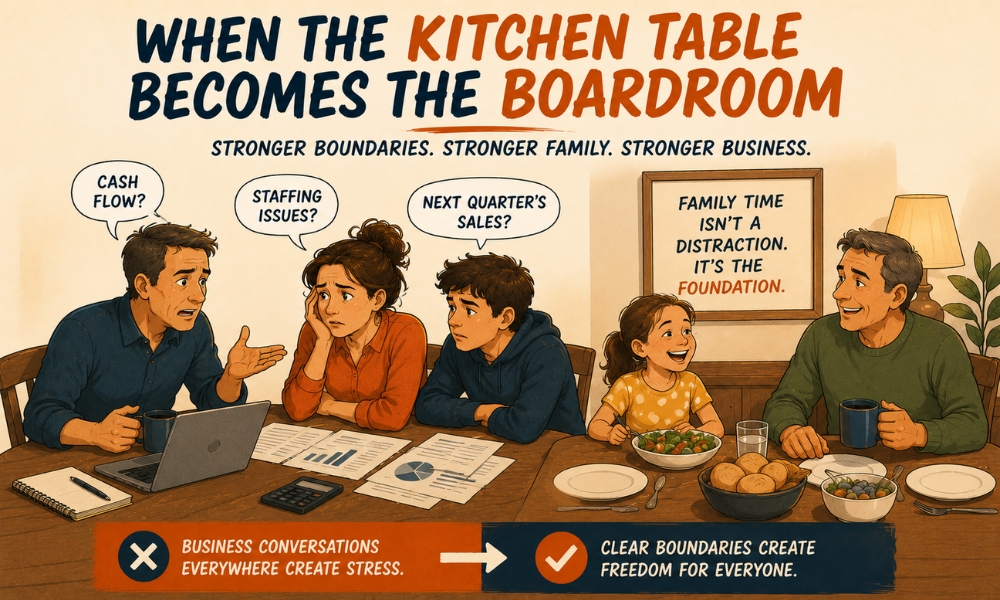
I have worked with plenty of family businesses where a casual dinner turns into a conversation about cash flow. A birthday celebration drifts into staffing problems. A Sunday barbecue somehow becomes a discussion about next quarter’s priorities.
At first, it feels normal.
After all, the business is part of the family.
But over time, something subtle can happen.
The kitchen table becomes the boardroom.
And when that happens often enough, both the family & the business can start paying the price.
The Problem Is Not Talking About the Business
Family business conversations are inevitable.
In fact, they can be one of the strengths of a family enterprise.
Ideas come up naturally. People care deeply. Someone may spot an opportunity over dinner or raise a concern that genuinely matters.
The problem is not that business gets discussed.
The problem is when business gets discussed everywhere.
When every family gathering becomes an opportunity to raise an issue, revisit a decision or debate something operational, there is no longer a clear boundary between family time & business time.
Eventually, people stop knowing which hat they are wearing.
- Are we siblings having dinner?
- Are we shareholders discussing ownership?
- Are we directors considering a strategic decision?
- Are we managers solving an operational problem?
Those are very different conversations.
Treating them as though they are all the same is where trouble starts.
The Three Circles Matter
One of the most useful ways to understand family business is through the three overlapping circles of family, ownership & business.
The same person may sit in more than one circle.
You might be a sister, shareholder & CEO.
Your brother might be a director, employee & family member.
Your parents may no longer work in the business but still own shares & have a strong emotional connection to what happens next.
The challenge is that each circle has different needs.
- The family circle cares about relationships, fairness, legacy & connection.
- The ownership circle cares about stewardship, value, dividends, risk & the future of the asset.
- The business circle needs performance, accountability, clear roles & good decision-making.
Confusion begins when a conversation belonging in one circle gets dragged into another.
An operational issue gets debated at Christmas lunch.
A family concern starts influencing a management decision.
A shareholder question gets raised with employees who have no responsibility for ownership matters.
That is why boundaries are not just about protecting family time.
They are about putting the right conversation in the right room.
When Business Starts Crowding Out the Family
The effect of constant business talk can be easy to miss because nobody intends to create a problem.
Partners who are not involved in the business can begin to feel excluded.
Children may hear tension or financial conversations they do not fully understand.
Family members who work in the business may feel as though they are never really off duty.
Someone may stop raising a personal issue because they know dinner will inevitably turn into another business discussion.
Slowly, family connection starts getting replaced by work.
That matters.
A family business is supposed to benefit from strong family relationships, not consume them.
If every gathering becomes another meeting, it becomes much harder to preserve the relationships that made the business possible in the first place.
Healthy Boundaries Help the Business Too
Some families worry that putting boundaries around business discussions will make things too formal.
I usually see the opposite.
Structure improves the quality of the conversation.
When a leadership issue is handled in a leadership meeting, the right people are there. They have the information they need. They can prepare properly. Decisions can be documented & followed through.
When an ownership issue is discussed in an appropriate ownership or governance forum, it can be handled with the seriousness it deserves.
And when dinner is simply dinner, people get to reconnect as family.
Good boundaries do not reduce commitment.
They reduce confusion.
Why Governance Matters
Governance can sound far more complicated than it needs to be.
At its simplest, good governance answers questions such as:
- Who gets to make which decisions?
- Where should different types of conversations happen?
- Who needs to be involved?
- How are decisions recorded?
- How do family members raise concerns appropriately?
- How do owners receive information without stepping into day-to-day management?
Without those answers, important conversations tend to happen wherever somebody happens to have access to the right person.
That is how a comment over dinner becomes an instruction to the business.
Or a family disagreement starts influencing operational decisions.
Clear forums make a huge difference.
That might include leadership meetings, board meetings, owner meetings or family council conversations, depending on the size & complexity of the business.
The names matter less than the clarity.
Family Members Still Need Permission to Switch Off
One of the biggest challenges in a family business is the feeling that talking about work is somehow proof that you care.
So family members keep going.
One more question.
One more update.
One more quick decision.
But constantly being available to the business is not necessarily healthy commitment.
Sometimes it is simply poor boundaries dressed up as dedication.
Family members need permission to switch off.
That might mean agreeing that certain occasions are business-free.
It might mean keeping operational discussions out of family group chats.
It might mean writing an issue down rather than solving it immediately.
It might mean saying:
“That matters, but this is not the right place for the conversation. Let’s put it on the agenda for Monday.”
That sentence can protect a surprising amount of family peace.
Not Every Family Member Needs to Be in Every Conversation
This becomes especially important as the family grows.
Partners join the family.
Children become adults.
Some members work in the business.
Others do not.
Some are shareholders.
Others may become owners later.
If every business discussion happens informally in family settings, people can easily become involved in conversations they do not have the context, authority or responsibility to participate in.
That is unfair on everyone.
The people running the business need room to lead.
Owners need appropriate visibility.
Family members need a voice on matters that genuinely affect the family.
But that does not mean everybody belongs in every conversation.
Clarity around roles protects relationships.
Stronger Families Build Stronger Businesses
One of the greatest strengths of a family business is trust.
Protecting family relationships is not separate from building a successful business.
It is part of it.
The quality of the family relationship influences how well people communicate, how safely they disagree & how effectively they make decisions together.
That does not mean every disagreement disappears.
It means the family has a stronger foundation for handling the difficult conversations when they come.
Sometimes the best thing you can do for the business is to leave it alone for the evening.
The emails can wait.
The staffing issue can wait.
The numbers can wait.
The family moments often cannot.
Five Frequently Asked Questions
1. Is it normal for family businesses to talk about work at family gatherings?
Absolutely. The business is often a major part of family life. The problem arises when business discussions dominate family occasions or important decisions are regularly made in informal settings.
2. Why are boundaries so important in a family business?
They help separate the needs of the family, the owners & the operating business. This reduces confusion, protects relationships & helps decisions happen in the right environment.
3. What role does governance play?
Good governance creates clear forums for different types of decisions. It helps families distinguish between operational, ownership & family matters rather than blending all three together.
4. How can family businesses stop every gathering becoming a business meeting?
Agree some simple boundaries. Keep operational discussions for scheduled meetings, avoid resolving major issues at family occasions & make it clear where different types of conversations belong.
5. What is one simple change a family business can make?
Agree that important business issues do not get solved casually at family occasions. Write them down, decide which forum they belong in & discuss them there.
Final Thought
The strongest family businesses do not just protect the business.
They protect the family relationships around it too.
That means recognising that not every issue needs to be solved immediately, not every family gathering needs to become a meeting & not every family member needs to be involved in every business decision.
Sometimes the best thing you can do for the business is leave it alone for the evening.
The emails can wait.
The staffing issue can wait.
The numbers can wait.
The family moments often cannot.
Because when the kitchen table is allowed to be a kitchen table again, everyone benefits.
Written by Debra Chantry-Taylor, FBA Accredited Family Business Advisor, Certified EOS Implementer & Founder of Business Action.
Business Action is focused on helping Entrepreneurs lead better lives, through creating a better business. We have a small team of accredited family business advisors, EOS Implementers & Leadership coaches, as well as access to a huge range of advisors through our Trusted Partners Network.