

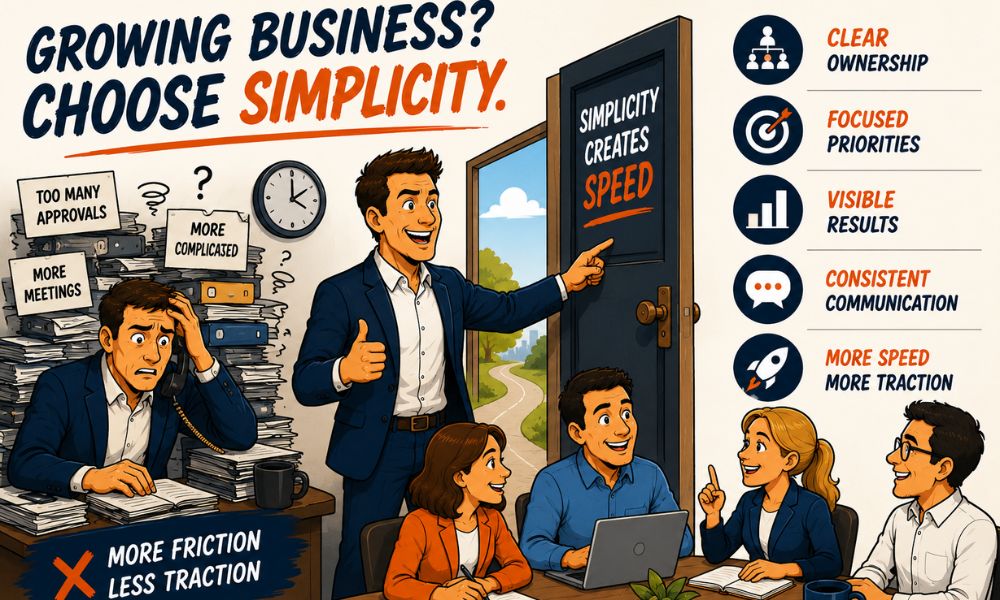
When businesses grow, many leaders assume they need more complexity.
More layers.
More approvals.
More reports.
More meetings.
More process.
It sounds logical.
But in reality, complexity is often the very thing slowing the business down.
The bigger a business becomes, the more important simplicity becomes.
Not simplistic thinking.
Clear thinking.
Because growth naturally creates enough complexity on its own.
Why Complexity Creeps In
Most businesses don’t intentionally become complicated.
It happens gradually.
A new process gets added to solve a problem. Another approval layer gets introduced to reduce risk. More meetings appear to improve communication.
Over time, the business becomes heavier.
People stop knowing:
- Who owns what
- Who decides what
- Which priorities matter most
Decision-making slows. Communication becomes noisy. Execution loses momentum.
And leaders often respond by adding even more structure.
That usually makes it worse.
Bigger Businesses Create More Noise
At 10 people, communication is easy.
At 50, complexity starts appearing.
At 100, communication pathways multiply dramatically.
Without simplicity, leaders become buried in:
- Updates
- Approvals
- Unnecessary meetings
- Duplicated conversations
The business spends more time coordinating than executing.
This is often the stage where leaders start saying:
“Everything feels harder than it should.”
They’re usually right.
Why Simplicity Creates Speed
Simple systems create clarity.
Clarity speeds up decisions.
When people know:
- Who owns the outcome
- What matters most
- Where issues should be solved
They move faster.
The business becomes more decisive because people spend less time navigating confusion.
Simplicity removes friction.
And friction is what quietly slows growing businesses down.
Where EOS® Supports Simplicity
One of the reasons the Entrepreneurial Operating System® / EOS® is effective for many leadership teams is that it helps simplify how the business runs.
Not through oversimplification, but through clarity.
The Accountability Chart™ reduces confusion around ownership.
Rocks help reduce competing priorities down to the few that truly matter.
The Scorecard focuses attention on a small number of meaningful measurables instead of overwhelming dashboards.
The Level 10 Meeting™ creates one consistent place for communication & issue-solving.
Simple systems are easier to follow consistently.
And consistency is what helps create traction.
The Mistake Growing Businesses Make
Many growing businesses think maturity means more complexity.
So they:
- Add layers
- Create more reporting
- Hold more meetings
- Introduce complicated workflows
But complexity often hides problems instead of solving them.
When systems become too complicated:
- Accountability weakens
- Decisions slow down
- Leaders step back into the weeds
- Teams become dependent on approval
The business feels heavier every year.
Family Businesses Feel This Differently
In family businesses, simplicity often disappears because informal systems build up over time.
History influences decisions. Relationships shape communication. Processes evolve unevenly.
Instead of clear structure, businesses often rely on:
- Tribal knowledge
- Verbal agreements
- Long-standing habits
As the business grows, this becomes difficult to scale.
Simple, visible systems create stability without removing the human side of the business.
They help the family, owners & leadership team separate what belongs where.
Family matters can be handled with care.
Ownership decisions can be made with discipline.
Business priorities can be managed with clarity.
That distinction matters.
Without it, everything gets tangled together, & the business becomes harder to lead.
Simplicity Is Not About Doing Less
This is where leaders sometimes misunderstand simplicity.
Simple systems are not weak systems.
They are disciplined systems.
Simplicity requires:
- Clarity
- Consistency
- Accountability
The goal is not less leadership.
The goal is less unnecessary complexity.
What Leaders Often Get Wrong
Leaders often think the solution to growth problems is adding more.
More process. More oversight. More meetings.
But often the real solution is removing what no longer serves the business.
Because when systems become clearer, businesses become lighter.
And lighter businesses move faster.
5 Frequently Asked Questions
1. Why do businesses become more complicated as they grow?
Because more people, decisions & communication lines naturally increase complexity over time.
2. Does simplicity mean fewer systems?
Not necessarily. It means clearer, easier-to-follow systems that reduce confusion.
3. How does EOS® simplify growing businesses?
EOS® helps create clarity around accountability, priorities, measurables & issue-solving.
4. Why do complex systems slow businesses down?
Because they create confusion, increase approvals & weaken decision-making speed.
5. Can simple systems still support large businesses?
Absolutely. In fact, simplicity becomes more important as businesses scale.
Final Thought
Growing businesses don’t usually fail because they lack effort.
They slow down because complexity quietly creates friction everywhere.
Simple systems create clarity.
Clarity creates speed.
And speed helps create traction.
Written by Debra Chantry-Taylor, FBA Accredited Family Business Advisor, Certified EOS Implementer & Founder of Business Action.
Business Action is focused on helping Entrepreneurs lead better lives, through creating a better business. We have a small team of accredited family business advisors, EOS Implementers & Leadership coaches, as well as access to a huge range of advisors through our Trusted Partners Network.