
One of the biggest misconceptions about family businesses is that their greatest challenges come from outside the business.
The economy, competition, rising costs & changing markets certainly create pressure. However, after working with family businesses across Australia & New Zealand for many years, I have found that the issues causing the most damage are often happening inside the business.
It is not usually because family members do not care. In fact, the opposite is often true. They care deeply about the business, the family, the people who work for them & the legacy they are building.
That level of care is one of the great strengths of a family business, but it can also make decisions more complicated.
A Family Business Story I See Often
I recently worked with a successful second-generation manufacturing business.
Dad was still involved, two siblings were part of the leadership team & a cousin had been “helping out” for years. The problem was that nobody was entirely sure what the cousin was responsible for, where Dad’s authority started & stopped, or which sibling owned particular areas of the business.
The company itself was performing well. Revenue was healthy, customers were happy & the wider team was capable.
Yet leadership meetings regularly ended in frustration. Conversations became personal, responsibilities overlapped & decisions were often shaped by assumptions rather than clear agreements.
They did not need another strategic plan.
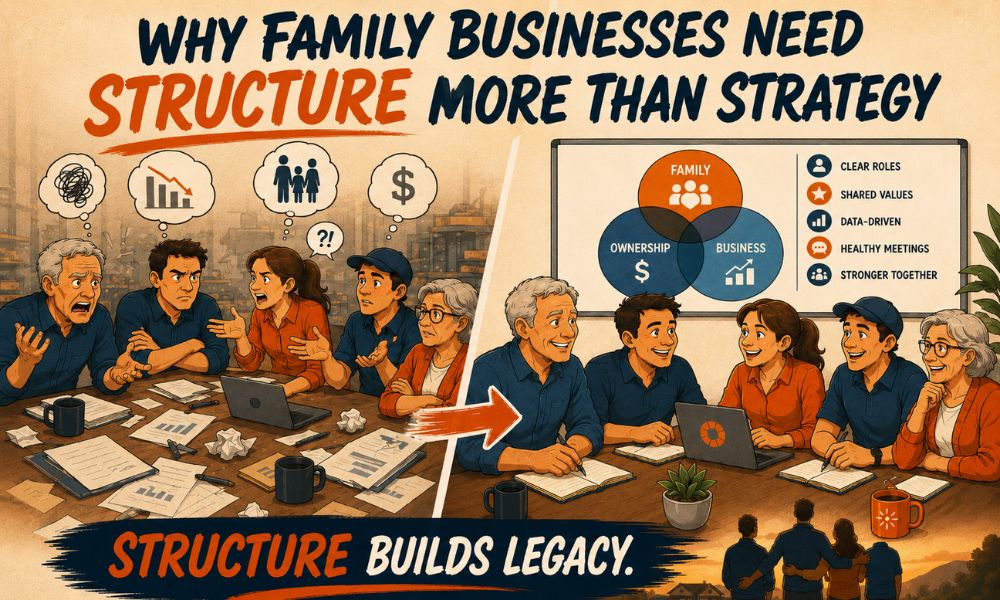
They needed structure.
The Hidden Cost of Assumptions
Family businesses often operate on assumptions because many important conversations feel unnecessary, awkward or too difficult.
People assume everyone knows what is expected. They assume succession will work itself out when the time comes. They assume family relationships will be strong enough to carry them through business disagreements.
Unfortunately, assumptions are among the most expensive things in any business, particularly when family relationships are involved.
I regularly hear statements such as:
“Everyone knows I’m taking over.”
“My sister isn’t interested in leadership.”
“Dad trusts us to make the decisions now.”
“Mum has retired.”
“We’ll work it out when the time comes.”
The problem is that these assumptions are rarely tested, & they are often understood very differently by each person involved.
What one person sees as a settled agreement, another may see as a possibility that has never been properly discussed.
Why Family Businesses Are Different
Every business has to manage people & commercial performance. A family business has an additional layer.
This is why the Harvard 3-Circle Family Business Model is so useful. It recognises that every family business operates across three overlapping systems:
- Family: relationships, emotions, fairness, identity & legacy.
- Ownership: risk, investment, returns, control & wealth creation.
- Business: performance, accountability, capability & results.
Each circle has different priorities, different responsibilities & different conversations that need to happen.
Problems arise when those circles become blurred.
A decision that feels fair from a family perspective may not make sense commercially. A sound business decision may create tension within the family. An ownership decision may affect both the family’s wealth & the company’s future direction.
None of those perspectives is automatically wrong. The challenge is knowing which circle you are speaking from & which responsibilities belong in that conversation.
Without that clarity, disagreements become personal very quickly.
Why EOS® Works Well in Family Businesses
One of the reasons I enjoy working with family businesses is that EOS® provides structure without stripping away the humanity that makes these businesses special.
It does not try to eliminate family dynamics. It gives the leadership team a clearer way to work with them.
The framework helps separate roles from relationships, performance from personality & business decisions from family expectations.
That structure protects both the business & the family.
The Accountability Chart® Creates Clarity
One of the first breakthroughs often comes through the Accountability Chart®.
It is not complicated, but it does require honesty.
Every person has a clearly defined seat with specific accountabilities, regardless of their surname or family status. Family membership does not automatically guarantee a leadership position, & being involved for a long time does not necessarily mean someone is in the right role.
A surname is not a job description.
The Accountability Chart® helps the leadership team answer practical questions:
- Who owns each major function?
- Who has the authority to make decisions?
- Who is accountable for the result?
- Where are responsibilities overlapping?
- Where are there gaps?
For the manufacturing business, seeing the structure clearly on one page was transformative. For the first time, everyone could see where they fitted, what they owned & where they had been stepping into someone else’s responsibilities.
Core Values Reduce Guesswork
Many family businesses assume that family members naturally share the same values.
They may share similar beliefs, but that does not mean everyone behaves in the same way or has the same expectations about how the business should operate.
Clearly defined Core Values help turn vague expectations into observable behaviour. They create a shared standard for hiring, recognition, accountability & decision-making.
Instead of saying, “You are not acting like part of the family,” the conversation can become, “That behaviour is not aligned with the values we agreed to uphold.”
That is a far clearer & healthier discussion.
It shifts the conversation away from family loyalty & towards the standards expected of everyone in the business.
The Scorecard® Reduces Emotion
Performance conversations can be particularly difficult in a family business because feedback may feel personal.
A conversation about missed targets can quickly become tangled with childhood roles, old disagreements or concerns about fairness.
The Scorecard® helps introduce more objectivity.
Instead of relying on opinion, personality or who speaks most confidently, the team can look at a small number of measurable results each week.
The numbers become the starting point for the conversation.
They do not tell the entire story, but they make it easier to identify where something is off track before frustration builds. They also ensure that family members & non-family employees are held to the same clearly understood expectations.
Level 10 Meetings® Create Healthier Conversations
Many families avoid difficult conversations because they do not want conflict.
Unfortunately, avoiding conflict rarely removes it. It usually allows resentment, confusion & frustration to grow quietly in the background.
Level 10 Meetings® give leadership teams a consistent structure for raising issues, discussing them openly & deciding what needs to happen next.
Problems can be addressed while they are still manageable. Concerns are less likely to be saved up for family gatherings, raised indirectly through another relative or allowed to become personal.
Because the discussion follows an agreed process, it becomes easier to focus on the issue rather than the individual.
What Happened Next?
Within 90 days, the manufacturing business had made two important changes.
The cousin transitioned into a role outside the business that was a much better fit. The change was handled respectfully & without the drama everyone had feared.
The two siblings also stopped competing for the same areas of responsibility because their roles, decision-making authority & expectations were finally clear.
The tension did not disappear overnight. Family businesses are not machines, & people do not instantly forget years of frustration.
However, clarity began to replace confusion.
That changed the quality of their meetings, their decisions & their relationships.
The Real Challenge Is Not Succession
Succession is often described as the greatest challenge facing family businesses.
I see it differently.
Succession is usually the event people notice. The real difficulty is everything that has been left unresolved before that event arrives.
Unspoken expectations, unclear roles, competing ideas about fairness, uncertainty around ownership & assumptions nobody wants to test are what make succession difficult.
A succession plan cannot solve years of avoided conversations on its own.
The strongest family businesses begin creating clarity long before anyone is ready to step away.
Does Structure Damage the Family Culture?
A concern I sometimes hear is that family businesses are built on trust, so introducing formal systems might damage the culture.
In practice, the opposite is usually true.
The right structure protects trust because it reduces the number of things people are expected to guess.
It creates guardrails around roles, decisions, accountability & communication. It makes expectations visible & helps prevent misunderstandings from becoming personal conflicts.
Most importantly, it allows family members to spend less time arguing about the business & more time enjoying being a family.
Final Thought
EOS® does not fix families.
Families are wonderfully complex, & no business framework can remove the emotion, history or relationships that come with them.
What EOS® can do is give a family business the clarity, structure, accountability & consistency it needs to handle those complexities more effectively.
The goal is not simply to build a commercially successful business.
It is to build a business that performs well without damaging the relationships that made it worth building in the first place.
If your family business is navigating succession, unclear roles, leadership tension or difficult conversations, let’s talk.
Written by Debra Chantry-Taylor, FBA Accredited Family Business Advisor, Certified EOS Implementer & Founder of Business Action.
Business Action is focused on helping Entrepreneurs lead better lives, through creating a better business. We have a small team of accredited family business advisors, EOS Implementers & Leadership coaches, as well as access to a huge range of advisors through our Trusted Partners Network.