One of the most frustrating things that happens in a growing business is that everything starts taking longer.
Not because people have suddenly become less capable.
Not because the market has changed overnight.
Not because the leadership team has forgotten how to run the business.
Things just start to feel heavier.
Decisions take longer. Projects lose momentum. Meetings become more complicated. Conversations happen before the meeting, during the meeting, after the meeting, then again with the people who were not in the meeting.
At some point, someone around the leadership table says what everyone else is quietly thinking:
“Why does everything feel harder than it used to?”
The answer is often simpler than people expect.
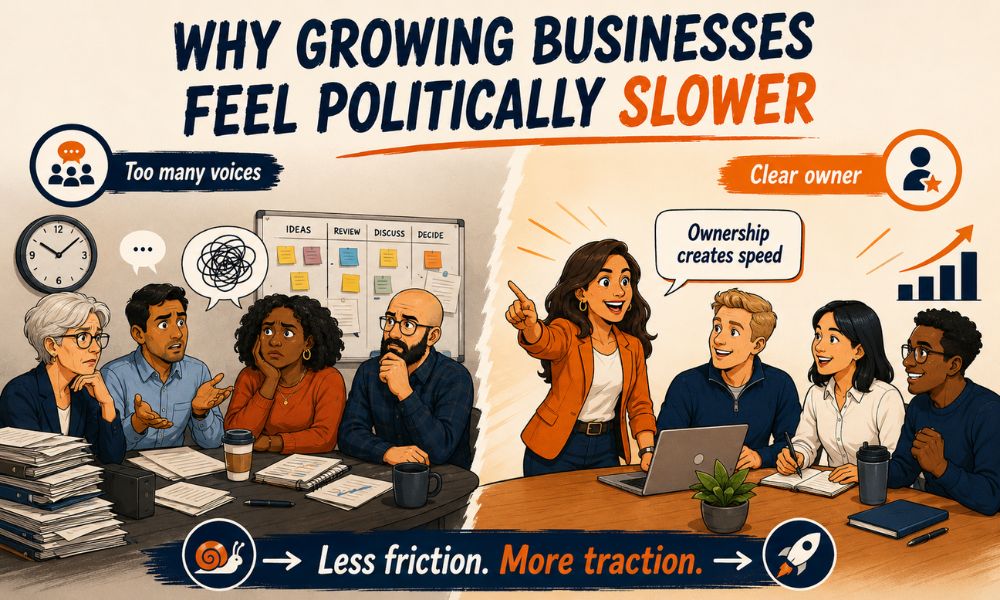
The business has become politically slower.
Not politics in the government sense. Business politics. The kind that quietly appears as companies grow, teams expand, roles blur, & more people want input into every decision.
Left unchecked, political slowness can become one of the biggest barriers to real traction.
What Is Political Slowness?
Political slowness is what happens when a business starts losing speed because decisions become wrapped in too much caution, consultation, ambiguity, or stakeholder management.
It rarely arrives with a marching band. No one wakes up one morning & says, “Let’s make this business more bureaucratic.”
It creeps in gradually.
A decision that used to take one conversation now needs three. A meeting that used to solve an issue now creates five follow-up conversations. A leader who once made a clear call now checks with four other people first, just to make sure no one is upset.
Most of the time, the intention is positive. People are trying to be collaborative. They are trying to be respectful. They are trying to bring others along.
But there is a fine line between healthy collaboration & decision-making by committee.
Once that line gets crossed, momentum starts to disappear.
Why Growth Creates More Politics
When a business has 10 people, decision-making is usually simple. Everyone knows who owns what. Conversations are direct. The founder or leadership team can often make decisions quickly because the business is still close enough to the ground.
At 50 people, things start to change.
At 100 people, they change again.
There are more departments, more managers, more priorities, more personalities, more customers, more complexity, & more people who feel they should have a say.
That is not wrong. It is normal.
Growth creates complexity. Complexity creates friction. Friction slows execution.
The problem is not that more people are involved. The problem is that many businesses never consciously redesign how decisions should be made as they grow.
So the old informal way of working gets stretched past its useful life. The result is a business where everyone is busy, everyone is talking, everyone is trying hard, but fewer things are getting fully decided and completed.
It is a bit like putting more cars onto the same narrow road & wondering why traffic has slowed down. The cars are not the problem. The road system is.
The Real Problem: Input Gets Confused With Ownership
One of the biggest traps I see in growing businesses is confusing input with ownership.
Good leaders seek input. Strong teams encourage debate. Healthy businesses want people to raise concerns before decisions are made.
But input is not the same as ownership.
Input means: “I have a view that may help.”
Ownership means: “I am accountable for the decision and the outcome.”
When that distinction is unclear, everything slows down.
Meetings get repeated. Decisions get revisited. Issues are discussed but not solved. Leaders become hesitant. Team members wait for someone else to make the final call.
Everyone contributes.
No one decides.
That is where political slowness begins.
What Political Slowness Looks Like In Real Life
Political slowness does not always look like conflict. In fact, it often looks polite.
It shows up when leaders avoid direct conversations because they do not want to upset someone. It shows up when decisions are softened so much that no one is quite sure what was agreed. It shows up when every major issue needs “a bit more discussion” but never quite gets resolved.
You might be dealing with political slowness if:
- meetings keep getting larger
- decisions are made, then quietly reopened
- leaders seek agreement from everyone before moving forward
- accountability is spread across too many people
- issues are discussed around the edges instead of addressed directly
- people leave meetings with different interpretations of what was decided
- projects move slowly because nobody is completely sure who owns the next step
The business can still feel busy. In fact, it often feels very busy.
But busy is not the same as effective.
Why Family Businesses Feel This More Than Most
Family businesses often feel political slowness more intensely because business decisions do not sit neatly inside the business circle.
They overlap with family relationships & ownership expectations.
This is where the Harvard Three-Circle Model of family business is so useful.
In a family business, people may be operating from different roles at the same time. Someone can be a family member, an owner, & an employee. Another person may be an owner but not work in the business. Someone else may be in the business but not yet part of ownership.
Each circle has different needs, different expectations, and different emotional weight.
That means a business decision is rarely just a business decision.
A role change may feel like a family judgement. A performance conversation may carry years of history. A decision about investment may raise questions about fairness, control, succession, or legacy.
So leaders become cautious. Conversations become softer. Decisions take longer. People worry about damaging relationships.
The intention is usually good.
The outcome is often slower execution.
This is why structure matters so much in family businesses. Not because families need to become cold or corporate, but because clear structure protects relationships. When roles, rights, responsibilities, & decision-making authority are clear, people do not need to rely on assumptions, emotion, or hallway conversations.
Clarity lowers the temperature.
How EOS® Helps Reduce Political Slowness
This is one of the reasons I love working with EOS®, the Entrepreneurial Operating System®.
Used well, EOS® gives leadership teams a practical way to cut through ambiguity & get back to clarity, accountability, and execution.
The Accountability Chart™ helps define who owns what. Instead of building the business around personalities, it clarifies the seats needed in the organisation & the accountabilities attached to those seats.
A Scorecard™ helps shift conversations away from opinion & towards measurable reality. When the numbers are visible, leadership teams can spend less time debating feelings & more time discussing facts.
Rocks help focus the business on the handful of priorities that matter most in the next 90 days. This reduces the temptation to treat everything as equally urgent, which is one of the fastest ways to slow a business down.
IDS® gives teams a structured way to identify, discuss, & solve issues rather than circling the same problem week after week.
The power is not in adding more process for the sake of process. Nobody needs more corporate confetti.
The power is in creating a simple operating rhythm where everyone knows:
- who owns the decision
- what matters most
- what the numbers are saying
- where the real issues sit
- what must be solved next
Instead of asking, “Who else should be involved?”
The better question becomes, “Who owns this?”
That one shift can dramatically improve speed.
Leaders Often Misdiagnose The Problem
When businesses slow down, leaders often assume they need more process.
Sometimes they do.
But more often, they need more clarity.
More clarity around decision rights. More clarity around ownership. More clarity around priorities. More clarity around accountability.
Adding process without clarity usually makes the problem worse. It creates more forms, more meetings, more reporting, and more noise.
Speed rarely comes from pushing harder.
It comes from removing friction.
Political slowness is friction. It makes good people second-guess themselves. It turns decisions into diplomacy. It rewards caution over ownership. It allows issues to stay alive long after they should have been solved.
The answer is not to become reckless. Fast decisions are not always good decisions.
The answer is to become clear.
Clear about who gives input.
Clear about who decides.
Clear about who owns the outcome.
Clear about what happens next.
The Warning Signs To Watch For
Political slowness is usually already present before leaders name it.
You may be seeing it if:
- people are unclear about who has final decision-making authority
- decisions keep coming back to the leadership team
- meetings create more conversations than conclusions
- team members wait for permission instead of taking ownership
- family, ownership, and business roles are being mixed together
- accountability feels personal rather than structural
- everyone is trying to keep everyone happy
That last one is a big one.
Trying to keep everyone happy is one of the most expensive habits in a growing business. It sounds kind. It feels inclusive. But it can quietly drain speed, courage, & accountability from the organisation.
Respect matters.
Clarity matters more.
What To Do About It
Start by looking at where decisions are getting stuck.
Do not make this personal. Make it practical.
Ask:
- Which decisions are taking too long?
- Who currently gives input?
- Who actually owns the final decision?
- Are we seeking alignment or avoiding discomfort?
- Are we solving the real issue or talking around it?
- Are family, ownership, and business roles being mixed together?
- What would make this decision easier next time?
In most cases, the answer is not to involve fewer people in everything. The answer is to involve the right people at the right time, for the right reason.
Some people need to be consulted. Some need to be informed. Some need to own the decision. Those are not the same thing.
When a business gets this right, the energy changes. Meetings become sharper. Leaders become braver. Teams stop waiting. Issues get solved faster.
And the business starts to move again.
Frequently Asked Questions
1. What is political slowness in a business?
Political slowness occurs when decision-making slows because of excessive consultation, unclear ownership, stakeholder management, or fear of upsetting people. It often appears in growing businesses where complexity has increased but decision-making structures have not kept up.
2. Is collaboration the problem?
No. Collaboration is valuable. The problem starts when collaboration replaces ownership. Healthy teams seek input, debate well, & then allow the right person to make the decision & own the outcome.
3. Why does this happen as businesses grow?
As businesses grow, they naturally add more people, departments, priorities, & stakeholders. Without clear roles, decision rights, & accountability, that added complexity creates friction. Friction slows execution.
4. Why is political slowness common in family businesses?
Family businesses often have overlapping family, ownership, & business roles. This can make decisions more emotionally complex because people are not only managing commercial outcomes, they are also protecting relationships, legacy, fairness, & future expectations.
5. How does EOS® help?
EOS®, the Entrepreneurial Operating System®, helps leadership teams create more clarity around ownership, priorities, measurables, & issue-solving. Tools such as The Accountability Chart™, Rocks, Scorecard™, and IDS® help teams reduce ambiguity & improve execution discipline.
Final Thought
Most growing businesses do not slow down because they lack talent.
They slow down because complexity quietly introduces friction.
One of the biggest forms of friction is political slowness.
It shows up in long meetings, repeated conversations, unclear ownership, slow decisions, & leaders trying to keep everyone comfortable.
The businesses that continue to scale successfully are not necessarily the smartest, loudest, or most ambitious.
They are the clearest.
They know who owns what. They know what matters most. They know how decisions get made. They know how to have the hard conversations without turning every issue into a political event.
That is what creates momentum.
And in a growing business, momentum matters.
Written by Debra Chantry-Taylor, FBA Accredited Family Business Advisor, Certified EOS Implementer & Founder of Business Action.
Business Action is focused on helping Entrepreneurs lead better lives, through creating a better business. We have a small team of accredited family business advisors, EOS Implementers & Leadership coaches, as well as access to a huge range of advisors through our Trusted Partners Network.