

In one of my recent EOS® sessions, the leadership team proudly told me their Level 10 Meeting® sessions were working well.
They were raising issues.
They were discussing them.
They were moving through the agenda.
On the surface, everything looked fine.
Then I looked at their Scorecard.
Sales were consistently off track.
And yet, no one had dropped it down as an issue.
That told me everything.
Because if your Scorecard is red & no one is reacting, your meeting is not working. It might be running, but it is not doing its job.
When I challenged the team, they reluctantly added the sales number to the Issues List.
Then came the usual responses.
“It’s just a temporary dip.”
“We’ve had worse months.”
“We already know what the problem is.”
But they didn’t.
They were describing symptoms. They were rushing towards pet solutions. And they were avoiding the deeper cause.
So, we slowed down.
I asked questions.
I refused to let them brush it off.
And we kept digging until we found the real issue.
It wasn’t what they expected.
And once the true cause was on the table, the conversation completely changed.
Suddenly, we were not patching symptoms. We were exploring real options that could solve the issue properly.
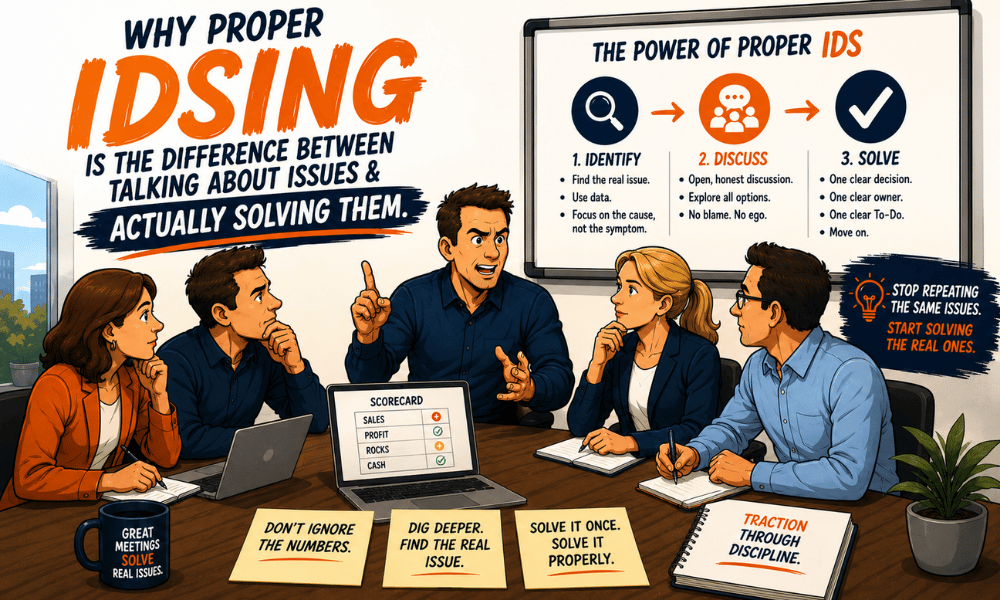
That is why using IDS® properly matters.
IDS® Is Not a Tick-Box Exercise
In EOS®, IDS® stands for Identify, Discuss, Solve.
It sounds simple, & it is.
But simple does not mean easy.
Too many teams treat IDS® as something to rush through at the end of the Level 10 Meeting® session. They use it as a quick clean-up section before wrapping up.
That is a huge mistake.
IDS® is where the real work happens in a Level 10 Meeting® session.
It is where patterns are uncovered.
It is where leadership teams stop talking in circles.
It is where real decisions get made.
When you rush IDS®, you waste the most valuable part of the meeting.
Worse, you train your team to tolerate unresolved problems.
Step 1: Identify the Real Issue
Most teams get this wrong.
They write down something like:
“Sales are down.”
That is not the issue.
That is a symptom.
A better issue might be:
“Lead generation has dropped 25% over the past 3 months.”
That gives the team something specific to work with.
A good issue is clear, specific & based on evidence. It is not emotional. It is not blaming a person. It does not take three paragraphs to explain.
If it takes too long to describe, you probably have more than one issue.
This is why your Scorecard matters so much.
Your Scorecard is your early warning system. When a measurable is off track, that number is telling you where to look.
Don’t ignore it.
Drop it down.
Step 2: Discuss Without Defending
This is where discipline matters.
Discussing does not mean lobbying for your favourite answer.
It does not mean giving a long history lesson.
It does not mean defending your department.
The goal is to open up the issue so the team can see what is really happening.
That means everyone has a voice.
The team stays focused on the issue, not the drama around it.
All options go on the table, including the uncomfortable ones.
This is often the hardest part of IDS® because most leadership teams want to jump straight to solving.
But if you solve too early, you usually solve the wrong thing.
That is how the same issue comes back next week.
And the week after.
And the week after that.
That is the classic insanity loop: repeating the same behaviour while hoping for a different result.
If your issues keep repeating, your use of IDS® probably is not going deep enough.
Step 3: Solve With One Clear Action
Solving is where clarity turns into action.
But only after the issue has been properly identified & discussed.
A good solve is specific.
It creates a clear decision.
It becomes a clear To-Do.
And it belongs to one person.
“Sarah to prepare 3 lead generation options by next Tuesday” is a To-Do.
“Look at marketing” is not.
That distinction matters.
Vague solves create vague accountability.
Clear solves create movement.
Once the decision is made, the team commits & moves on.
No rehashing.
No side conversations.
No quiet disagreement after the meeting.
That is how Traction® builds.
Why Using IDS® Properly Changes the Business
When teams use IDS® properly, everything changes.
They stop treating symptoms.
They stop recycling the same problems.
They stop tolerating vague excuses.
Instead, they build a rhythm of solving issues once & solving them properly.
That creates trust.
Because the team sees that problems can be raised honestly without blame.
They see that hard conversations can lead somewhere useful.
They see that the meeting is not just a routine.
It is a decision-making engine.
And that is when Level 10 Meeting® sessions become genuinely powerful.
The Biggest IDS® Mistake I See
The biggest mistake is speed.
Teams think faster is better.
It isn’t.
Effective is better.
A rushed IDS® conversation may feel efficient in the moment, but it usually means the real issue is still sitting there under the surface.
Slow down.
Name the issue properly.
Let the team discuss it honestly.
Then solve it clearly.
That is how you stop issues coming back.
Final Thought
If a number is off track, do not brush it aside.
Drop it down.
Push through the excuses.
Identify the real issue.
Discuss it properly.
Solve it clearly.
That is how your Level 10 Meeting® sessions stop being routine & start becoming genuinely useful.
Because the goal is not to have another meeting.
The goal is to solve what is getting in the way.
If your team is raising issues but not really solving them, let’s tighten up the way you are using IDS®.
Written by Debra Chantry-Taylor, FBA Accredited Family Business Advisor, Certified EOS Implementer & Founder of Business Action.
Business Action is focused on helping Entrepreneurs lead better lives, through creating a better business. We have a small team of accredited family business advisors, EOS Implementers & Leadership coaches, as well as access to a huge range of advisors through our Trusted Partners Network.