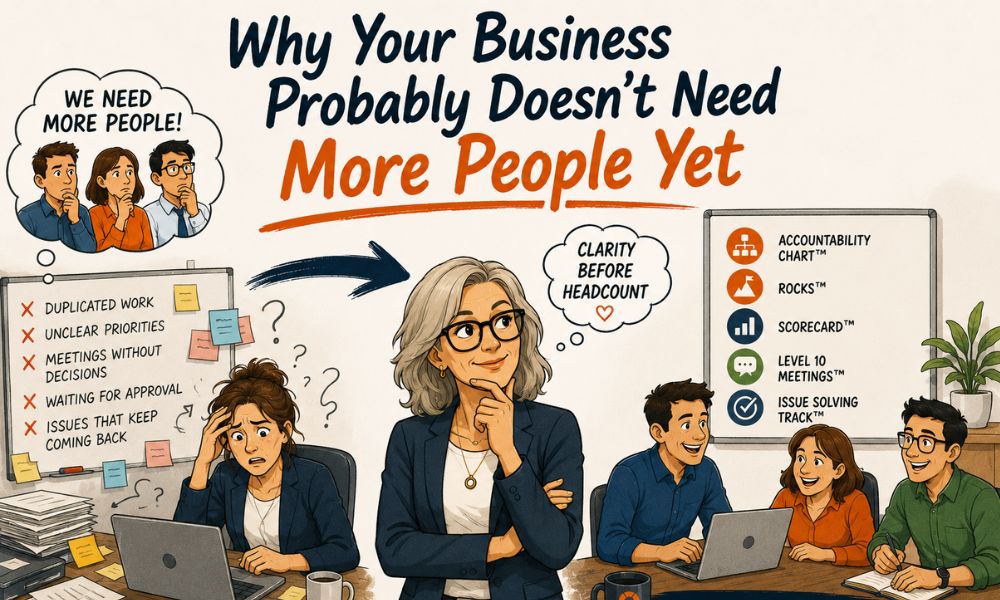
When a business starts feeling stretched, one of the first solutions leaders tend to reach for is hiring.
“We need another salesperson.”
“We need another project manager.”
“We need another administrator.”
Sometimes they’re absolutely right. There comes a point where demand genuinely exceeds capacity & the business needs more people to keep growing.
But sometimes hiring is simply the most obvious answer to the wrong problem.
I’ve worked with hundreds of leadership teams over the years, & I’ve seen this pattern repeatedly. Everyone feels busy, work is piling up, leaders are being dragged into too much detail & the natural conclusion is that the team is understaffed.
Yet when we start digging into what is actually creating the pressure, the problem is often not headcount.
It’s clarity.
And adding more people to an unclear business rarely makes things clearer. More often, it gives the confusion somewhere else to spread.
Busy Doesn’t Always Mean Understaffed
Growing businesses naturally become busier. There are more customers to look after, more projects underway, more decisions to make & more people who need information.
That is part of growth.
But increased activity does not automatically mean the business needs another employee.
Sometimes the existing team is spending too much time doing work that should not exist in the first place.
Two people may be doing versions of the same job because accountability is unclear. Work may be sitting around waiting for approval because nobody knows who can make the decision. Meetings may consume hours without producing clear actions. The same operational problems may keep appearing because nobody has addressed the root cause.
In that environment, hiring another person can actually make things worse.
You have not removed the inefficiency. You have simply added another person who has to navigate it.
The Hidden Cost of Hiring Too Early
Hiring is expensive, but salary is only part of the cost.
Every new employee requires onboarding, training, communication, management & coordination. They need to understand how decisions are made, what they own, what good performance looks like & how their work connects with everyone around them.
When those things are already clear, a new person can add capacity relatively quickly.
When they are not, the opposite happens.
Leaders find themselves answering more questions. More meetings appear. Responsibilities overlap. Decisions get escalated because nobody is sure who owns them.
The person who was supposed to relieve pressure can unintentionally create more of it.
That does not mean they were the wrong hire. It may simply mean the organisation was not ready for another person yet.
Look at the System Before the Headcount
Before approving another role, I encourage leadership teams to ask a different question:
What is actually creating the pressure?
That question forces you to diagnose the problem rather than immediately prescribe a solution.
Perhaps the answer really is capacity. You may have more demand than the current team can reasonably handle.
But the pressure could also be coming from somewhere else.
Accountability may be unclear, so work is falling between people or being duplicated.
Priorities may be changing so frequently that the team is constantly starting, stopping & switching direction.
Decisions may be unnecessarily escalated to senior leaders instead of being made where the work happens.
Processes may vary depending on who is doing the job.
Or the business may simply be carrying too much work that adds very little value.
None of those problems are solved simply by recruiting another employee.
Where EOS® Helps
One of the things I find valuable about EOS® is that it gives leadership teams practical ways to understand what is really happening before they add more complexity.
An Accountability Chart® can help clarify what the business actually needs from each seat & whether there is genuinely a missing role.
Rocks help leadership teams focus on the few priorities that matter most rather than allowing everything to become urgent at once.
A Scorecard gives leaders objective information that can reveal where genuine capacity constraints exist, rather than relying solely on the feeling that everyone is busy.
Level 10 Meetings® also create a regular place to identify & solve recurring operational issues before they become accepted as “just how things are around here”.
Quite often, when these fundamentals become clearer, leaders discover that they do not immediately need another seat.
They need the existing seats to work together better.
Family Businesses Can Fall Into This Trap Too
There is an additional version of this problem that I often see in family businesses.
The business becomes busy, someone in the family is available or interested, & bringing them into the company feels like an easy solution.
Sometimes it works brilliantly.
But availability is not the same as organisational need.
From a Family Business Three-Circle perspective, this is where the boundaries between family, business, & ownership can become blurred. A decision that makes perfect sense from the family circle may not necessarily be the right decision for the business circle.
Before bringing another family member into the company, the same questions should apply as they would with any other hire.
- What work actually needs to be done?
- What accountability will this person own?
- Would this role exist if the family member were not available?
- What results will tell us whether the role is working?
Without that clarity, the business can end up creating a job for a person rather than finding the right person for a job.
And as the family & the business grow, that can become increasingly difficult to unwind.
When You Really Do Need More People
Of course, sometimes hiring is absolutely the right answer.
A healthy growing business should expect its team to grow over time.
The difference is that the decision should come from evidence rather than exhaustion.
You are probably looking at a genuine capacity problem when demand consistently exceeds what the current team can reasonably deliver, responsibilities are already clear, processes are working well & the team is performing effectively but simply cannot absorb additional work.
You may also identify an important capability that genuinely does not exist within the current structure.
That is very different from hiring because everyone feels overwhelmed.
Busy is a signal.
It is not yet a diagnosis.
What Leaders Often Get Wrong
People absolutely can solve capacity problems.
But people solve capacity problems best when the structure around them already works.
- If accountability is unclear, more people create more overlap.
- If processes are broken, more people create more variation.
- If priorities are unclear, more people create more competing activity.
- If decision-making is slow, more people create more decisions waiting to be made.
That is why I would look at structure before headcount.
Get clear about what work needs to happen, who should own it, how it should be done & how you will know whether it is working.
Then decide whether you actually need another person.
You may still arrive at exactly the same conclusion.
But now you will know why you are hiring.
And that makes it far more likely that the new person will actually help the business grow.
5 Frequently Asked Questions
1. Does being busy mean I need to hire?
Not necessarily. Being busy tells you there is pressure somewhere in the business, but it does not tell you what is causing it. Before hiring, look at workload, priorities, accountability, processes & decision-making to understand where the pressure is really coming from.
2. How can I tell if I genuinely need another employee?
Look for sustained capacity constraints after you have addressed obvious structural or process issues. If the right people are doing the right work efficiently & demand still exceeds what they can reasonably deliver, additional capacity may be justified.
3. How does EOS® help with hiring decisions?
EOS can help leadership teams clarify accountability, identify whether an additional seat is genuinely required & use measurable information to understand capacity. The goal is to make hiring decisions based on the needs of the business rather than assumptions or frustration.
4. Can hiring too early slow a business down?
Yes. Every additional person increases communication, management & coordination requirements. If responsibilities or processes are unclear, that extra complexity can make the organisation slower rather than faster.
5. Should I fix my systems before hiring?
Where possible, yes. You do not need perfection before adding someone, but there should be enough clarity around the role, accountability & key processes for the new person to succeed. Otherwise, they are likely to inherit the same problems the existing team is already struggling with.
Final Thought
Hiring is one of the biggest investments a growing business makes.
So before adding another salary, another role & another layer of complexity, make sure you understand what problem you are actually trying to solve.
Sometimes the answer will absolutely be another person.
But sometimes the business does not need more people yet.
It needs clearer accountability, better decisions, stronger processes or fewer competing priorities.
Fix those first & you may discover that the team already has more capacity than you thought.
And if you still need to hire afterwards, you will be bringing someone into a business that is much better prepared for them to succeed.
Written by Debra Chantry-Taylor, FBA Accredited Family Business Advisor, Certified EOS Implementer & Founder of Business Action.
Business Action is focused on helping Entrepreneurs lead better lives, through creating a better business. We have a small team of accredited family business advisors, EOS Implementers & Leadership coaches, as well as access to a huge range of advisors through our Trusted Partners Network.