

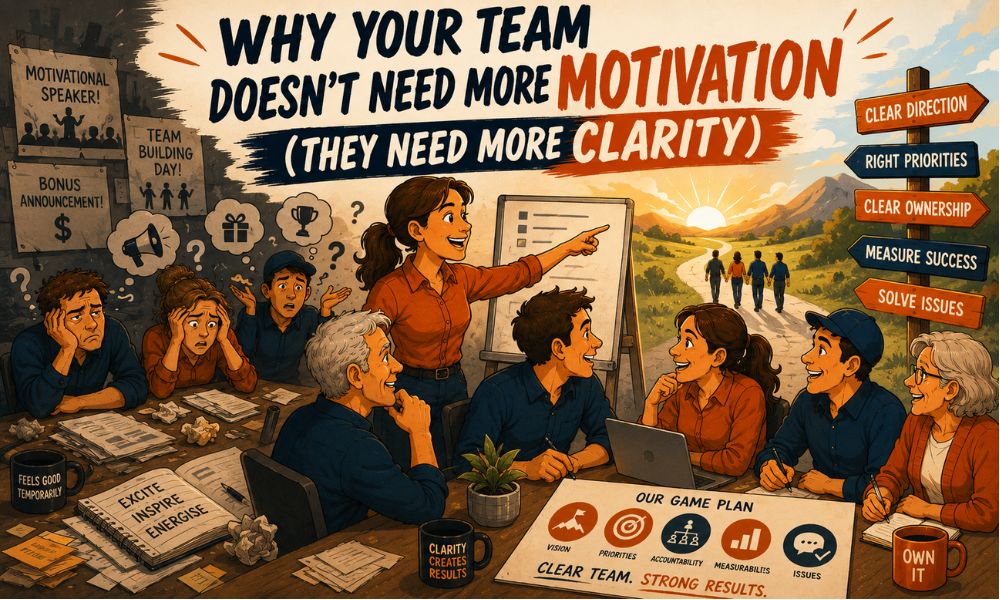
Have you ever noticed how quickly motivation fades?
A leadership conference fires everyone up for a week. A team-building day creates a burst of enthusiasm. A bonus announcement gets people talking for a while.
Then, before long, everyone returns to normal.
That is because motivation is temporary. Clarity is far more sustainable.
Yet when a team is not performing, many leaders immediately assume they have a motivation problem. They start looking for ways to inspire people, lift morale or make everyone more engaged.
But what if the problem is not motivation at all?
What if your team already wants to do a good job, but the environment around them makes that harder than it should be?
This is one of the most common leadership mistakes I see. Good people are labelled disengaged when the real problem is that priorities keep changing, accountability is unclear & nobody is entirely sure what success looks like.
You cannot motivate people through confusion.
The good news is that clarity is much easier to improve than motivation. It is also one of the reasons I love EOS®. It gives leadership teams a practical way to create the structure, focus & accountability people need to perform well.
Most People Want to Do a Good Gob
Most people do not arrive at work hoping to fail.
They want to contribute, do meaningful work, feel valued & be part of something worthwhile. They want to finish the day knowing they have made progress.
The problem is that many businesses unintentionally make success difficult.
People receive mixed messages. Priorities change from week to week. Different leaders give conflicting instructions. Responsibilities overlap, important decisions are delayed & nobody is entirely sure who owns what.
Then, when performance begins to slip, leaders conclude that people do not care enough.
In many cases, that is not true.
People care, but they do not know what winning looks like.
Motivation Is Not a Reliable Operating System
Motivation is wonderful as a feeling. As a way of running a business, it is hopelessly unreliable.
Think about your own motivation. Some days you feel energised, focused & ready to tackle anything. Other days, you would rather stay in bed with a coffee & pretend your inbox does not exist.
That is normal.
A well-run business cannot depend on everybody feeling inspired every day. People need to be able to perform even when they are tired, distracted or dealing with something outside work.
That is where structure matters.
EOS® focuses on creating clarity around the business’s direction, its priorities, each person’s accountability, the numbers that matter & the way issues are solved.
When those things are clear, people do not need a daily motivational speech to keep moving. They know what needs to be done & can get on with doing it.
Ask a Better Question
Instead of asking:
“How do I motivate my team?”
Try asking:
“Have I made it easy for my team to succeed?”
That question leads to a much more useful conversation because it shifts the focus towards the things leaders can actually influence.
Is the direction clear?
Are the priorities clear?
Does everyone understand what they are accountable for?
Do people know how success is measured?
Are issues being solved, or simply discussed repeatedly?
These are leadership questions, not motivation questions.
What High-Performing Teams Really Need
Over the years, I have noticed that strong teams tend to have five things in common.
1. They know where the business is going
People need context.
They do not need to know every detail of every decision, but they do need to understand where the business is heading, what it is trying to achieve & why their work matters.
Without that context, people struggle to make good decisions. They may work hard, but their effort can easily be directed towards the wrong things.
EOS® helps leadership teams clarify the vision & communicate it throughout the organisation.
When people understand the destination, they are far better equipped to help the business get there.
2. They know what matters most right now
One of the biggest causes of frustration in a business is competing priorities.
Everything cannot be urgent. Everything cannot be the number-one priority. Yet many businesses accidentally operate as though it can.
People are asked to juggle dozens of initiatives while still managing their day-to-day responsibilities. They jump between tasks, lose focus & struggle to complete anything properly.
Rocks help create clarity around the handful of priorities that matter most during the quarter.
Instead of spreading attention across 50 things, the team agrees on the work that will make the biggest difference & protects the time needed to complete it.
That does not mean routine work disappears. It means people understand the difference between running the business & moving the business forward.
3. They know what they are accountable for
Whenever I hear phrases such as “I thought someone else was doing it” or “I wasn’t sure who owned that”, I do not immediately assume there is a people problem.
More often than not, there is an accountability problem.
The Accountability Chart® helps remove that confusion by clarifying the structure of the business, the responsibilities attached to each seat & the person who owns each area.
Clear accountability does not mean creating a culture of blame. It means removing guesswork.
People should know what they own, what decisions they are expected to make & what others are relying on them to deliver.
4. They know how success is measured
Imagine playing tennis without knowing the score.
You would have no idea whether you were winning, losing or improving.
Businesses often expect people to perform without clearly showing them what good performance looks like. Goals remain vague, progress is based on opinion & problems are discovered long after they have started.
A Scorecard® gives the team a small set of useful measurables that show whether the business is on track.
People know which number they own, what the expected result is & whether action needs to be taken.
Clarity around performance builds confidence because people can see where they stand. It also makes conversations more objective. Instead of debating how things feel, the team can look at what is actually happening.
5. They know issues will be solved
Few things drain a team’s energy faster than recurring problems.
These are the issues everyone knows about, everyone complains about & nobody properly resolves.
After a while, people stop raising concerns because they assume nothing will change. That is when frustration begins to look like disengagement.
The Issues Solving Track® gives teams a disciplined way to identify the real issue, discuss it honestly & solve it at its root.
When people see that problems are dealt with rather than avoided, trust grows. They feel heard, progress becomes visible & the team stops wasting energy on the same frustrations every week.
Signs you may have a clarity problem
A clarity problem does not always announce itself clearly. It often appears through everyday frustrations.
People repeatedly ask the same questions because expectations have not been properly communicated.
Work is completed differently depending on who is doing it because processes are inconsistent.
Deadlines are missed because priorities are competing or constantly changing.
Leaders spend their time chasing updates because accountability is unclear.
People appear frustrated, but they have not stopped caring. They want to succeed, but the business has not made the path clear enough.
These symptoms are often treated as motivation problems when they are really signs that the organisation needs greater focus, structure & consistency.
What Leaders Should Do Instead
Before organising another team-building day, incentive scheme or motivational speaker, pause & look at the environment your team is working in.
Ask yourself:
- Is the vision clear?
- Does everyone understand the most important priorities?
- Is accountability clear?
- Do people know what is expected of them?
- Are the right measurables being tracked?
- Are issues being solved properly?
- Are leaders sending a consistent message?
When the answer to any of those questions is no, that is where I would start.
Motivation may create a temporary lift, but clarity changes the way the business operates.
Clarity scales. Motivation does not.
Strong Teams Are Not Motivated Every Day
The best teams I have worked with are not constantly enthusiastic. They have difficult days, frustrating conversations & periods when the work feels hard.
What makes them effective is not endless motivation. It is clarity.
They know where they are going, what matters most, who owns what, how success is measured & how problems will be addressed.
That clarity helps them stay focused when enthusiasm inevitably dips.
They do not need to wait until they feel inspired. They understand what needs to happen & they follow through.
That is what EOS® is designed to create: not a team that relies on constant motivation, but one that has the clarity, structure & accountability required to perform consistently.
Frequently asked questions
1. Why is motivation not enough to improve performance?
Motivation changes from day to day. It can help create energy, but it cannot replace clear expectations, priorities, accountability or systems. Sustainable performance comes from helping people understand what good looks like & giving them the structure to deliver it consistently.
2. How can I tell whether my team has a clarity problem?
Look for repeated questions, missed deadlines, unclear ownership, changing priorities, inconsistent work or leaders constantly chasing updates. These are often signs that expectations or accountability have not been made clear enough.
3. Which EOS® tools help create clarity?
Tools including the Accountability Chart®, Rocks, Scorecard®, Level 10 Meeting®, Vision/Traction Organizer® & Issues Solving Track® help leadership teams create alignment around direction, priorities, accountability, performance & problem-solving.
4. Does accountability improve motivation?
It can. People are more likely to feel confident & engaged when they understand what they own, what is expected of them & how their contribution supports the wider business. Clear accountability also reduces frustration caused by duplication, confusion & unresolved work.
What role do leaders play in creating clarity?
A significant one. Leaders are responsible for communicating the vision, setting priorities, defining accountability, reinforcing expectations & making sure issues are addressed. When leaders are inconsistent or unclear, the confusion quickly spreads throughout the organisation.
Final Thought
Most teams do not need another motivational speech, another poster on the wall or another short-lived burst of enthusiasm.
They need clarity.
They need to understand where the business is going, what matters most, what they are accountable for, how success is measured & how issues will be solved.
Before deciding that your team lacks motivation, ask yourself one harder question:
Have I made it clear what winning looks like?
Because clear teams do not need to be continually pushed, persuaded or inspired.
They know what matters & they get on with it.
Written by Debra Chantry-Taylor, FBA Accredited Family Business Advisor, Certified EOS Implementer & Founder of Business Action.
Business Action is focused on helping Entrepreneurs lead better lives, through creating a better business. We have a small team of accredited family business advisors, EOS Implementers & Leadership coaches, as well as access to a huge range of advisors through our Trusted Partners Network.