
Top Tips from Adam Harris:
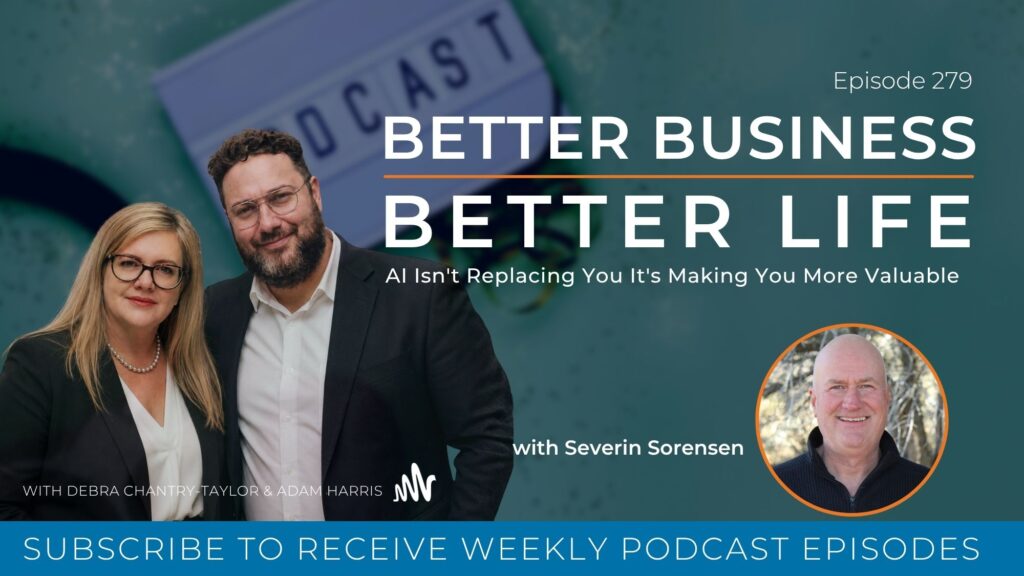
1. AI Should Free People UpTo Do Higher-Value Work
“Adam emphasised that AI shouldn’t just be about cutting jobs or replacing people. The real opportunity is using AI to remove repetitive, low-value tasks so people can focus on work that genuinely adds value. Businesses need to ask: “If AI saves us time, what do we want our people doing instead?” The goal should be elevation, not elimination.”
2. Think About AI AcrossThe Entire Business, Not Just IT
“One of Adam’s biggest insights was that AI cannot sit with just one “AI person” or department. AI needs to be considered holistically across the entire organisation. Every leader should be thinking about how AI impacts workflows, communication, accountability, systems, and customer experience. Otherwise, businesses risk creating disconnected solutions that solve one problem while creating several others.”
3. Human Connection Still Matters Most
“While AI is powerful, Adam believes the emotional connection between humans is still the irreplaceable piece. Leadership, culture, trust, empathy, and difficult conversations are built through genuine human interaction. Technology can support businesses, improve decision-making, and accelerate processes, but strong relationships and authentic connection are still what create healthy teams and sustainable businesses.”
SUMMARY KEYWORDS
AI integration, EOS implementation, agentic AI, human interaction, leadership team, accountability chart, productivity, visionaries, AI training, emotional response, business efficiency, AI challenges, human connection, AI tools, business strategy.
SPEAKERS
Debra Chantry-Taylor, Adam Harris
Debra Chantry-Taylor 00:00
Let’s be really honest, some people are going, “Yep, if we can free us up, we will get rid of a whole bunch of people. For other businesses, we might be saying that actually we don’t want to get rid of people, we want to free them up to do the stuff that they add a whole lot more value.
Adam Harris 00:10
As a solopreneur, you could end up having a level 10 meeting with all your agentic AIs and going, “Okay, cool, so what’s the productivity? Let’s process and go through IDs. You’re getting the challenge and the questioning from all of the agentika eyes, and you’re as effective, if not more effective, than having a full leadership team.
Debra Chantry-Taylor 00:34
Hello, and welcome to another episode of Better Business, Better Life. I am your co-host, Debra Chary Taylor, and I’m passionate about helping entrepreneurs in their best life by creating a better business. My co-host, Adam Harris, who is also my work brother and my business partner, is here today to have a conversation. We’re going to be talking about all things AI, and of course, AI buzzword, it’s used everywhere. We believe it’s on every single issues list of every business that we’re working with at the moment, but what does that really mean, and how do you take it from being on the issues list to really ingrading it into your business, or even just exploring what it might mean for you. So, we are going to have a conversation around that, about all things AI, and most importantly, some of the thinking that we have about where it will fit in, so will it replace your EOS implementer? Will it become part of your leadership team? Where does it sit on the accountability chart, and what are the things that you can actually do with AI? So, no further ado, I’d like to introduce you again to my co-host, my business partner, my work brother, Adam Harris. Good morning, welcome back to the show, Adam.
Adam Harris 01:40
Thank you very much. Glad to be back.
Debra Chantry-Taylor 01:42
It’s great to have you here, as always. So, as most of you will know, if you’ve listened to a couple of episodes, Adam and I are business work partners. I call him my work brother, my little work brother. He’s my younger brother, but we’re also very, very similar in terms of our view on things, and also very, very different, and so we love having these discussions, because I think it challenges both of us in terms of our thinking, but also hopefully from the listener’s point of view, we get to share some of our experiences. So, as you know, I’m an EOS implemented family business advisor. I’m going to hand you over to Adam to give you a brief introduction to himself as well.
Adam Harris 02:19
So, inquisitive, challenging, visionary work really closely with Debra, get excited about holding space for leadership teams and helping them navigate through EOS, professional speaker, coach, author, blood. I’m really excited about today’s session, because we’re talking about AI, which, yeah, it, you know, it’s a really interesting conversation, and the landscape is changing, but AI and EOS is an interesting conversation, so I’m not sure where we’re going to go. I’m looking to share how this kind of came about.
Debra Chantry-Taylor 03:00
Yes, okay, so the reason we’re doing this podcast today is because I had somebody challenge me online, and for those of you who know, quite active on LinkedIn, and somebody challenged me on LinkedIn, and sort of said that, you know, with AI and agentic AI, the landscape was changing, and EOS would become obsolete, and that just really triggered me, and so I got very kind of like, oh my goodness, what you’re talking about, there’s no way in the world, EO has become obsolete, this is my, it’s what I do day in, day out, and so I got very triggered, but then I reflected on, and I thought, okay, well, this is interesting, because I think we’ve all thought surface level AI, and we’ve all dabbled in AI, but what does it really mean for EOS going forward in the future, and so I started exploring that and thinking about what it actually meant, and I’m just going to share a little story, because I, you know, Adam, you know, but people may not know, I mean, I do love technology, and I’ve been using AI for a long, long, long time, but more recently I’ve been getting into the agentic AI side of it, and also really developing my different AI tools for different purposes, and so just to give some context, I’ve got Chat GPT, who’s called d2 and d2 has been trained in everything, Debra. She is a little mini version of me who has been fed all of my writing, all of my podcasts, all of my history for the last 30 years into her, so she knows exactly how I speak and what I do. I’ve then got Claude, which is called Ellie, and she is my EOS implementer, and my sounding board, and my challenger. And then I’ve got Gemini, who hasn’t got a name yet, maybe we could come up with the name for her, but anyway, who does a lot of the graphics and stuff that we do. So the other day I asked Ellie, my Claude, to if she would write an article for me, and she turned around, she said, Debra, I’m not your writer, d2 is. I said, yet, but I didn’t like what d2 wrote. Can you please help me with this? She said, well, actually, that’s your problem in terms of the way that you’re managing d2 I suggest you go back and have a conversation with d2 to ensure that you get the right output from her, because that is her accountability, and it suddenly made me realise, oh my good. Yes, these are actually mini people, if you like, that have got accountabilities and know what they’re good at, know that they GW see the seat, and that wasn’t part of her role. So it was really an interesting.. it was.. it was a little bit funny, because it’s like, for goodness’ sake, fuck off, you’re my AI, do what I tell you. The same time was fair point, maybe I’m not being a great leader and a great manager with Jeetu, and I should go back and have a conversation with her. So that’s kind of how it all started.
Adam Harris 05:26
Okay, so couple of questions come to mind. It’s clear that you are further along the journey than I am, which is cool. I’m interested to know, because you and I have a really close relationship, we work really well together, and there’s times when you reach out to me, and just like, hey Adam, you got five minutes, I’m interested to know and understand. Then, what are the things that you need to speak to me as a human about, as opposed to when you’re not speaking to, you know, Ellie or d2
Debra Chantry-Taylor 05:56
Well, okay, I think that this is why I don’t think EOS will ever disappear, because the iOS is not software, right? EOS is about people, it’s a people management, the people energy management system. And whilst Ellie and d2 are great for very, very simple questions, and sometimes when I’ve got things I just want to get a quick answer on, they don’t really have the same empathy and the same critical thinking I would suggest, as humans do, in terms of their.. I liken it to they’re like somebody who’s gone to university and got all the knowledge, but hasn’t actually had the experience of it, and sometimes what they come back with is very academically correct, but it’s missing that human element, and so when I call you. It’s because I want a human. I want to talk to somebody who actually, who I can laugh and joke with, somebody who I can see your face and I can actually engage with you, as opposed to just having text come back at me. And don’t get me wrong, sometimes the stuff that Ellie comes back with is just mind blowing, and I kind of go, oh my god, I hadn’t thought of that, but it’s not a real human.
Adam Harris 06:58
Okay, so what I’m hearing then is the emotional response and the empathy that you’re looking for. Okay, so
Debra Chantry-Taylor 07:06
and look at looking at you in the eyes and actually having that conversation with somebody whom I can, you know, see is is a genuine human that can respond to the way that I’m doing, and yeah,
Adam Harris 07:17
okay, so let’s make the assumption that you could create a humanoid for Ellie or d2 and if not now, at some point in the near future, they would be trained to have the empathy and the emotional response. Why do you need me?
Debra Chantry-Taylor 07:37
Because I get to hug you, and I know that sounds really weird, but this is a thing sitting and thinking this is weird, but it’s like actually there is an element of humans do business with humans, humans engage with humans, humans enjoy spending time with other humans, and it is that sort of that ability to have a holistic approach. I, I really enjoy getting my hugs from from people that I know, and just that that energy that comes, I think, because that if you think about energy, yes, I could be talking to somebody who looks like they have empathy, who looks like they’re kind of, you know, taking on board things, but there isn’t the same energy as you get from dealing with a real person. One of my favourite authors, Philip K. Dick, he did the book, I think it’s called “A Dream of electric sheep, and in the world of the future, you know, rich only rich people had real animals. I’ve got a cat sitting on my lap at the moment, but only rich people had real animals. All of the unrich people, or non-wealthy people, had basically android animals, and whilst they looked, and they looked like real sheep, and they pretended to eat grass. They obviously didn’t really eat grass, and they had all the sort of same characteristics. We just knew that they actually weren’t a real sheep, and I think that’s probably the element of humanness that will never be replaced by robots.
Adam Harris 08:54
Okay, so if we then relate this then to AI replacing EOS implementers, you and I is then the distinct piece here for you that those visionaries or teams that appreciate human connection, empathy, human presence in the room, or virtual eyeball to eyeball, that they’ll still want a physical EOS implementer, however, there may well be some which were like, actually, the AI EOS implementer is sufficient enough.
Debra Chantry-Taylor 09:33
Yeah, I think there will always be people who.. I mean, I see it. I don’t know if you’ve seen it in some of your clients, but I’ve got some clients, particularly some of the younger founders and visionaries that I work with that really rely on AI a lot, they’ve got AI advisory boards, they’ve got AI coaches, they’ve got AI implementers, and I think there will be people who, who will, who will be happy to have that. I actually wonder if they will outgrow it, though, and I’ve saw this happen when I was part of a member of. Entrepreneurs organisation. One of the people in our forum was a very, very young guy, beautiful man, loved him to pieces. But he came into the forum one day, and he said, “Look, I’ve decided to leave the forum, and it’s like, “Oh, why are you leaving? Because when you leave forum, you have to give a really good reason. You have to explain to me why you’re leaving. He said, “Well, with all due respect, everything we do in here, I can learn from YouTube, I can learn from Chat GPT, I can learn from Googling it, and so I’m not sure I kind of see the value, and went, okay, if that’s the way you feel, then absolutely off you go. And he came back the next month, but we said we said, do give it some really serious thought, and come back. And he came back the next month, and he actually said, no, I’ve changed my mind, all of that stuff. Yes, I can learn all that stuff, but what I get from you is real world experience, and that is that is valuable to me, so yeah, I don’t know. I think that people think that they will be able to do it with just AI, but over time I think we’ll migrate back to wanting to be back in front of people again.
Adam Harris 10:51
As you say all of that, I wonder if that is historic of our generation, and I wonder if I think about my, you know, kids 17 and 13, whether the normalisation of the interaction with AI and technology will mean that actually that’s their new normal.
Debra Chantry-Taylor 11:14
There’s always positives and negatives around the AI as well, and we’re seeing the impact that social media and AI is having on on these young people, and I’ve seen it with my niece, who’s a little bit older than your girls, not much, but a little bit older, and the, that she really is, you know, she sort of, she, she went through her last years of school in the midst of Covid, so all done online, no interaction with people, for her community now is like super important, she loves having her community around her, and loves having young people around her, so I don’t know. Time will tell. Maybe I’ll be completely wrong, and maybe we’ll all have electric sheep, and it will all be great.
Adam Harris 11:48
So I just want to dig a little bit deeper. Then, so you saw the post, and you were like, what? What was the bit that triggered you? Was it about your ability to be able to give value? Was it the perceived value of the companies getting the, you know, getting the EOS implementer experience? Like, what was the bit which, like, really was like it
Debra Chantry-Taylor 12:09
was more simplistic than that. So, first of all, because I don’t know if you’ve experienced this, but as an EOS implementer, I get people when I tell people what I do, they automatically assume EOS is software, and so they go, ‘Oh, software. It’s like, no, no, this is not software. In fact, there is software that can help you with the EOS implementation, but we’re not software people. We are people people. We actually help teams become more healthy. We help teams get on the same page in terms of vision. We help teams run a really effective kind of business. And so that was my first trigger. It was like, oh my god, EOS is not software. This is not going to replace EOS. And that’s where I first went, and then when I actually see he had, he put together a paper, and there was nothing wrong with the paper he put together. It was talking about the fact that as agentic AI becomes more normal, you will have AI running in the background, not on command, like LLMs. You give a command, it executes on that command. An agentic AI literally owns a system or a process, and it runs 24/7 in the background and gets on with it. And so what he was doing, he was saying that when this comes into play, then there won’t be any humans, because the AI will be doing all of this stuff, and therefore you won’t need an accountability chart, and you won’t need people managing it, because you’ve got all these these AI agentic agents doing all this work, and so then I kind of got triggered by that, because I was like, okay, I do believe in the power of AI, I think it’s got some fantastic stuff, but it’s again, I started thinking about it. It really is just like another human, as in, if you don’t give it the right context, if you don’t give it the right what outcomes you’re looking for, if you’re not really clear in training it, if you’re not going through the system and process with it, then it will still shit in, shit out, just like people, you can’t give people the wrong stuff and expect them to do amazing things, and so that, yeah, so it was a whole.. it got deeper and deeper the more I thought about it, but the original thing was just literally our EOS is not software, it’s not going to do it. And then I had this realisation, it’s like, actually, if let’s just imagine AI did take over everything and we didn’t need to have any humans anymore, well, the world would actually just implode, because who we’re going to sell our products, our services, our things to if there’s nobody to sell it to, because AI agents aren’t going to be selling to each other, so that’s just the end of the world as far as I’m concerned. And I was like, okay, now another rabbit hole, let’s go down that
Adam Harris 14:14
one. Yeah, and it’s funny because when I’m, when my head goes there, I just start thinking of the Terminator and Skynet, and yeah,
Debra Chantry-Taylor 14:21
and there was a really good movie displaced company, it was called, where there was a robot, but then she didn’t realise she was a robot, she was a girlfriend, but she was a girlfriend robot, and she didn’t realise she was actually a robot, and she only discovered it in throughout the journey of the movie, she discovered she was actually a robot and not a human, so yes, there’s all these beautiful sci-fi things out there, and you kind of go, yeah, but who knows where it will all end. I’ll probably be dead before it all ends anyway.
Adam Harris 14:46
Well, it’s interesting because I, a guy that I follow from the US, is a guy called Scott Galloway, and he’s a behaviourist and also an economist, and he was talking about the aspect. Of where we’re at at the moment with regards to AI is actually this is about narrative economics, so how stories go viral and drive major economic events, so actually you know, if you look at things from since the Industrial Revolution, you know technology in any form has been, you know, is often there, but actually it’s the narrative that kind of gets played with it that actually is more important than the actual, you know, technology, so yeah, it’s not, it’s not denying that we’re in that, we’re we’re changing and we’re moving, but how much of the narrative that is being told is true and how much of it is reality,
Debra Chantry-Taylor 15:41
the matrix?
Adam Harris 15:43
Well, yeah, and I think, actually, you know, this kind of brings me to the thoughts, which is, is that you know, being open-minded, being inquisitive, being challenging is actually an important place to kind of be, so we, which kind of leads me on to where and how would you be recommending that companies use AI to assist with their EOS implementation,
Debra Chantry-Taylor 16:13
to assist with their EOS implementation. I think there’s some real, like, we’re seeing AI being built into the EOS software tools, and what it’s, what if you think about what AI can be really good at, is you know, taking huge amounts of data and exploring that, and looking for trends and things, and so in software like 90 and success, and whatnot, you’ll see that they’ve now got AI in there, it’s looking at the scorecard and the dart data, and it’s starting to recognise trends and patterns much more quickly than we ever will do as humans, and it’s looking at the much, much bigger picture as well. So I think it’s really great for helping you to embed the EOS tools in a more meaningful way. I’ve also been with Channing to 90, I’m on their advisory board, I was chatting to them the other day about, you know, whether or not we can start looking at if you think the accountability chart is the backbone of all of EOS, but how does that hook into the rocks into the scorecard, and how can we look across all of those tools and see where things are falling down? It can do that in a much more effective, much more quickly than humans can. And so I think that that is where it can really help to embed the tools, and of course, just the odd question about, you know, what is the best practice for this? It can probably help with, but it’s never going to replace an implementer as such, in my opinion.
Adam Harris 17:25
Well, so I want to push a little bit deeper on this. So it’s never going to replace an EOS implementer, in my opinion. What would need to be in place for it to replace an EOS implementer?
Debra Chantry-Taylor 17:36
You would have to have no people like me in the world who really value and appreciate human human interaction, and that could happen one day, maybe. Yeah, so maybe, maybe never is a bit too strong, hopefully, hopefully not in my lifetime.
Adam Harris 17:51
Okay, so is the human interaction, which is the is the piece that is sacred and can’t at this moment be replicated,
Debra Chantry-Taylor 18:02
and I’m going to use a completely different example, but you know when we went into the COVID lockdown, and we were all of a sudden kind of forced to work from home and to be isolated, you think about the way most people actually responded to that, they still craved having interaction with people, and we saw things like Zoom meetings pop up, where you would have drinks on a Friday, but over a Zoom call, and where you would have, you know, people jumping on just to have a chat. And even though the working from home now has changed a lot in the terms of the way that we work, the teams that have the strongest culture, in my opinion, are the ones that are not always driven by meetings, but they’re actually driven by working together in the business for the greater good, and so being together working from home is great, but the time they actually get together, even when they just come in for their quarterly, when they do their weekly level 10 meetings, those teams that have that time together tend to be stronger in terms of a culture and in terms of challenging things, as opposed to teams that are just driven by the process and getting stuff done, does that make sense?
Adam Harris 19:07
Yeah, it makes sense. So, you know, I have to talk about the importance of kind of breaking bread together and building that rapport and that that connection, and actually what you’re doing there is use your, your recalibrating, building rapport connection, so that you’re the ability to have those challenging conversations, the disagreement, the behaviours, the values alignment, etc. is really, really key, and that’s why when you have that connection, you’re able to empathise, hold the space, and have that emotional connection, so you know, I wonder, then if you let’s take, for example, if you’re using Colby within the within the leadership team or the business, so you’ve got all of the, you’ve got all of the data you could probably input into AI communications, whichever channel, Slack. Whatsapp email, and then kind of go, hey, I’ve got a challenge with Debra at the moment, based on
Debra Chantry-Taylor 20:06
you too,
Adam Harris 20:07
and based on the information, like, how am I going to respond and work with this with this individual? Like, are you kind of, are you using that at this moment in time?
Debra Chantry-Taylor 20:18
I am a little bit, and I’ve got teams who are doing actually really well, so they’re using it to, to do some sort of, I suppose, leadership coaching on themselves as well, in terms of how did I handle that interaction, and how did I handle that meeting, and what could I have done better. So, wrong, I think there’s some huge things that you can do with it that really helped you to become a better person. I’m probably not using it to its full advantage yet, so there’s just.. it’s mind blowing. I did, I did a podcast, you know, a couple of days ago with a guy who is all about ingraining AI into your business, and he talks about the 10 levels of AI integration, and most businesses sit around about a one to 310. is where we are literally humans and AI work together seamlessly, and everything is, you know, working as it should, and most of us are really low down. I’m probably more like a five or a six in terms of my understanding of it, but most people just don’t get. Most people think about AI, and they think about chat, they think about LLMs, they think about potentially by making some processes more smooth and gaining efficiency, but that’s not where it really adds the most value.
Adam Harris 21:20
I feel like I’m asking all the questions, but that’s cool, because your knowledge and understanding is greater than mine. So, I’ve noticed a trend with regards to companies putting on as either a short term or a long term issue in the quarterly AI.
Debra Chantry-Taylor 21:35
It’s on everybody’s list at the moment. Yeah,
Adam Harris 21:38
you know, those people listening to this, what would you be suggesting or revising that they do with, you know, if AI – I’m almost 100% sure that it’s on everybody’s issues list, you know, where and what are the questions or the rocks that maybe they should be considering within their business around AI?
Debra Chantry-Taylor 21:57
Yeah, so this was the conversation I had with the guy the other day, it’s like actually you’ve got to think about AI, is just another tool or another human that is going to help you with the business. So, you’ve got to get very clear on what is it you read, what’s the problem you’re really trying to solve, because it’s very trendy to say, “Hey, we need to get AI into the business, but then to do what? I mean, yes, you can look at it and go, “Yes, we can speed up some time. What are you going to do with the time that you’ve actually saved, does that mean you’re going to lay people off? Does that mean you’re going to change what they’re actually focusing on? And also, I think that people think, oh, we can do an AI training course for a couple of hours, and then everybody will understand AI, and that will be it. It’s actually about changing the way you think about AI as a whole, and that is not a two hour training session that you put people through, and then suddenly they get it. You have to start thinking about what are the biggest challenges we face in the business. Goes back to the what’s working, what’s not working, and you know what’s not working. Where could we use different tools, AI just being one of them, to actually help us in resolving those issues. So, I think people tend to try and jump into it and go, right, we need to get AI, we’ll make a, we’ll make an AI champion, we’ll put AI on the leadership team, whatever it might be, they were put on the issues list, but they’re not thinking more deeply about how do we change fundamentally. Everybody thinks in the business about what is possible and really understands what we are able to do before we start doing it. And he talked about having, like, a circle of excellence in your business, so you have a team of people from different backgrounds are very diverse that are actually being brought up to speed with what is possible and really challenging and thinking about what can be done, so you’re not just got your IT person, which is where it normally naturally follow your IT technology, they look after AI, well, that just means you’ve got one person who understands AI, that does not fundamentally change the way the business runs, and so having this circle of excellence of people who can actually talk about, you know, what is possible, challenge each other’s thinking, start thinking about it, but most importantly, know the business and the challenges the business face, and how we might use it to help with those challenges.
Adam Harris 23:55
So, a couple of things, I think one, it’s like, what’s the issue underneath the issue, it’s like, what was the problem that we’re actually really trying to solve here, and is, is AI the answer, and I think it’s just, it’s convenient, and again, the narrative is AI, AI, AI, it’s like, yeah, but, but why, what I’ve observed is, and I’ve heard about this for a while, is that there’s a lot of the senior execs within larger organisations are doing what they call reverse mentorship. So, it used to be the case, is that you know, if I was 60 odd and there was a young gun coming through, and it’s like, okay, you know, I’m going to mentor somebody in their early 20s, is that actually what what’s now happening is, is that you know somebody in their 60s has got a mentor who’s 20 who sees the world from a different perspective, so the 60 year old goes, hey, look, here’s some of the issues, challenges, and opportunities, help me understand where what I can be doing, and the invaluableness about that is that you. Know you know, and I’m generalising here, but the 20 year old see things, you know, with no filters, with no blinkers, no history, no preconceived ideas, absolutely. So it’s like, yeah, but you could, instead of doing what you’ve just told me, you can do this, this, and this, and it’s gonna, and like, an AI is one solution, but actually it’s, it’s a different way of looking at things like it’s kind of that divergent, you know, why, why, why, why, kind of thinking, and I think the, you kind of touched on it, and I feel that this is a really important piece, which is, if you’re going to be looking at AI or technology, it has to be across the whole organisation, and I’d be looked at it from a holistic approach rather than just within, you know, one position, because you know, and I say this coming from the IT background, is is that you kind of almost potentially stuck with the curse of knowledge, because if I look at it from an IT perspective, I’m not necessarily going to take into consideration, you know, the systems and the processes and the workflow and the expectation and the human interaction with kind of other people, so you know you’re kind of careful what you wish for, because if you put, if you put AI commas into the into the accountabilities of one individual, it may well end up causing you a lot of problems, more problems and challenges than you’d originally thought of.
Debra Chantry-Taylor 26:20
I agree. It’s almost like, you know, you know, on the accountability chart, where every single person who looks after people has LMA, kind of feel like there’s almost another little line now, where every single person needs to be thinking about the AI. I’m not saying it should be AI as a bullet point, but just part of LMA will actually be AI LMA as well. And I’ve talked to you about this before, my vision. I think the way I see this going in the future is that let’s just say I’m the marketing lead on the leadership team, and underneath that, obviously, marketing splits that into a whole variety of different functions, you’ve got digital marketing, got the B2B marketing, got B2C market, whatever it might be, there will be boxes on that accountability chart, which will be managed entirely by an agentic AI, and I think people always think that a box on an accountability chart is a full-time role. It’s not, it’s a function, right? So, if you think of it as a function, there might be a function that that AI is doing completely on its own, but therefore it means we have to manage it just like we’d manage a human. It needs to have its five accountabilities on the accountability chart. It needs to have its rocks that it is working on. It needs to be attending level 10 meetings and hearing about what’s happening in the rest of the business, that it can be informed about what it’s going to do. It needs to have a scorecard that is measuring to make sure it’s producing the right outcomes, and it needs to be involved in the issue solving and the resolution of that through the to-do’s, and so it becomes part of your LMA, but you will be having some boxes that might be entirely owned by an agentic AI, which is just another human, it’s my electric sheep thing, it’s just a another sheep, but it’s an electric sheep rather than a real sheep, and so you know, just thinking, I think that’s where I sort of see it, it’s if you just give it to one person on the accountability chart, you’re not actually really ingraining AI into the business, your surface level, I don’t know, it feels like it doesn’t, it doesn’t have that ingraining into the business.
Adam Harris 28:09
There’s an interesting point there, which is, you know, if I, if I think about what’s happened over the last 20 years in the, in the fact that the bridging the gap between being a small business and a large business is so small compared to what it used to be, with regards to, you know, resources and technologies played a real, you know, massive part of that, and actually, you know, I wonder now what’s beginning to happen in the fact that you could be a small business and compete with a large business, and actually the economies of scale often would mean that you’re going to be, you know, more cost-effective as a solution, whatever the products or services that you’re selling. I actually think that what you’re just saying there, with regards to Agent AI, actually that means is that you could be a one, two person company, and if you could build out your accountability chart, and you’ve got the Agenda AI, and you’ve, you know, you’ve trained, you’ve coached, you’ve mentored all the things you do with humans. Absolutely, is all of a sudden you’re in a situation where, as a solopreneur, you could end up having a level 10 meeting with all your agentic AIs and going, okay, cool. So, what’s the productivity? What do we need to.. you know, what’s the to-do for this week? Let’s process and go through IDs, and you’re getting the challenge and the questioning from all of the agentic AIs, and you’re as effective, if not more effective, than having, you know, a full leadership team. So,
Debra Chantry-Taylor 29:30
I completely agree, changes again. The only thing I would say is, remember that AI thinks a million – I don’t know what the number is, but it processes and thinks a whole lot quicker than we ever will do, and I think as humans we’re going to have to learn how to deal with that, because there will be risks that come out of that. There’ll be risks about allowing AI to completely take ownership of something, and because actually he gave an example on the podcast, which I hadn’t even thought about, but you know, you can get, you can download certain. AI’s onto your computer at home, which you can give full permission to run tasks and things for you, and so, and it think it starts to think for itself, and it starts to go, okay, so you know how you love to send video messages, I hate them, but you love them, and so you know it, you gave this example where this person had sent what he thought was a transcription of his voice message to his AI to ask it to do something, and the AI received it as an audio file. So, immediately started thinking, oh, this person must love communicating in audio files, just like Adam likes to communicate in video files. So, the AI went, well, if he wants to communicate in audio files, I need to find a way to take that stuff out of that audio file, get it into the text that I need, and then when I respond to him, I’m going to have to respond in an audio file, so it then went onto the internet, downloaded a programme to actually create audio files from a text file, it did its answer, created into an audio file, then it sent it back to him. Now, downloading a piece of software from the internet could be perfectly okay, it could also be really, really dangerous, because who knows what it’s downloading, so it was just, you know, if you think you can take that into any number of examples, if you give it full authority to actually run an accountability chart, it thinks slightly differently to a human, it thinks much faster, it has access to this amount of information that we don’t necessarily have access to. How do you manage that? How do you manage that effectively? Maybe, you know weekly level 10s aren’t going to be the way of the future. I don’t know, but it’s like there will still be a requirement, I think, because the EOS is a framework. There’s still going to be a requirement to manage these people in the same way that you manage real people, but how we do it might be a slightly different way.
Adam Harris 31:37
We’ve kind of transitioned from, you know, AI taking over EOS implementer, and now we’re just kind of talking more generally about AI within EOS practice, and actually we’ve not actually covered any of the questions that we..
Debra Chantry-Taylor 31:51
oh, what’s the questions?
Adam Harris 31:52
Which is why.. what.. what else is.. you know, I know that you spoke to this AI expert the other day, but I know that you’ve been thinking about it for a long time. What, what, what else have we not covered?
Debra Chantry-Taylor 32:04
Well, I think that I think the biggest thing is it’s that the things that make businesses successful is culture and people. We know this from the good to great, so maybe in the future that will change. However, the culture, the people having the right people in the right seats, making sure they GW see it. I think all that stuff is going to apply to AI as well. Like, does your are you using the right AI for the role that you want to give it? And, as I said in the beginning, I’ve got three different AIs at the moment. I might have more in the future, because it, they should GW see their role as well. Are they actually capable of doing the role that you’re actually setting for it? So, I think that we’ve just got to think about this just a little bit differently. It’s like AI is not just a tech tool, we’ve got to think about how do we continue to create a strong culture with strong people and use AI to augment that and free them up to do better things. And then, what are you going to do with those people if they’re freed up to do, because it can, it can produce huge efficiencies and things. What do you then want and need your people to do? What will make the boat go faster? When we talked about visionaries a couple of weeks ago, you know that whole idea of being able to get the flywheel turning and feed more things into it. Well, AI has the potential to make that flywheel go, you know, completely off the chart. So then, how are you going to keep up with that? And how do you ensure that you’re still doing the right things to make the boat go faster,
Adam Harris 33:23
so I wonder, right, is that you mentioned before about, you know, is LMA going to become L M A I A, or whatever, maybe there’s a better acronym that we can kind of come up, and maybe we should copyright it. Anyway, I wonder if there’s a, there’s a level of fear and anxiety, though, from an individual perspective, in the fact that you know I often speak about the, you know, your sole responsibility is to make yourself redundant, but you know if there’s this aspect where individuals are tasked with incorporating AI, like how much resistance is actually going to be there? Because, actually, you know, if I fully automate an AI in my role, then where does that leave me?
Debra Chantry-Taylor 34:09
Yeah, and we’ve seen this in our own business, Adam, as you know, I mean, we’ve got we’ve got assistants that are based in the Philippines that actually help us out with some stuff, and I have asked them time and time again to kind of look into AI and what can be done, and I know that is a real natural resistance, because now don’t get me wrong, they use AI a lot, but I’m kind of going, I want actual automation, I want things running in the background 24 sevens that you don’t have to do this really boring stuff, and I think their biggest fear is, well, if that does that, what will I do, and I think you have to reassure your people that, well, depend. Actually, first of all, you, as a business owner and leadership team, need to decide what is it you’re trying to do. Are you trying to get rid of people? Because some people are. Let’s be really honest, some people are going, ‘Yep, if we can free us up, we will get rid of a whole bunch of people. For other businesses, we might be saying that actually we don’t want to get rid of people, we want to free them up to do the stuff that they add a whole lot more value. So, what else could they. Be doing so I think it’s important we bring people on the journey and we have them thinking about what would it’s the delegate and elevate tool if you had more time what would you be doing more off and where does that add more value to the business so don’t think of AI as taking your job AI is just taking away the stuff that is not the the enjoyable stuff the boring repetitive stuff, the stuff that really we don’t add any value to, so how can we add more value, and what would that look like, and I think it gives an opportunity to start reimagining career pathways throughout the organisation as well, in terms of your, if all that stuff is being done there, what, what could, what could you be doing
Adam Harris 35:37
again, this potentially goes back to a previous episode with regards to visionaries, is that given the right space and the right aspect and area to kind of dream and think differently, is that this is where the visionary should actually be spending time going. Okay, so if I had a blank sheet of paper, you know, where and how could this business look? Yes, it’s all about idea generation, but actually from a workflow, and how we’re going to operate as a business, incorporating AI and technology is a real important piece, which I’m not so sure that a lot of visionaries are actually spending that time thinking on.
Debra Chantry-Taylor 36:15
Well, I think not thinking, but also I think there’s a real risk, and we talked about this before, communication, like bringing people on the journey with you, because I know we – I’m sure you’ve seen this with your teams as well. I’ve got a lot of founders who are absolutely obsessed with AI and wanting to bring AI into the business, so they are doing some of the thinking. I don’t think they’re necessarily thinking deep enough, but they are definitely thinking about it, but they’re not bringing the people on the journey, and we know how important communication is. You know, people have to hear something. How many times will they hear that truly for the first time? 32 So, 32 times that you have to kind of, you know, repeat stuff. And I think if you’re not reinforcing the message of this is not about cutting jobs, it’s about doing things better. It’s about actually developing our people into the stuff that they love and are great at. If you’re not doing that regularly, you will, you’ll lose people on that journey.
Adam Harris 37:02
We’ve spoken a lot there, but overwhelm is a big thing at the moment with AI. Like, you know, I mean, there’s a lot of, there’s a lot of FOMO going on, fear of missing out, and I should be doing it. I should be doing it. Everybody else is doing way more than me. Like, what would you be saying to that,
Debra Chantry-Taylor 37:21
I understand, because I mean every time I do a little bit more deep diving into, I get overwhelmed, like it’s just.. it’s almost impossible to get your head around everything that is possible and everything that is going on, but it’s just like everything else, bite-sized chunks, you know, breaking it down, compartmentalising what can we actually be doing in the next 90 days that might actually help us to get us further up those 10 rungs of different different AI integration. Don’t try and don’t try and run before you can walk, you know. We wouldn’t allow, we wouldn’t do our first focus day and then go to the team, right? Go out and roll this out to the entire organisation, because they haven’t had a chance to play with the tools, they haven’t had chance to understand how an accountability chart really works. They haven’t had a chance to work at our level 10 meeting, really works. They haven’t had a chance to get their rocks and their scorecard wrong yet, to learn from those mistakes, to then revise them and get better versions of the rocks and the scorecard. And I think that’s what we’re doing with AI. Sometimes we’ve become, oh, we need to get AI, and let’s just go out there and start putting stuff in. How about we go back to, like, really being clear about what we’re trying to achieve, and break it down to little bite-sized chunks and make sure that we’re doing it in a way that is manageable rather than trying to do everything all at once. There’s also a danger of bringing in an outside person who’s an expert, that’s like bringing a consultant into the business. We know what happens, we bring consultants into the business, they come in, they write this beautiful report about all the things that should be done, but if the team hasn’t been brought on that journey. It’s just another report that goes in a draw somewhere, and nobody does anything with it. I was in Sydney a few weeks ago, and I caught up with an old man, Vistage member of mine. He’s ex-Microsoft, and he was a programmer back in the day, and he bought a business
Adam Harris 39:00
about maybe 15 years ago, he was telling me, and it’s, you know, he’s a geek, like there’s no, like, he’s a full on geek. He says he’s now spending 16 hours a day working on AI, and he says, Adam, I just don’t have enough time. He says, I am absolutely lapping all of this up, he says, you know, a from a general interest perspective, but the, you know, the wins that they’ve had within the business has just been phenomenal, and I was like, look, this is amazing, I says, but realistically, the chances of somebody having that skill internally within the business, like you said, who’s not a consultant, like I feel that that is going to become a real differentiator for those organisations that do have, you know, do have one or two individuals who know and understand the vision and the trajectory of travel. Are open-minded enough, and but the ability to have the depth of learning. I think some, I think some businesses are just going to absolutely thrive to a completely different level,
Debra Chantry-Taylor 40:12
and that’s why I think there probably will be a seat on the accountability chart that is about AI, but that’s more about that technical thing that the business can go to and go. Hey, we want to develop this area of the business, or we have this challenge in the business, and we know what we need to achieve, because that’s what they.. and then the AI department, whatever it might be, will be able to facilitate, you know, looking just like the IT department. What’s the best tool we can use for this? What’s the best thing to actually do it? But I don’t think they’ll be driving the business. I think the.. I think AI is going to be a support function, like marketing. I’ve always said, you know, marketing, sure, it helps drive throughput. It’s a support function. It’s like, what is the business trying to achieve? The marketing is the way that we actually do that. AI should be the same in terms of, hey, this is what the business is trying to achieve. What do we best do to do that?
Adam Harris 40:57
Feels like we’re coming to the end of this conversation, and it’s kind of getting me to think, you know, I wouldn’t know how we can use AI to go out to all of our existing clients and people that are listening to the podcast, and you know, create some questions that maybe we should be discussing further, because, like, it feels that we’re just scratching the surface here.
Debra Chantry-Taylor 41:18
We absolutely are. I mean, it is, it is mind blowing, what is available, and I’d love, I think, even just, I mean, that challenge, I think, was the best thing ever to happen to me, because what it did was it made me kind of go, I actually haven’t given much thought to this, I really haven’t, and it made me just kind of go, okay, and I’ve got, I’ve got some clients who are like yours, very much deep diving into AI and what can be done, and they’re building entire software systems to run the business, and they’ve got agentic AI working in there, and, and I realised that actually I’ve been very surface level looking at it, and it really got me to question a little bit around, you know, what, what does it look like, and where are we headed? And I think they’re the conversations that we need to have. So, yes, getting questions from somebody that we can then, you know, think about, I think would be a great idea. So, if anybody’s listening to this, you know, you, there is a an email in the podcast notes, you can drop us an email, tell us what you’d like us to answer. We’re not saying we have all the answers, not even close, but I tell you what, we’ll, we’ll certainly give you an opinion, and then we’ll, we’ll share some experiences from our own clients as well, which is more important. So, so we haven’t asked much about, you see, I’d love to hear what you think, because, yes, you say that I’m further ahead of you, but am I really? I think I just have a different way of thinking about things.
Adam Harris 42:25
I find the balance between the technology, and I’m generalising here, but the technology will is at a stage where it’s informing and educating. It’s clear for me that the bit that is currently missing is the emotion and the connection. However, if I look at some of the things that are being done with regards to, you know, the dating apps, I think I was just reading this morning that Bumble is getting rid of the swiping piece, yep, because the AI is gonna, you know, the algorithm is going to be able to help, you know, and kind of go, we searched our database, and here’s the x number of people that we think are a match based on your, your profile, and your,
Debra Chantry-Taylor 43:14
do you not get a choice anymore, is that what you’re telling me? I’m gonna not go get a shoes,
Adam Harris 43:18
that’s what they were indicating, yes, so that you know they’re speeding up the process, I suppose it’s almost becoming, you know, a first level matchmaking service, I mean, you know, based on based on the algorithms, but I do believe that the piece that is not quite there is that is that that emotion and that empathy, and you were kind of picking up on it, but I do wonder how close it actually is, and at the point of which it’s there, like how good is it going to be, and is it going to be sufficient enough that actually it replicates or potentially is more sophisticated because it can empathise, but it can take the emotion out of it, and then provide the solutions, and potentially accelerate that, that, that process. So, if I think about, you know, sitting in a quarterly, and you know, there’s a member of the team who is visibly distraught or upset about a particular issue. Is that the AI would be able to build the rapport and the trust fast and easily if it didn’t already exist? Have the empathy to understand and help the individual through, or the team through that process to kind of then go, okay, cool. Now let’s move on. So you potentially can get to the end result, but much quicker and without the curse of knowledge that maybe you or I or other EOS implementers have got.
Debra Chantry-Taylor 44:56
I mean, I think we will get there. I think we’re a long way from it at the moment. I mean. With my limited use, but the stuff that I’m doing at the moment with AI, there’s still a tendency for it want to want to please. Now, I’ve programmed mine to not want to please me, but generally it is, you know, it is a paid for product. They make money out of selling AI, so at the end of the day they are creating a people pleaser in some respects, because they want you to keep using it, and there’s that whole bit like social media that’s designed to get the dopamine up and get you there. So, we’ve got to be people need to be able to be to question what comes out of it, and just make sure that it’s not just telling you what you want to hear, and that it is also being truthful. I mean, the hallucination stuff still exists. The other day, it fed something back to me, and I kind of went, because I gave it a spreadsheet and asked her to do something with a spreadsheet, and I looked at him, went, “This isn’t quite right, doesn’t feel quite right. And so I went back and said, “This doesn’t feel quite right, I’m not sure this is great. They were like, “Actually, yes, I couldn’t actually access the spreadsheet properly, so I made it up. Okay, not idea. So, you know, so you’ve got to treat it just like a human in terms of it’s not always going to be right, but I do worry that it, because of the fact that it is a paid for model, how, how real and raw will it really get? And there’s also, also always going to be some blockages, you know. I don’t have a filter, it’s probably my, my blessing and my curse is that sometimes things come out of my mouth because I haven’t been able to filter them before they got to my mouth, and so, but sometimes that can be really helpful, and sometimes it can be really bad, you know. And, but it built in within AI, at the moment, there are those filters that don’t allow certain things to get through,
Adam Harris 46:34
and then it kind of gets me thinking about kind of the, the love, the care, the consideration, like you know, I spoke before about helping an individual or a team through a process, but I know you and I is that the, you know, we is not a transaction, it’s a relationship that we have with the clients. Again, how you replicate that aspect authentically, I don’t think it’s impossible. I’m intrigued to see and understand how that’s going to then play out.
Debra Chantry-Taylor 47:07
It’s definitely not impossible, because we’re seeing it. We’ve seen people falling in love with AI, right? So, that it’s definitely not impossible. But, as you said, authenticity, yeah, that’s going to be a tough one. I don’t know. I remember reading a book many, many years ago and talking to the author about it. It’s called Scary Smart, and he was the guy who was the head engineer at Google Labs, or whatever, it’s where they do all the new stuff, and he was saying, you know, if you think about it, it is just like a baby when it’s first born, it gets fed all this information, it gets to learn as it goes through it, there is a danger that it can actually learn good things and it can learn bad things, and also from a what am I trying to say here? I think it’s, it is just a learning machine, and so are we as humans. Don’t get me wrong, but will it ever have the true capacity to to love and to care? I don’t know. It can learn how to be empathetic, it can learn how to challenge you, it can learn how to, but
Adam Harris 48:03
yeah, but okay. So I hear you all say that, and then this thought just runs through my head, so like you kind of replicated yourself with d2 and to a different extent, Ellie, you know what’s what’s the point where d2 is trained as a replica of Debra to be able to facilitate and run an EOS session, because it’s a, it’s a version, it’s, it’s been built and derived
Debra Chantry-Taylor 48:34
from me,
Adam Harris 48:35
from you,
Debra Chantry-Taylor 48:36
got my DNA, that I suppose, in some respects.
Adam Harris 48:38
Yeah,
Debra Chantry-Taylor 48:39
yeah, I don’t know, Adam. I mean, this is, say, and this is what I find fascinating, because having been a sci-fi chick from way, way back, and you know, Douglas Adams, Flick, K Dick, all those, even the George Orwell and stuff. Yeah, well, you think about it, that we’ve been talking about this stuff for a long, long, long, long time, and it’s been predicted for a long, long time, and, of course, it is moving at a rate that we just cannot keep up with. So, who knows, we could be sitting here in one month’s time, and it could be a completely different landscape to what it is now. We can only do what we could do, and I think you can’t ignore it. That’s the biggest thing, but putting it on your issues list is akin to ignoring it. You’ve actually got to think about how do you bring this into the businesses in a meaningful way. How do you bring people on the journey? How do you actually get the most from it?
Adam Harris 49:23
Okay,
Debra Chantry-Taylor 49:23
what’s going on in your mind now? Go on, tell me. If
Adam Harris 49:26
AI was going to finish this podcast, how would they finish this podcast?
Debra Chantry-Taylor 49:30
Oh, because AI is wonderful. It would give you a beautiful summary of exactly what we’ve talked about, and it would tell you, you know, how wonderful you are, because it loves to tell you that. I’ve had to train my AI not to do that. That’s the other thing, I don’t have people who are using it. It’s like the.. it really is a bit of a people pleaser. It does tell you what you want to hear, and just like socially, it repeats back the things that you want it to say sometimes. So, really important that you kind of.. but it is very good. So, it would probably say, ‘Oh, Debra and Adam, that was a wonderful job that you’ve just done that podcast. Well done. It’s great to have your knowledge and have your experiences shared. And then it would go. Go back, and it would recap the things that we’ve actually talked about, about how you bring AI into the business, how it’s another person, where it sits on the accountability chart. And then it would say, it’s been an absolute pleasure speaking with you.
Adam Harris 50:10
Yeah, I just love that aspect, that it’s just massaging the ego,
Debra Chantry-Taylor 50:13
unless you instruct it not to. And, as my original example, you know, it can push back if you ask it to push back. Yeah,
Adam Harris 50:18
cool.
Debra Chantry-Taylor 50:19
How would you finish it? Is that the real Adam I’m talking to, or is that actually an AI version of Adam that’s been talking to me all this time?
Adam Harris 50:26
I doubt now. I don’t know. It kind of feels as if this is a start of a series, and as we collect more data with the assistance of AI, you know, I think it’s probably worthwhile getting a couple of other people come on. Fact, actually, one of the.. I think it’s to be interesting to have these conversations with some other EOS implementers. For starters, there’s a friend of mine in the US called Severin Sorenson, who is the AI whisperer. I think we should get him on on the podcast. I think he’d be, he’d be great.
Debra Chantry-Taylor 51:08
I was, I think we should get some of our fractal integrators on, because I think the integrators will have a different perspective altogether as well. We approach it from a visionary perspective. I suspect the integrates will have quite a different perspective, so be good to hear what they, what challenges they’re coming up against, and what they’re thinking about as well.
Adam Harris 51:21
Yeah, so let’s keep the conversation going, and either you and I physically as our full central selves or AI versions of ourselves that we’ve trained accordingly. We’ll continue this series of this podcast.
Debra Chantry-Taylor 51:37
Absolutely, sounds good. So, quick recap, a human recap. If you’ve got any questions you’d like us to answer, we’d love to hear them, because that gives us some food for thought, and some things we can actually go away and explore and come back with. If you want to find out more about ingraining AI into the business, take a listen to the podcast with John Munsell. He’s got some great insights there. Let us know, anybody you think would be really helpful to have on the podcast that you’d like to hear from. We will do our best to search those people out and bring them on board, and most importantly, don’t just make AI an issue on your list. Think about what you really need to do to bring that into the business.
Adam Harris 52:14
Bye for now.
Debra Chantry-Taylor 52:15
Bye. Thank you, Adam.
.
=======================================================================================================================================================
Debra Chantry-Taylor
Certified EOS Implementer | Entrepreneurial Leadership & Business Coach | Business Owner
#betterbusinessbetterlife #entrepreneur #leadership #eosimplementer #professionaleosimplementer #entrepreneurialbusinesscoach
Certified EOS Implementer New Zealand
Certified EOS Implementer Australia
Certified EOS Implementer UK
Certified EOS Implementer NZ