

Top Tips from John Munsell:
1. Upskill People Before You Automate Everything
“Many businesses make the mistake of jumping straight into advanced AI projects without first building AI capability across the organisation. John recommends focusing on training employees to use AI effectively before investing heavily in complex automation. When employees learn how to use AI properly, they can often save 10–12 hours per week, creating significant capacity and uncovering opportunities that leaders may never have considered.”
2. Don’t Skip The Foundations Of AI Mastery
“AI isn’t just one skill. John describes a progression of mastery levels, from simply chatting with AI to managing autonomous agents that make decisions independently. Businesses get into trouble when they jump from basic AI use straight into advanced autonomous systems without understanding the risks, governance, and controls required. Building expertise step-by-step is safer and far more effective than chasing the latest AI trend.”
3. Focus On Capacity Creation, Not Just Efficiency
“Most leaders think AI is about productivity, but John argues the real opportunity is creating capacity for growth. When repetitive work is automated, businesses can redirect that time into higher-value activities, innovation, and revenue generation. The goal isn’t simply to work faster, it’s to free up people to do work that creates greater impact and drives business growth.”
SUMMARY KEYWORDS
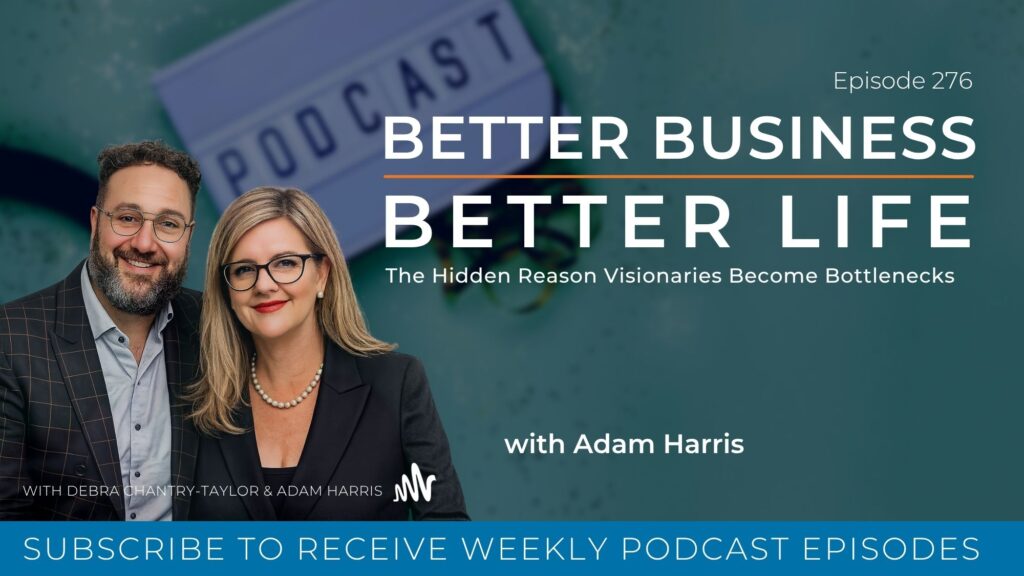
Visionary, integrator, big picture, day-to-day, EOS, Rocket Fuel, clarity, leadership, healthy conflict, delegation, execution, business growth, accountability, team dynamics, strategic planning.
SPEAKERS
Adam Harris, Debra Chantry-Taylor
Adam Harris 00:00
I remember a visionary saying to me, Adam, why is it taking my team so long to get onto the same page as me? And it’s like they don’t need to be on the same page as you, they just need to be making sure that we’re working together. Having worked with a lot of CEOs, visionaries over the years, is that really understanding what your why is? I believe is a really important piece.
Debra Chantry-Taylor 00:21
The visionary role is that big picture thinking, where are we headed, looking for that future stuff. The integrator is about executing on a day-to-day basis on the plan to get there. Hello, and welcome to another episode of Better Business, Better Life. I’m your host, Debra Chantri Taylor, and I’m passionate about helping entrepreneurs lead their ideal lives by creating a better business. Today on the show, I am chatting with my work brother Adam Harris, and we’re going to be talking about all things visionary. So, there are a couple of books out there that have been released in the EOS book series called Rocket Fuel and visionary by Mark C. Winters, and these really talk to that visionary integrated relationship, and we just thought it’d be great for us to chat about that and share some of our insights from our own personal experiences, but also from the experiences of our clients. So, please welcome to the show Adam Harris. So, it’s great to have my work brother Adam back on the show again. Welcome to the show, Adam.
Adam Harris 01:22
Thank you for having me, as
Debra Chantry-Taylor 01:24
always. Oh, it’s going to be fun, as always. So, we’re going to talk about visionary stuff today, which I think, before we get started, we probably just introduce ourselves a little bit, so that people know who we are, but also what role we play in the various businesses that we run, as well. So, for people who’ve never listened to the show before, Adam, why don’t you give them a little background about yourself, and then also what role you play in our businesses.
Adam Harris 01:46
Cool. Thank you, Debra. I’m pretty convinced that the first questions that came out of my mouth were why, why, why, why, why. I’m an incredibly inquisitive, intuitive individual, actually got me into a lot of trouble when I was younger. I struggled to find where I belong, and kind of had my first business when I was kind of eight years old, helping or doing car washing. I had a bit of a car washing empire. Fast forward through the years, I’m a qualified butcher, baker, candlestick maker. I’m a true visionary in the fact that I see opportunities, and kind of, you know, I do a lot of improv comedy, and there’s a phrase that we use, which is yes, and so anytime I’m faced with a situation, it’s like, oh, wonder where the opportunity is here. So I’ve had a couple of strange things over the years. I was a professional look-alike for a number of years, that’s maybe for another episode, and I had a business that supplied inflatable extras to the TV and film industry. So, yeah, we had 15,000 blow-up dolls, but really, probably for the last 15, maybe 18 years, I’ve been a coach, facilitator, speaker, author, and I would say that I am truly visionary, because I see the big picture. I don’t like getting stuck down into the into the into the weeds into the day to day, so I look at things from that diverse perspective. What if, why not, what next? So, yeah, that’s me,
Debra Chantry-Taylor 03:24
perfect. And for those of you who know me, you’ll see that we have some kind of similar backgrounds. We’re both from the UK. I also have my first business very, very young. I used to make and sell little tiny little mini notepads and envelopes and things as I was an avid writer, and I had this thing about miniature stuff, so I used to make these things and sell them at school, and then obviously got put into the traditional work force because my parents thought I should get a good job to attract a great husband, so that has been my, but now in terms of business, I have obviously been running businesses since my very, very early 20s, and I also am a visionary, but a slightly different visionary to Adam, in terms of I’m very good at seeing the big picture, but then I also have this capacity to bring it right the way down to the ground, in still in a big sense, not to minute detail, but be able to take those massive concepts and translate them into everyday stuff, and so Adam and I have a couple of businesses together, we have Business Action, which is our EOS implementation business, and then we have Integrated Executives, which is about to rebrand to Sherwood Foundry, and in those roles, so in the Business Action thing, we actually, in both of those companies, we have a unique situation where we actually have two visionaries and two visionary boxes, we have an integrator that actually runs the practices for us, and so we always say that, you know, it’s unusual to have two visionaries, but if you do want to do that, you’ve got to have two separate boxes and be very, very clear about what each one does, and so within our businesses, Adam is the big picture visionary, the one that sees the massive opportunity to connect the dots, I’m the one. On that is about operationalizing that, but not down to day to day level of detail, but more about how do we take those big concepts and implement in the business, and yeah, so that’s that’s how I would describe it. Anything to add to that, Adam?
Adam Harris 05:14
Yeah, I think what you just said there about the definition of the of the roles is really important. I’ve got a couple of businesses that I’m working at the moment that also have two visionaries, my favourite saying of all time, and those listeners that have heard me before knows that clarity creates confidence, so having that clarity and that definition is really important. I don’t necessarily think so much for the visionaries themselves, but actually, when you cascade them through the organisation to know and understand, especially as a leadership team, who’s accountable, who’s owning, and who’s responsible for what in the differing boxes, is a really important piece.
Debra Chantry-Taylor 05:54
Yeah, I had it with a client that was in the wealth management space, and again, they had two visionaries, and it was very, very specific, so they had one that was very much about mergers and acquisitions and really big growth, and the second one was more about that organic growth, but looking for the opportunities with partnerships and relationships, so you know, as long as you’re very, very clear about what each one does, it can work. It’s not normal, it’s not something we see all the time, but it certainly is something that can work if put in the right context. So we’re going to talk about visionary stuff today, because obviously we are both visionaries, but also Mark Winters released his book, Visionary, a few months ago, and we’ve been sharing that book with our clients, and been having conversations with Mark Winters as well, and we just thought, like, why don’t we explore what it really means to be a visionary, and hopefully give some insight into visionaries for other visionaries, so I’m gonna, I’ve got a whole bunch of questions. We’ve asked our Chat GPT to give us a whole bunch of questions, as we always do, and we’re just gonna, we’re gonna chew the fat and answer these questions for you. So, Adam, I’m gonna ask the first one for you. What does the word visionary actually mean, and where do people misunderstand it?
Adam Harris 06:59
Yes, the word visionary is for, and this is just my understanding of definition, is it’s about being able to see the big picture, but actually also to create the picture that doesn’t quite yet exist, that you know, there’s there’s the things that we know, there’s the things that we don’t know, and there’s the things that we don’t know that we don’t know, and actually given the right space and opportunity, a visionary is able to kind of go into that space of kind of intrigue, wonderment, and kind of go to places that maybe often that they wouldn’t be able to do normally, if I reflect on businesses that are running on EOS, the visionary is so caught up in the day to day that actually they don’t have that ability to have that level of thinking and being able to kind of think six months, 12 months wider, because they, they haven’t let go. There’s probably a lack of, you know, a lack of trust, and there’s probably some level of fear. So, when you can create the foundation and the right leadership underneath, actually that then creates the space for them to kind of think further. What about you?
Debra Chantry-Taylor 08:17
Well, just thinking, as I was listening to you, then it’s like you can’t see the wood for the trees, right? You’re so deep in the weeds that you just cannot see the stuff that you need to see, and I think there’s a really great saying, I’ll probably get this wrong, but you know, visionaries, they’re considered crazy in the beginning until they actually are right, and then all of a sudden they’re geniuses, and we often see that is that they have that ability to see so far ahead and really reimagine things that people, most people, can’t keep up with them, and therefore can’t understand what they’re trying to do, and I think that’s the important thing, is that you need that, otherwise the business stagnates and doesn’t grow.
Adam Harris 08:49
Yeah, and I think there’s an interesting piece there, which is if the visionary is communicating through to the integrator and the rest of the leadership team, and it’s like, oh yeah, that makes sense, that makes sense. Then maybe the visionary is not thinking or believing big enough, like you kind of want a little bit of healthy tension into, you know, the integrator or the rest of the leadership team to go, “Wow, I got no idea how we’re ever going to do, create, build, whatever that is, and actually part of the visionary’s role is to kind of, you know, have that level of conceptual ideas or big picture thinking, and then kind of go, okay, how now do we take that and then bring it back down to kind of, you know, reality.
Debra Chantry-Taylor 09:38
Yeah, and I think what’s really interesting about this is the term visionary. I’m sure it’s been around for a long, long, long time, but in the concept, or in the context of EOS, it was introduced by Geno and Mark many, many years ago in their first book, Rocket Fuel, and what it said was you have to have a visionary role, and then this integrator role, and these two really need to work together like two pieces of a puzzle. To get the most from business, and if you think the visionary role is that big picture thinking, where are we headed, looking for that future stuff? The integrator is about executing on a day-to-day basis on the plan to get there, and if you don’t have both of those roles, the person who is the founder of the business is trying to do both, and that’s like trying to be a unicorn, because you’re trying to be big picture reimagining, and at the same time managing all the minute detail and really getting involved in the business, and I think that for me, when I first came across EOS, and then I read the Rocket Fuel book, that was a real game changer. It opened my eyes up to some of the businesses I’d run in the past, where I was trying to do, but and wondered why I was struggling.
Adam Harris 10:39
Yeah, and also I found over the years that there are there’s a number of visionaries, inverted commas, who have somebody potentially sitting in that integrator seat, but actually they’re kind of the visionaries micromanaging them, that the structure doesn’t, and the relationship and the and the context and the boundaries don’t exist for actually the integrator to really fully do what they need to do, they, and interestingly, was having a conversation with somebody last week, you know, where they have got an integrator, but the visionary still has kind of got almost that grip, and there’s absolutely a stranglehold, and it’s like, you know, and if the relationship is strong enough, then the integrator should be turned around and going, okay, what, what, where’s the itch, where’s the rub, what, what’s stopping you from letting go? Let’s work through this together, and often I don’t see those conversations happening because the visionary hasn’t enabled and transferred the trust through to the individual that’s sitting in the integrator seat
Debra Chantry-Taylor 11:46
now. Let’s explore that a little bit further. So, you know, why do you think that founders do struggle to let go? Because they often – we’ve seen this all the time, like we work with the EEO members and Vistage members and tech members, and things – is they’ll, they’ll read the book and they’ll go, ‘Yes, this is what I need. I absolutely need an integrator, and they really understand the difference between the two roles. They then either go out and find someone or somebody in their organisation, they allow them to step up to be the integrator, but they don’t actually let go. Why do you think that happens?
Adam Harris 12:14
I feel that there’s there’s a number of potential different reasons. I think one is they’ve not got the right person sitting in the right seat, for starters, i.e. the role either hasn’t been defined, or if it has been defined, then the capacity and capability of the individual is not where it needs to needs to be. So, I think that’s the first thing. I think the second thing is often is trauma from the visionary in the fact of and that may well be from lived experience within the business or some trauma from, you know, years ago as to what, what, what’s the barrier, or there’s a level of resistance from them being able to let go, which is about them as an individual, and often, if I reflect back to kind of, you know, my days as a Vistas chair, is that often there was some real deep stuff to kind of work through, work through there, and a large part of it, and this is kind of the third thing I’d say, is that a lot of it’s actually around kind of fear, so you know, fear is kind of false evidence appearing real, is that there’s a story that’s created in, in the head, which is I can’t let go because dot dot dot dot, and actually there’s no sense of reality that kind of sits behind that, if that assumption is is challenged, and I also believe that there’s this thing, which is actually a lot of owner founders, visionaries, they actually love the chaos, so when thing you know, when they have team members that are on the edge of their seat, they don’t necessarily feel comfortable or confident, and they have a lack of clarity, that kind of, you know, chaos theory. In fact, there’s one, there’s one visionary that I know, the rest of his leadership team call him Captain Chaos, because just comes in and just stirs the honey pot, you know, drops, you know, drops a big bomb, walks out, and it’s like, huh, what, how are we going to now kind of deal with it? So, yeah, I think there’s the number of contributing factors, that’s my thoughts. What about you?
Debra Chantry-Taylor 14:24
I always describe them as ski gulls. They come in, they shit all over the place, and then they disappear again. And you’re right, I think there was a certain element of being addicted to chaos, but I think that comes from a little bit of a fear in terms of, but what will I be doing if I’m not actually involved in the day to day running of the business, and I had this one of my visionaries that I worked with many years ago, and we worked through it, and she had brought on a really strong leadership team, and they really stepped up, and they took over the running of the business, and then all of a sudden she felt lost. It was like, so if they’re doing all of that, what am I doing? And I had to talk her through, well, actually, you should be going back to doing what you. Did, when you first started the business, which was a true visionary, she’d actually revolutionised the industry she was working in, and she had spent a lot of time thinking about how to change and revolutionise that industry. I said to her, guess what, now you’ve got the time to do that all over again, and you’re not caught up in the weeds, and that’s what you should do, and it’s just like, yeah, but I don’t feel like that’s really adding value, and it took a little while to get back to being a true visionary, because she had been so caught up in that day-to-day functioning of it, so I think there is that element of, but you know what will I do if everybody else is running the business.
Adam Harris 15:31
Let’s go on to the next question. When, when does being a visionary become a superpower, and when does it become a liability?
Debra Chantry-Taylor 15:40
Okay, so a superpower is when you really truly are freed up to do that big picture stuff that we know will eventually change the world, and I think you have to have space to do that. So, if you’re caught up in the minute detail of day-to-day running, you’re never going to do that. So, that’s when it’s a superpower. And, as I said, visionaries literally change the world because of the way that they think and the way they think differently to most other people. When it becomes a liability, in my opinion, is when they are not letting go, not allowing their team to kind of step up and not recognising that they should stay in their box, and I don’t mean that in a, in a negative way, as in get back in your box, but it really is about being very clear about where you add the most value and allowing others to actually step up and do the things that they, where they had the most about you. What about you?
Adam Harris 16:25
I think one of the.. I don’t think I know. One of the things I love about your EOS is it creates the framework to create the conditions for success for the visionary, so it can’t.. it allows for do what you need to do, but understand that you can’t do everything, and it’s about, you know, making sure that we make the right decisions at the right time, have the ideas, know where to put them, compartmentalise them individually or collectively as a team to allow you to be the best version of yourself, but actually more importantly to add the most amount of value to to yourself, but also to to the business, the liability comes when, as the owner, founder, more often than not, is that they pull rank and they go, yeah, but it’s my company, like no, when you’re playing that card, you have to question yourself, kind of going for what benefit, you know, I might.. there may well be the case that I might win the short-term battle, but you know, you know what.. what’s the long-term war? What we’re trying to achieve here as an organisation, and you know, what’s the damage that I’m causing for for the business, and I think it’s important that there’s an awareness, even if you’re the owner, founder, and it’s your inverted commas, baby, is it? It’s its own entity, so the decisions, or the home runs, as we might call them, that you’re deciding to do, I think there’s a real, there’s a real piece which is challenging those decisions and kind of going, are you really doing what’s best for the business, or are you actually feeding your ego, and I think there’s some conversations that individuals need to be having, either with themselves in the mirror, or potentially with their integrator, or a coach, or sitting in a mastermind group, because you know, just making those quick, snappy, rash decisions, which a lot of visionaries are kind of renowned for, you know, it’s not demeaning the success that you’ve had up till this point, but it’s like, in order for the business to be a success, subtle changes are going to make a big difference in the medium to long term, yeah, it’s
Debra Chantry-Taylor 18:43
true, which lays very nice into the next question. So, what are the classic signs that a visionary has become the bottleneck in their own business?
Adam Harris 18:50
Well, I work on a phrase, which is, denial is the first sign of admittance. Actually, the biggest thing for me is if there’s no healthy conflict and everybody’s saying yes, then you created potentially a dictatorship, and or you don’t have people strong enough that are challenging your own assumptions. So, I think that’s, I think that’s a big warning for me. The other thing is, is that if you’re, and again, if you’re not, if you’re not used to having external challenge, whether that be a coach or a peer group, is that you only know what you know. So, if you’ve been shown as a leader that this is the way to do things, and you’ve got a successful business, actually it may well be the case that you’re not – you’ve got no awareness that actually there’s a different way of doing it, and I’m not – I’m not saying for one minute that you know EOS is going to answer all prayers, and you know, but having having a framework and having the challenge internal, I believe is a really important piece, and if you’ve not got that, then I would be asking yourself, why is everybody saying yes to everything that I do, I never. Not got any challenge, then you know it’s I’ve just created extensions of myself. Now some people may say that’s a positive thing. I would say that healthy conflict, like one of the things I love about the fact that you and I are both visionaries, is is that I might say something, you know, we had this last week, is that I was like, oh yeah, but what about this, and you go, yeah, but Adam, you’ve not thought potentially about this and this, actually, yeah, you’re probably right on that, and that, that kind of backwards and forwards, I feel, is a really important conversation that needs to have,
Debra Chantry-Taylor 20:34
and I think that, you know, that is where the integrated role is so key in the business as well, and having the right person in that role that actually supports that visionary, but does challenge them, because if the visionary, the integrator, have a good relationship where they’ve got that healthy conflict, it encourages the rest of the team to also be open, because once you start to become vulnerable yourself, you can see that opening up other people and being able to do it, but you’re right, there are, we’ve all done it right, we sit through the level 10 meetings where there just don’t seem to be any issues, and it’s really just because you’ve got a whole bunch of yes people kind of going yes, yes, yes, but the scorecard and the rock say otherwise,
Adam Harris 21:08
yeah. And then that’s probably a good early warning signs, is that you know the data is saying one thing, but the conversations are saying something different.
Debra Chantry-Taylor 21:16
Yeah, the other thing about the whole bottleneck thing is you do see it where even when you’ve got a very, very large company and a leadership team, there’s stuff when rocks aren’t being done. I think that’s sometimes a warning sign, because the rocks aren’t being done because when you actually start digging deeper as to why they’re not, is because they’re waiting on the visionary, or they’ve been held, been hijacked by the visionary, or perhaps they’ve been given other tasks by the visionary, and then you start to realise that actually this business is not running purely on EOS, that there is still that whole end run thing where the visionary is going in and go, yes, I know that we said we said we agreed on that, but I really want this done, and everybody jumps and goes, yes, sure, how high,
Adam Harris 21:55
oh yeah, it reminds me of, I can’t remember that song, you say jump, I say how high, you playing dead, you got a bullet in your head. Anyway, next question, why do so many visionaries say they want freedom but keep designing businesses that depend on them?
Debra Chantry-Taylor 22:11
I think we may have touched on this before, but I think it’s a little bit of ego, and as I said, there’s also a thing with visionaries in terms of wanting to feel wanted and needed, and so therefore they don’t, you know, they like, they like to be sort of be seen to be in charge, and yeah, what am I trying to say here? They, they actually enjoy. I mean, I sometimes say that a lot of our visionaries are like arsonists. I think they love creating little fires, because then they can become the hero that actually puts the fire out, and so I think that often that is the challenge is that they say they want freedom, but then they actually kind of get a little bit off on the on the chaos that they create.
Adam Harris 22:50
Yeah, having worked with a lot of CEOs, visionaries over the years, is that really understanding what your why is, I believe, is a really important piece, you know, having worked on a one on one basis with over 150 owner founders, there’s often this, there’s story and reasons as to why they’re doing what they’re doing, and it’s either toward a mood towards something or away from something, and that may well be something that happened in their childhood. It may well be in a previous boss or organisation. It may well be screw you, you know, other, you know, other shareholders that I was involved in your business, but actually, there’s a really important piece was, is that if you know and understand where them, that motivation comes from, it allows you to then know and understand how you’re behaving in certain situations, which then allows you to then kind of go, okay, so why am I, why am I doing this? Okay, and then the question then is, is that okay? So, what does freedom look like? Speaking to somebody in the US a couple of weeks ago, you know, they’re earning a substantial amount of money. Their business is incredibly successful, but they struggle to spend any money on themselves, and there’s, yeah, and this, and, and there’s, there’s deep-rooted stuff that’s there, and actually it allowed us to kind of explore and kind of go a little bit further. It’s interesting, like I feel that the EOS Life book is a really important book to kind of understand, you know, that the it talks in there about that, the five aspects, you know, do what you love with people that you love, making a huge difference, being compensated appropriately with time for other pursuits, like that ability as a visionary to kind of take a step back and go, what’s all this for? Like, you know, is it is it for is it for ego, is it for revenge, is it for you know generational wealth, is it for the like what, what’s underneath it? You know, I don’t think enough time is spent as a visionary and understanding what that why. What the end game
Debra Chantry-Taylor 25:01
- Yeah, andit’s a key part of the visionary book, and also the EOS Life book, which is Know Thyself. You know, you actually need to really truly know thyself. And yes, it comes back to your why, but it also comes back to you, as you said, what is actually driving you. And then, what are your triggers? Because we all know that due to our previous childhood, our past, whatever might be, we’ve got certain triggers. We might be trying to prove something, I know that a lot of my motivation early on was very much about pretty much sticking it to my dad, because my dad sort of, you know, wanted me to get married, settle down, have children, live in with a white picket fence happily ever after, and he always negated the work that I did in terms of my business, and so it was always like I wanted to prove to him that no, I can do this, I’m, you know, I’ve got this, and it was a driving thing, but it was also a trigger, because, of course, whenever I felt I’d failed at something, I would get horribly, horribly defensive.
Adam Harris 25:48
My triggers are about being heard and being held. The aspect for me, for when I was growing up, is that I was always very inquisitive, and I never felt as if I belonged and could be just my authentic self, so the important thing for me is around, is you know, the reason why I do what I do is, is that you know, I create a world of intrigue, challenge of wonderment by holding space, supporting others, and making people feel comfortable in going to the places that they otherwise wouldn’t, you know, so again, when you know, when you understand that yourself, it really, I feel, for me and the people I’ve worked with, and I know you and I’ve had conversations about this, is that it just makes things so much easier, because you know the reasons why,
Adam Harris 26:38
yeah,
Adam Harris 26:39
yeah,
Debra Chantry-Taylor 26:40
and I think it’s a lot of my triggers is about being alone as well, and I think that’s also probably why we love doing masterminds and peer groups and things, is because you know that feeling where I always felt like I was different to everybody else that I ever came in contact with, and then suddenly you meet other people, other visionaries, you kind of go, oh, this is normal, this is okay, this is actually what this is a normal thing, and I think for the other, the opposite side of that coin is the integrators, you know, when they’re working with these vision results. Let’s face it, can be tough having a peer group where they kind of go, oh, that just happens to you too. Okay, it’s not just me.
Adam Harris 27:12
Absolutely,
Debra Chantry-Taylor 27:13
okay. So, the next question is around what is the difference between having big ideas and having a clear vision,
Adam Harris 27:22
there’s an aspect which is called Golden Penny Syndrome, which is, oh, something shiny, let’s go over there, and then a short time goes by, and then it’s like, oh, something shiny, let’s go over there. I feel that this, the thing on this is actually around when you have a vision, a thought, an idea of kind of going right. Okay, this is an overarching as to, you know, who we are, why we exist, where we’re heading. Cool. Then, as the ideas then start coming up and percolating, or they’re found, is how does that idea contribute add value significantly, change impact the big vision as to where we’re heading. So, what it does is, is, is that all of those ideas are percolating and coming up, and it’s like, oh, okay, that one’s going to help us go towards that one’s going to help us go away. Okay, so actually I believe then it allows it allows the visionary to prioritise the ones that are important in line with the vision,
Debra Chantry-Taylor 28:33
and it’s that old adages, and if you don’t know where you’re going and your rope will get you there, which means you’ve got to have that vision very, very clear, not only in your own mind, but also in the minds of all of your team, which is where that VTO is so important, is having that two-page plan, where we’ve got that 10 year big, hairy, audacious goal, we know what our core focus is, and it can really help us to look at those ideas and sort of ask the question, does it really make the boat go faster, does it take us in the right direction, or doesn’t it, and let’s face it, I mean, you know, you know me and tech, I mean, I, you know, I’m always getting distracted by, oh, look, another kind of piece of tech over here, and, oh, look, another little gadget I can have, or whatever it might be, and it’s really good to have that to hook back into your why and what you’re trying to achieve, and go, does this really help, or is it just another, another Debra obsession.
Adam Harris 29:17
Well, just as a side note, the last recommendation that you had for software was amazing.
Debra Chantry-Taylor 29:22
Ah, Whisper Flow,
Adam Harris 29:23
Whisper Flow, it’s been a game changer for me in the last week, though. I’m happy with that. I think the big thing on this, though, is that it basically is a filtration system, and it just allows you very quickly to kind of go, yep, drop that one in, drop that one, and drop the one in. Okay, no. Push that, and I think actually, when a visionary is able to kind of, you know, even if it’s like 50% of the ideas are going one way, 50% of the ideas are going another way, that level of filtration, because all visionaries, you know, they never – we don’t want to stifle that for those thoughts. Sorts of those ideas that creativity, but just instantaneously being able to qualify half in and half out is a big, big game changer for a lot of people. Cool. Next question, I like Chat GPT has done daughters proud. I love this question. How can a visionary tell the difference between a genuinely great idea and a shiny distraction wearing lipstick,
Debra Chantry-Taylor 30:26
it knows me too well, doesn’t it? Okay, this is actually a really interesting one. I’m not even sure that I can genuinely kind of answer this, because I often get distracted by shiny distractions wearing lipstick. How can you tell that? I mean, I think, as I mentioned, I put my integrator hat on, because, as you know, I’m one of the few people who scores very highly in both of these areas, and I know that when I am working with visionaries as an integrator, the one of the things that I tend to do is to, if they’ve got a great idea, you should never ever detract from that or put it down, because you just never know, it might seem really odd to you, because it doesn’t feel like it fits in, but that idea might percolate into something that is really quite different and really good for the business, and so what I tend to do is I tend to push back on the visionary and sort of say, yes, that is a fantastic idea, why don’t we do a little bit more thinking about that, why don’t you go and take a clarity break and have a think about what that might fit in, and really get them and push back a few times to get them to really look a little bit deeper into it, because if they spend a bit of time on it, they will start to understand if it genuinely is a great idea, or if it is something that is just another distraction, and so I think that that’s my thing as an integrator, is like if you can push back a couple of times, not in, not in a negative way, because that idea might actually morph over time as they think about it more deeply, and it could have a massive impact on the business, but it’s about just not just we think too fast as vision is right. What a great idea. Oh, I heard that right. Let’s go ahead and do that right away. It just gives it a bit of time to really percolate and work out what the gold is within that thinking. What about what about you from the visionary perspective?
Adam Harris 31:57
I think you just summed it up there. Is is that it’s as a visionary, it’s very easy to see all those great things, but it’s almost like it’s a very quick knee-jerk reaction, and I feel that there’s times when that is appropriate, but most of the time actually just having that pause, just having that sounding board, just having that challenge, you know, first and foremost, you know, in the same page meeting with the integrator, you know, second, potentially, you know, discussing with the leadership team, you know, at an L 10 or at the quarterly is a really important, you know, it’s almost like a qualification piece, which is going, yeah, actually, actually, maybe that’s not the right thing, or it’s a really good thing, but not, not now, like you know, relevancy is a real key part, because we need to keep the wheels turning, and we need to build, you know, one of the great things again I love about EOS is that we’re building the foundations, and actually you get to that perspective where the foundations are built, and then all of a sudden you get the hockey stick from a traction perspective, because the foundations have been built, the culture exists now, we can take those big things on. I feel that there’s an aspect, which is as a visionary, which is like you’ve kind of got to take three to five steps back to build the foundations to actually create the engine, which allows for the flywheel, you know, as Jim Collins would say, to then be able to really start turning, because if the flywheel is turning now, hell, we can really get some shit done, like, and that actually then becomes a really important piece for the visionary, but you know, it’s kind of.. it’s almost like that first bit, you know, and that may well take a couple of years, is kind of like long and a little bit laborious. It’s like, you know, I remember a visionary saying to me, Adam, why is it taking my team so long to get onto the same page as me, and it’s like they don’t need to be on the same page as you, they just need to be making sure that we’re working together, like you will always be where you are, but we just need to bridge the gap between the two to make sure that you know the wheels are turning.
Debra Chantry-Taylor 34:14
Yeah, it’s that slow down to speed up thing as well, isn’t it? It’s like you, again, we as visionaries, we think fast, we act fast, we work at a different speed to most other people, and I think that you have to bring them on the journey, and so that does take some time as a slowing down to bring them on the journey. Yes, it’s frustrating when they don’t see what you see, but at the same time they will get there, and like you said, if you can get the machine working well, then you can throw more things into it. It’s what I love. I’m looking at our videos in front of us at the moment. What I love about the VTO is that there is that long-term stuff. So, as a visionary, you can still keep hooking back into that long term. What are we actually wanting to do long term? But there’s a really clear focus, and I think the danger is that visionaries want to keep throwing more things in, and that distracts people from what needs to be done. If we can just allow them to get on with those rocks, they fundamentally change the way the business operates, and then, over time, as you said, the flywheel will start to turn, and it will start to get faster and faster and faster, and then you will get to where you want to get to a whole lot more quickly.
Adam Harris 35:15
Yeah, just one last thing on this, I remember having a conversation with a visionary 10 years ago, and could still picture where I was, and you know, remember having the conversation, and the upshot of the conversation was, I’m paraphrasing, hey Jack, you do realise that if everybody was like and thought like you, they wouldn’t be here, and they’d be running their own business and feel that there’s a, there’s a respect and an understanding as a visionary that you know people, if people were thinking and feeling the same, they wouldn’t be in your business.
Debra Chantry-Taylor 35:53
It’s true, they would be offering their own. Okay, our next question, I think, is really interesting, because it’s why do visionaries often struggle to finish what they start, even when they deeply care about the business, and we always say we don’t give rocks to visionaries because their attention span is not going to hold out for a full 90 days, but why do you think that is? Why, why do they struggle to finish what they start?
Adam Harris 36:18
Sorry, what was
Debra Chantry-Taylor 36:20
the correction, like, but,
Adam Harris 36:22
but that’s the point, is like, you know, I’m bored already, I want to go on, I need and want the next, the next, the next thing, so it’s almost kind of like being the instigator or the fire starter, is like, now that the touch paper has been lit, it’s like, cool, you know, you guys get on with it, I want, I’m off, I’m off trying to find the next.. the next new thing. I.. I can only speak for myself, but I feel that the.. it’s the conceptual idea, the ability to kind of bring things together, you know. And not sure if the listeners or watchers remember a film called The Minority Report, Tom Cruise, and it’s cut the film’s probably about 20 years old, and you know, set in the future, and he was kind of bringing lots of different information with his hands, you know, putting up on screen, going, what about this, what about this, what about this, and like kind of this, this moulding of kind of ideas and generations, and that’s what I find for me, but also where the visionaries are like, it’s like you, you, it’s almost like you’re in the matrix, or you’re observing the matrix, and you’re able to see things from different perspectives, so when you’re able to see, or when I’m able to see those different things, it’s like, what about this, the execution part, it’s like, oh, okay, that now means there’s detail, and there’s frameworks, and there’s process. It’s like that’s the bit that I find really drains me, because I’m having to drop down, and maybe you know, maybe there’s there’s a thing about up and down, but you know, in my, in my head, back, like dropping down, and it’s like, so understanding what excites you and what, what drains you, I think is important, but also then knowing is that you know, if you create the right people, then you get people who go, oh my god, I love the detail, I want to take those. I can’t come up with those ideas, but I could take an idea and I can execute, and I’m going to do this, and I’m going to do this, I’m going to do this. It’s like I don’t care, just get on and do it. Like, I don’t want to know, like, yeah, we’ve agreed that this is the thing, but like, just allow me to now work on the next thing. Sorry,
Debra Chantry-Taylor 38:37
I think it comes down, if you think about it, a visionary is a type of personality, right, and we know that most visionaries usually are somewhere on the ADHD scale. They usually, if you think about the Colby profile, they’re quick starts there. There’s certain characteristics which actually define them, that’s where they are a visionary and not an integrator and not a worker bee, and those personalities traits are the things that actually stop them from being able to do the level of detail getting done in the weeds, because it’s just not naturally their style, and I think that’s really important. That’s why knowing myself is really important, but also knowing the rest of your team and what they love to do, because if you get to understand your team really well, and you understand what they love and are great at, then you can hand off that stuff that bores the shit out of you and give it to somebody else who’s going to get really excited by it. I mean, I always used to joke about my ex-husband being, you know, being an actuary, the things that he loved pulled the pants off of me, but he just would get really engrossed at it, and so it’s like, great, have people around you that are diverse, so you can throw that stuff to them, and they’re going to get off on it, while you can carry on with your big, big ideas,
Adam Harris 39:39
yeah, I just, you know, on the aspect around know thyself, it’s also about knowing your energy as well, so you know, I was reflecting that rant, which felt like a bit of a rant, like I got, I could feel my energy pumping in my body, it’s like, okay, well, that’s the things that excite me. So what’s the things that don’t excite me, like understanding that difference I feels like really important. Okay, next question, what should a visionary stop doing immediately if they want the business to grow beyond them?
Debra Chantry-Taylor 40:14
That links into what we’re just talking about, right? It’s really about getting very, very clear around where your strengths are, where you add the most value, and in EOS, we talk about delegating and elevating to your God-given talent or unique ability, and I think it applies to everybody, but particularly the visionary, is just making sure that you really are playing in this space where you, that you love and are great apps, that you really are adding the most value to the business, because we know when we’re doing that stuff, that is where it adds the most value, and what happens is, we, we keep jumping back in and wanting to meddle in the weeds and meddle in the day to day stuff, and then that takes us away from where we can really add the most value. So, as what should they stop doing, all that stuff that they’re not great at, or even that they’re there’s a lot of stuff we get involved in that we love, we’re that we’re good at, but we don’t necessarily like, but we kind of feel that we can do it better than anybody else, and so we don’t want to let go. When you let go of that stuff, it just frees up so much time, and that’s the opportunity cost. If you continue to keep doing that,
Adam Harris 41:11
yeah, for me it goes back to what we said before, what I said before, which was around if you’re the only one that’s having the conversation, and you’re not getting the challenge. I feel that you should stop doing that, unless you want to dictate. Look, if you’re listening to this and you want a dictatorship, great, you know, crack on.
Debra Chantry-Taylor 41:32
But that comes down to knowing thyself too. If that’s what you actually want, then do that. Don’t, don’t try and be what everybody else says you should be.
Adam Harris 41:38
Yeah, and maybe actually, just as I’m reflecting, as I’m, as I’m, as we’re going, maybe the thing you should stop doing is to be blaming others, because actually, if things aren’t working and you’re the owner, founder, visionary, and you’re sitting at the top of the tree, you know you’re, you’re responsible and accountable for creating what’s there, so if you’ve got, if the business isn’t working, if the team isn’t achieving, if you’re not getting the numbers that you want, what you should stop doing is blaming, blaming everybody else, and actually look in the mirror and go, okay, what’s the conditions that I need to create to allow success to happen within this business, and you know, sometimes you know, having somebody external coming in, and you know, whether it be you or I or an EOS implementer to hold the space and to challenge the team, sometimes that’s what’s needed. Sometimes it may well be bringing in the integrator. Other times it may well be a case of, you know, what you know, we need a board, or we need, we need a coach. Like, if there’s problems going on, the chances are you’ve created them.
Debra Chantry-Taylor 42:43
Yep, fair enough. And that kind of leads very nicely on the next one, because the question is around how does a visionary know whether they need better discipline, better people, or a true integrator type partner, and I’d add to that, or whether they actually need to look in the middle themselves and see what’s going on. But yeah, how does a visionary know whether they need better discipline, better people, a true integrator type partner,
Adam Harris 43:03
is it working? Has it been working? Is it going to continue working? You know, and those kind of deep soul searching questions is what is it that I am trying to achieve for self and or the business. And then go right, okay? Could I be a better version of myself? Could we be a better team? What do we need to do differently? I, you know, if, irrespective as to whether you’re doing EOS, you should, I feel strongly that you should be asking those questions continually, because otherwise you just stagnate.
Debra Chantry-Taylor 43:36
Well, I think it goes back to that sort of clarity break thing, and we recommend this for all of our clients is to actually take time out on a regular basis to literally ask those questions, what’s working, what’s not working, and they’re hitting the ceiling, you know, the answer usually lies, if you’re feeling stuck and you feel like it’s not working, which is why most people look for help in the first place, because they feel like they have hit that sin, they are feeling stuck, you know, it’s going to come down to one of those five things, are you keeping things as simple as they need to be? Are you delegating and elevating when you go beyond your 100% capacity? Are you predicting short term and long term in the business world? Have you systemized all of your core processes, and have you got the right structure to execute on the plan? And if you ask those kind of five questions, the answer will lay in there somewhere, and then you can delve deeper and go like what’s really going on, and I think we have to remember, you know, when we talk about issues, there is a tendency, especially for visionaries, especially male visionaries, to want to jump in and kind of solve the issue as it is stated, when often the issue is stated is not the real issue, so in asking those questions, even of yourself, you should go a little bit deeper and go, so what is that, what’s really going on there, and why is that? And why is that? And you know what? What does that mean for us? And what, who’s it affecting, and why is that? And really get to the root cause before you sort of jump in and try and solve it.
Adam Harris 44:51
Yeah, the five whys.
Debra Chantry-Taylor 44:53
I love the five whys. Yeah,
Adam Harris 44:55
what makes the visionary integrator relationship so powerful when it works well?
Debra Chantry-Taylor 45:01
I think it is. I always liken it to a marriage, right? You want somebody who fundamentally is on the same journey as you and wants the same things and has the same values, but they have a slightly different perspective on things, which means they’re able to challenge you both ways. I think that if you’re good, visionary, integrated relationship is where they’re actually able to challenge each other and really nut things out in a very constructive, very vulnerable way, so they get the best results, and I also think that it is you, the two pieces of the puzzle they talk about in Rocket Fuel, and again in sort of visionary, is about making sure you’ve got somebody who is fundamentally different to you, and they, they balance your weaknesses, so their strengths actually balance your weaknesses, so you’re not having a person who is, so it’s easy to get somebody similar to ourselves and put them in there, and of course it’s going to be wonderful, because it’s easy, and they’re going to say yes, but you’re not going to get the most value out of it. We
Adam Harris 45:54
are in a conversation a couple of weeks ago, which was around integrators that are operational, as opposed to strategics, I feel that there’s a, there’s a difference, and it, you know, there’s a capacity and a capability conversation around those two different types of potentially integrators, but actually it’s around, you know, the, the aspect for me around healthy conflicts, in, you know, do do I, as the integrator, feel comfortable, confident, and supported to push back and challenge. We were talking earlier this week about a word, confrontational.
Debra Chantry-Taylor 46:45
Yes,
Adam Harris 46:45
does the environment exist for both parties from a caring perspective to ask those challenging questions, and if it’s not, I’m not sure how strong the relationship actually is, and you’re, you’re, will you succeed absolutely, but you’re probably, as a visionary, not going to succeed as well as you could do, because the integrator is doing everything that you’re telling them to do, or you know, 70% plus, like, you know, as a visionary for me, if I come out of a meeting and go, wow, that was difficult and challenging, but my assumptions have been been questioned and challenged, I go, hmm, actually that’s really powerful, because you know I was seeing the world and you know the idea from my narrow lens, and like you said before, actually what the integrator has done is they’ve helped me see a differing perspective, and actually we’ve come to a conclusion, or a decision, or a next step, or a to-do, which is going to help us get closer to where we need to, not where I say or suggest we need to go to. It is
Debra Chantry-Taylor 48:01
interesting in the visionary bookmark, Winters also talks about there are different types of integrators, and you just mentioned that, of course, but and different stages of the business do require different types of integrators, so if you’re in a high growth phase, the type of integrator you’re likely to need will be very, very different when, if you’re in sort of more of a stabilisation phase, and so just like everything on the accountability chart, I always say that the accountability chart is not set in stone, is a living, breathing document, and you have to look at it almost, you should look at it every 90 days. I’m not saying you should change it every 90 days, but you should look at every 90 days and say, is this still the right structure to take us forward? I think with the integrated relationship, it requires visionary, integrated relationship, it requires revisiting on a regular basis to go, is this still the best integrator vision relationship that we need for the current stage of the business?
Adam Harris 48:47
Yeah, so I just wonder, then going off script, which is cool, what’s the one or two questions that the visionary and or the integrator should be asking of the relationship in the same page meetings?
Debra Chantry-Taylor 49:00
Again, I mean, taking it back to basics, it’s really, I mean, the two questions I love, what’s working, what’s not working, you know? When you start thinking about that, it relates to everything, what’s working, what’s not working, it starts to get things out on the table, but also, I suppose, in that visionary integrator meeting is like, how being really honest about how we’re going against our VTO, how we truly going against our 10 year picture, our 10 year target. Sorry, how are we going against our three year picture? Are we really moving at the pace that we have agreed to? Because we, if not, why aren’t we? And what is actually going on? I
Adam Harris 49:35
agree. I think there’s this, it’s the subtleties of the relationship in that when it gets more than 5% out of kilt, the impact then can be seen with very, very easily with the rest of the leadership team, the side conversations, so ensuring that what’s working well, even better if you know aspect is really, you know, and I’ve, you know, that’s the reason. My same page meeting should be, you know, and it depends on the relationship, but you know, minimum every four weeks, probably every two weeks, you know, and I know some that have it weekly, because actually what you’re doing is you just check, there’s the recalibration, and if that calibration goes too far from either side, that’s when it becomes dangerous.
Debra Chantry-Taylor 50:22
Yeah, and something I would like to explore, just very briefly. This whole same page meeting, I think that I get pushed back in the beginning when I work with EOS clients. We’re meeting all the time, we’re talking all the time. The same page meeting is about going deeper. It’s a little bit like our EO forums, or I sort of tech visitor forums, where it isn’t about surface level stuff, it’s not about having a chat about the weather and what’s going on and day to day operation. It’s about really going deep, and it’s about for me, it is about questioning that longer term vision. Are we actually on track for the longer term vision as much as we are for the day to day stuff? Because the day to day stuff should be handled at the leadership team level. This is really about are we taking the business forward, and so, yep, weekly, fortnightly, monthly, that the cadence doesn’t matter so much, provided you’re putting aside the real time to have those deep and meaningful conversations, as if you’re having it weekly, an hour doesn’t cut it. I’m sorry, because that’s not enough to actually go deep. We’ve been talking for almost an hour now, and you know that there is so much more that we could talk about, and if you think about those VI same page meetings, an hour can be very surface level. Sometimes you need to have a little bit longer to really go deeper on some of those issues. So, I don’t think it matters too much about the frequency, but it should be at least once a month. Even in established businesses have been going for a long time, and when you’ve got a business that is growing really fast, the cadence needs to be more regular, but it still needs a decent amount of time to allow you to to get deep on those issues.
Adam Harris 51:46
Let’s take this one, and then it feels like we need to probably break and then do it. The second version,
Debra Chantry-Taylor 51:53
I’d agree. I agree.
Adam Harris 51:55
Yeah,
Debra Chantry-Taylor 51:55
I’m a yes person. Yes, yes, I don’t. Absolutely.
Adam Harris 51:58
Where does the visionary integrate to relationship usually go wrong, so ego, communication, trust, control, or all of the above.
Debra Chantry-Taylor 52:11
I think it tends to go wrong when there’s a little bit of an imbalance, and they’re not both prepared to be really open and honest about the way things are going, so I’m just reflecting on my clients and thinking about where I’ve had seen it go wrong. Is that where either the integrators kind of given up on pushing back against the visionary because those they feel like they’ve been knocked back too many times, or they think I think it’s community communication, trust are probably the two biggest things. It’s like, if you’re not prepared to have the open and honest conversations and have the trust to actually really challenge it, when you think things are going wrong, it’s like every relationship, if you haven’t got those two things, you’re not going to get there. That’s my, my view.
Adam Harris 52:54
I agree. I think there’s an aspect, which is, as soon as it’s, it’s almost like the energy shifts, it’s like, I can’t be bothered, I haven’t got the energy to kind of push back or challenge or hold the space, or like it’s almost like that’s the beginning of the end, and I think actually there’s probably people that are listening to this that are already there with that, that relationship, and it’s probably been there, potentially not even months, potentially years, but the the need to change is, and the pain of changing or adapting either the relationship and the and the boundaries or getting a new person in is too difficult, so it’s like, you know, what it ain’t broke, so you know I’ll just leave it as it
Debra Chantry-Taylor 53:43
is, but we see this in personal relationships too, don’t we, as well. And it’s like you want to be very, very careful. It’s you, you’ve either got to commit to working on it and being really open and honest about what needs to change and work together to actually fix it, or sometimes you have to say this just isn’t working and it’s time to move on.
Adam Harris 53:58
Yep,
Debra Chantry-Taylor 53:59
yeah. And I think sometimes I think I’m going to be, I’ve seen this a couple of times just recently. Actually, the integrator knows it’s not right and know that they aren’t necessarily the right person for that visionary, but they don’t necessarily want to lose their job or lose their income. And you see this in not just visionary integrative relations, but in all kinds of relationships, it’s like, yeah, and so you have to really challenge them and sort of say, yeah, but yeah, sure, it’s great to have money coming in every week, and it’s great to have a title and everything else, but are you truly happy, and what is it costing you? Because life’s too short, you know, that’s my, my favourite saying, life’s too bloody short to be doing something you don’t love with people you love, and so what are you doing?
Adam Harris 54:37
Yeah, that self-preservation piece is a dangerous place to be in, and also there’s this aspect, which is, you know, your sole responsibility is to make yourself redundant. Ideally, that’s through, you know, delegating and elevating, you know, automation, you know, getting rid of the things that you don’t need to do. But actually, if it’s the case that it’s not the right fit for you.
Debra Chantry-Taylor 55:04
Yep.
Adam Harris 55:04
like a recruitment company of mine in the UK spoke about this aspect of saving souls, so if you’re sat in a position that is not giving you the energy, you know you don’t GW see it, let’s, let’s go back to basics, if you don’t, GW see it, what’s the point? A waste of time,
Debra Chantry-Taylor 55:25
and a square peg in a round hole always feels out of place. So, go, go be a square peg in a square hole. Okay, let’s wrap this up. There’s three. Always, I like to always ask for three top tips or tools. So, I’ve got a couple, and I’ll ask you for a couple as well. So, I mean, my first thing is, read the Rocket fuel book, read the visionary book. They are, they are great. They’ve got some really nice questions in there that will really start you thinking about this stuff. But also, there is the rocket fuel index, I think it’s called.. no, the rocket.. I don’t know how it’s called.. I’ll put the crystalliser assessment.. that’s what there is. The rocket fuel index as well, but the crystalliser assessment is a really good starting point to help you understand, you know, where you are on that scale of being a vision and an integrator, and then there is some deeper stuff on the Rocket Fuel University, and in the Vision Read book that really gets you thinking about what is the right integrator for you, and who do you need in that role. So, that would be my, my tip.
Adam Harris 56:13
Couple for me, I think whether you’re the visionary or the integrator listening to this, or anybody, I think do the delegate and elevate tool. I think the other one for me is, is about really sitting down, and you know, actually, this would be a really good thing to do in a, you know, same page meeting, or on your own. Do I really GWC, like, if nobody else is around, and I’m really going internal, and I’m taking that time to reflect, you know. Do I really GWC? That’s what I’d leave it with.
Debra Chantry-Taylor 56:47
Fantastic. Hey, great to chat to you. We’ll come back, and we’ll do a second part of this, which I don’t know when we’ll do it, but we’ll definitely do that. So, look out for part two. Always a pleasure to chat to you, Adam.
Adam Harris 56:57
I’ll see you soon.
=======================================================================================================================================================
Debra Chantry-Taylor
Certified EOS Implementer | Entrepreneurial Leadership & Business Coach | Business Owner
#betterbusinessbetterlife #entrepreneur #leadership #eosimplementer #professionaleosimplementer #entrepreneurialbusinesscoach
Certified EOS Implementer New Zealand
Certified EOS Implementer Australia
Certified EOS Implementer UK
Certified EOS Implementer NZ