

Top Tips from Jeff Starin:
1. Stop Being The Bottleneck In Your Business:
“AI isn’t here to replace leaders or EOS, it’s here to remove the administrative burden. Kris believes the real value of AI is helping leadership teams spend less time preparing for meetings, chasing information, and writing updates, so they can spend more time solving important business problems, coaching people, and making better decisions. Technology should amplify leadership, not replace it.”
2. Build The Right Structure Before Filling The Seats:
“One of the biggest breakthroughs came from designing the business around the roles it needed rather than the people already in them. Jeff emphasises that creating the right Accountability Chart first, and then finding the right people for each seat, builds a stronger, more scalable organisation. Structure should serve the business, not individual personalities.”
3. Have The Difficult Conversations You’ve Been Avoiding:
“Jeff believes that business growth and personal happiness often sit on the other side of the conversations leaders keep putting off. Whether it’s addressing performance, making a tough decision, or tackling a long-standing issue, avoiding difficult conversations only prolongs the problem. Great leaders create clarity by having honest conversations early rather than waiting until issues become crises.”
Debra Chantry-Taylor 00:00
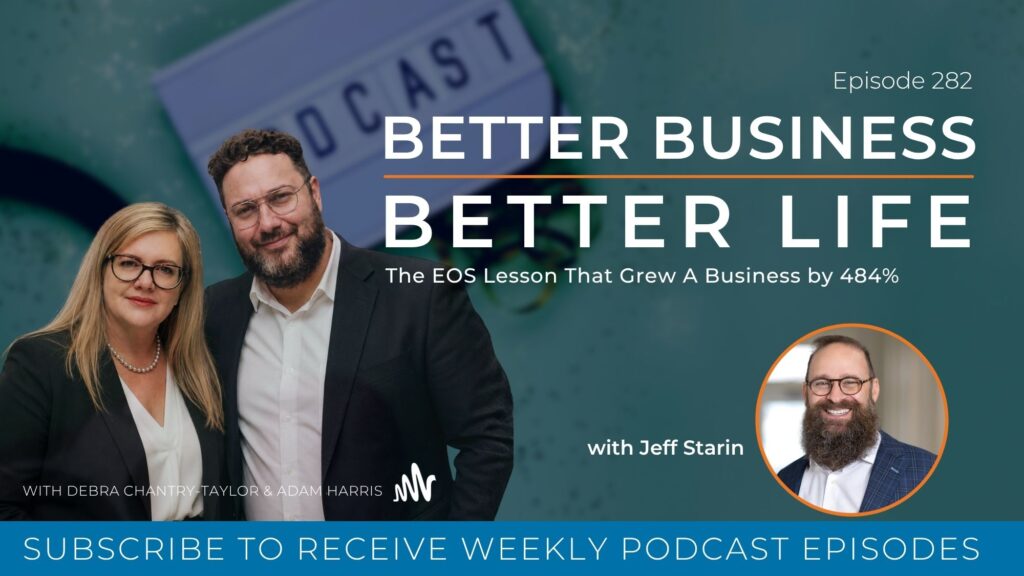
I’m your host, Debra Chantry-Taylor, and I’m passionate about helping entrepreneurs lead their best life by creating a better business. I started this podcast about six years ago, and the idea was to share stories about other entrepreneurs and how they had learned through the ups and downs of running a business. These days, I do it just because I really enjoy the conversations that I have, and today’s guest is absolutely no exception. So today’s guest dropped out of college to become a professional pool player.
He set up his business, which was a parts business purely to make enough money to open a pool hall. He’s been a yoga teacher and is now an EOS implementer. And he implemented EOS into his business. And while the business had been flat for a number of years, in the space of five years, he managed to grow his business by 484%.
So today they’re going to share with you that story, you know, how this all started, how that business grew, how they self implemented EOS, then took on board an EOS implementer, and then how they’re now an EOS implement themselves and the tools that they use to help other businesses achieve similar results. I’d like to introduce you to Jeff Staran, who is a certified EOS implementer, and also a president of the Entrepreneurs’ Organization chapter in LA. Welcome to the show, Jeff.
Debra Chantry-Taylor 00:00
You here? Really looking forward to chatting about your experiences.
Jeff Starin 00:04
Thank you. It’s lovely to be here, Deborah. I’ve been a fan for a while.
Debra Chantry-Taylor 00:07
Yeah. No, we had a thank you, that’s very kind. We’ve just been having a little bit of chat offline before we come on board as we always do. And you just told me your story and it it is fascinating and I’d love you to share that with the listeners.
Jeff Starin 00:18
My story’s a little wacky. I w went to college, as all my friends did, and it was not for me. I wasn’t prepared for it and I wasn’t well suited for it, so I dropped out to become a professional pool player. Or I dropped out and became a professional pool player is probably more apt. That was super fun. I’m glad I did it. I’m glad I stopped doing it. And at some point after a couple of years, I decided I wanted to open my own pool hall in New York.
But I didn’t have enough money. So my plan, which made total sense in my 20-year-old brain, was open a business to make enough money to open a pool hole. Right. So I did. I opened what I would generously call an auto parts distribution business, which was me in a van hustling. lube shops had just popped up. They didn’t exist a few years before that. So I was
Debra Chantry-Taylor 00:57
Yep, so far so good.
Jeff Starin 01:15
I would go find out what parts they needed, find somebody to get them from and I was just hustling, just, you know, making a living. I found a couple of niches and eventually scaled that to I still own that business. It’s thirty five years later now. But I scaled that business along the way. I did some other things. I was I would probably call it a semi professional poker player. I didn’t do it for a living, but I was a winning poker player, which I think probably one percent of poker players are, I had a guess.
So that was kind of fun. I I I stuck with that business for a long time, and at some point we got stuck. I had scaled to about five million in revenue, and we were stuck so hard. I mean, four years in a row of exactly the same revenue, plus or minus three percent. We were selling the same things to the same people at the same prices. I tried everything I could imagine, and I I didn’t know what to do. So somebody gave me a
Copy of the book Traction. I tore it apart. I was like, I need this book. Implemented EOS in my business. It was an absolute game changer. Within five years, our sales had doubled. Profit was up 484%. I remember that number so specifically. And it was it. Then I I I started to enjoy my job again. I was teaching, coaching, mentoring by people. I I liked going to work again. It was such a nice thing. And then at some point, I felt like I stopped.
Debra Chantry-Taylor 02:31
Ha ha ha
Jeff Starin (02:45.411)
learning and growing, I got a little bored and I started doing this. I became an EOS implementer a couple of years ago. It is my favorite job I’ve ever had. And this is I’m I’m it’s such a privilege to be able to do for other people what w you know was done for me some years back. So that’s how I ended up here.
Debra Chantry-Taylor 03:05
Yeah. Awesome. Who was your implementer out of interest? Josh. Okay, cool. Yeah, I love Josh. Perfect. Okay. Yeah, I see. yeah. That’s what I love about the EOS implementers. They’re all great people and we become friends very quickly. Hey, you but you did share with me that you didn’t get an implementer straight away, did you?
Jeff Starin 03:09
Josh Holtzman.
Yeah. He’s he’s a dear friend of mine actually. Yeah.
Jeff Starin 03:27
No, so I tried to self implement for I read the book and I spoke to a couple of im implementers. I think I interviewed three and I decided to self implement because of course I did, because I’m an entrepreneur and because you know, I’m not that they’re expensive. Like I yeah, they’re exp I don’t want to spend the money. I’m sure I could do this. I I tried that for about nine months and I I won’t say there was no benefit. There there were certainly were some helpful things, but
Debra Chantry-Taylor 03:40
Yeah. How hard can it be?
Jeff Starin 03:56
some point I realized this was silly. And yeah. And then I hired Josh and within almost immediately, if I remember, and this is ten years ago now, I I remember thinking to myself, yeah, this this wasn’t expensive. This is the biggest bargain I’ve ever paid for because the value is so through the roof. It was just night and day from doing it myself. So I that was how I ended up hiring somebody. Yeah.
Debra Chantry-Taylor 04:20
Yeah.
Debra Chantry-Taylor 04:24
really pleased to hear that but I’d I’d love to kind of delve a little bit into that. So lots of people read the book, get excited, decide to self-implement. And let’s let’s face it, they definitely get some benefit out of it, but it isn’t the full the full picture. Tell me wh what did you do? Like once you read the traction book, what was the first thing you kind of went to in terms of self-implementing?
Jeff Starin 04:44
So I went through building the vision, building the VTO. And I I I followed the exercises in the book, you know, as prescribed. I think if I remember correctly, the book says go off site somewhere with your leadership team. And we did that. So I mean I took it very seriously and and I did create the vision. Although, of course, looking back, I think what I created was not as potent as it as it could have been, right? Because you just don’t have a coach. Like my my long-term, my tenure target was
I don’t it was very long and there were a lot of goals and it was, you know, kind of convoluted and but yeah, you know, you don’t know exactly. So I I remember that was the first part. And then the part where I got stuck, the part where I got quite frustrated was it was the traction part. It was the discipline, it was the accountability, it was how do I get people to do the things they need to do? And that’s where it really I think fell apart for me was learning to
Debra Chantry-Taylor (05:18.334)
Yeah.
Jeff Starin (05:43.314)
to learning to get right people, right seats, I I understood. It was the accountability chart doing a good job with that and then the scorecard measurables to go along with it. How do you make sure that the people are doing the right things all the time? I I never got a handle on that until I hired Josh.
Debra Chantry-Taylor (06:02.7)
And I’m also interested because you were of obviously the visionary. I mean that’s a that’s a no-brainer. Did you have did you have an integrator in your business at that point? Or did you Yeah, okay. And was was there somebody in there that that became that role, or did you have to go outside to look for it? And and what was the aha moment when you kind of went, this is this is what we need?
Jeff Starin (06:07.515)
Very much, yes.
Jeff Starin (06:13.99)
Not at first.
That was another thing.
Jeff Starin (06:29.565)
So my I hesitated hiring an EOS implementer partially because of the money. I was like, this is expensive, right? But then I did and I was like, it’s a bargain. So then I was sitting in both the visionary and the integrator seats for a while, knowing I was not well suited for the integrator seat. But to hire somebody, I didn’t have anyone internally at that time that I thought would be good at it. And to hire somebody was gonna cost a lot. And I said, I think we could figure this out or maybe take somebody from within the organization. You know, at that point we probably had
30 or 35 employees, I think. And at some point I had that same feeling that I did before I hired Josh, which was, is this saving me money or is this costing me money by not hiring the proper person? So I ended up hiring a firm that specialized in EOS. They brought me in my first integrator. And he was great. Unfortunately, after about six months for family reasons, he had to move.
She moved somewhere and this was sort of pre COVID. So working remotely in a re it wasn’t gonna work very well. So he left and at that point, there was somebody by that time internally, and I was like, She’s the one. Like she can do it. So she and I had some conversations, a lot of coaching, a lot of confidence building, and she moved into the integrator seat. She’s been it been in it ever since, and she’s spectacular.
Debra Chantry-Taylor (07:52.665)
Wonderful. Hey, so for so for some of the listeners listening in, they may not know really these roles of visual and integrators. Do you want to br quickly describe what a visionary does and what an integrator does?
Jeff Starin (08:02.481)
Visionary drives people crazy with ideas. One of the things that we do, it’s very hard to work for for it was hard to work for me as a visionary. Visionary is the person who walks into the room with 49 ideas every day and everybody is dizzy. Like, wait, what are we doing now? What’s going on? But they’re so good at relationship. Like, that’s the person, they’re the best salespeople because they’re so authentic in the way that they communicate and the way that they connect with people.
Visionaries certainly me and and most of us, just terrible at getting things done. Like I’m if you needed a project manager, I’m the worst person you could hire to do that. I just my brain doesn’t function that way. And if I can
Debra Chantry-Taylor (08:44.174)
Yeah.
Jeff Starin (08:51.001)
One of the things that happened to me when I read traction was I always felt flawed. Like I always felt like there was something wrong. I didn’t know how to run a business well. And I couldn’t I was not a good manager and I knew that I was very kind, but I was like, Can’t you just do your job? Like why do I need to manage everybody all the time? Just go do the thing you need to do. And I the fact that I I knew that I I had a hard time driving things through to completion.
And was always on to new things. Like people would tell me that. And I remember when I read the book, I felt I’ll tear up a little bit probably. I I felt seen. I felt I said, I’m not flawed. Like I’m just this person and I need that person. So the other person, the integrator, is the person who is responsible. Like they’re the adult in the room for all practical purposes, right? Like they’re the person who
Debra Chantry-Taylor (09:47.938)
Mm.
Jeff Starin (09:51.24)
People will eventually like they’ll go to that person and they keep everything moving and running and coordinated. And that’s the person who is excellent at following things through to completion and and all the detail and making sure people are where they’re supposed to be doing the things they’re supposed to be doing. And I just didn’t have that skill set. I still don’t have that skill set.
Debra Chantry-Taylor (10:14.293)
Yeah. Well, I think it’s it’s within us, right? It’s kind of inherent. You either are or you aren’t. there are some people. I’m actually I’m one of the few people who actually scores high as a visionary as an and as an integrator, which means it has some benefits. It also has some cons, let me tell you. I have a whole bunch of stuff going on my head all the time about which personality I am. But yeah, it’s but most people are naturally one or the other, or neither. I think this is the thing that was really interesting for me is when I first read the Rocket Fuel book. I I was sitting there kind of going,
Jeff Starin (10:26.042)
Really?
Debra Chantry-Taylor (10:42.733)
I’m sort of that and I’m sort of that. And did the test. I was above, I was in the high 80s on both of them. So it’s like, my gosh, I’m I’m I’m a I’ve got a dichotomy kind of brain that’s just not not normal. but then I thought, this must be bullshit. This this test can’t be right. So there’s no way in the world this could be right. So I actually asked my husband at the time, who was an actuary. so I don’t know if you know what an actuary is, but yeah, they’re the big Boffin numbers guy. Yeah, yeah, yeah. And I said, do the test, do the test, I want to find out, you know, if this thing works. And it came back and it said, you’re nice.
Jeff Starin (11:03.734)
Of course I do, yeah.
Debra Chantry-Taylor (11:11.239)
I was like, okay, it works. it is interesting. Yeah. So I think it is it it it is a it’s a real light bulb moment for a lot of my clients is when they suddenly realize, as you said, it’s like actually there’s nothing wrong with me. I’m just really, really good at this. And I’m really not good at this. And and I think as soon as they make the decision to actually get an integrator in, that’s when the business starts to change in terms of
Jeff Starin (11:14.213)
That’s interesting.
Debra Chantry-Taylor (11:37.525)
It’s a relief. It’s like you’re I’m not not immediately, nobody lets go immediately ’cause we’re all control freaks, right? But but once you do finally let them run the business, it just becomes easy, doesn’t it?
Jeff Starin (11:47.882)
It’s very interesting because i you know, we build a business and I think we all convince ourselves, I certainly did, that the business was successful because of me and because I was involved in everything. So delegating becomes hard. And I thought I was delegating, but I really wasn’t. I was still all over everything. And when I eventually learned to delegate, what I what I learned was which I talk to clients about a lot is
70% of the time when I would delegate to somebody else, it was fine. Like maybe they didn’t do it as well as I did, but not everything needs to be done perfectly. Everything needs to be done, or I would give them a little feedback and it was fine. And then about five percent of the time, it was a problem and I needed to be involved. Very rarely. It was like, I think I need to be involved in this ongoing. Maybe it was a big relationship with the big customer or something like that where I I
I said, yeah, I I need to be there. And about twenty or twenty-five percent of the time, they did it better than I ever would have. And I I it hurt my ego. Like somebody would come in and do something I wouldn’t let go of. And I was like, she’s doing a much better job than I ever did. And it was like that was such a startling thing for me because I was so convinced that the business needed me. And turns out a lot of other people are pretty smart and capable.
Debra Chantry-Taylor (12:53.833)
Yeah.
Debra Chantry-Taylor (13:08.757)
Mm-hmm.
Debra Chantry-Taylor (13:13.259)
Yeah. And I think in the beginning that’s a bit of a blow to our ego though, isn’t it? Because you know, we we’ve we’ve kind of built this thing up that we’re the best at it. And I always say, you know, I’m I’m perfect. I’m the only person in the whole world is perfect, but I am perfect. And nobody can live up to this like, damn it, I’m actually not. And th you’re right, there are people who do things way, way better than me. And but it in the yeah, but in the beginning it’s hard.
Jeff Starin (13:30.854)
Way better.
Jeff Starin (13:35.472)
It’s very hard. You know, I I I I think on my website it says something like, I built a business that was really good at one thing, which was needing me. Like if everybody’s coming to you all the time for everything, it’s because that’s how you built the business. That’s what I did. I was like, there’s another way. And it was just such a light as I as that sort of unfolded over over the course of a couple of years. It was magical, really.
Debra Chantry-Taylor (14:05.759)
Yeah. we’ve got a we’ve got a a sister business that does fractional integrators, fractional sort of C suite level people and also training and stuff and one of the the the the books that I’ve written for that is about the visionary being the bottleneck and I I think it’s something that most visionaries can relate to. But they but it’s almost like our blind spot, right? we we need somebody to we need something like the traction book or an implementer to point it out to us. It’s like, of course, that’s what’s going on.
Jeff Starin (14:31.309)
I have I literally had a conversation two hours ago on the couch that you can see behind me with with a a wonderful person who we’re talking and that’s exactly it. He he’s telling me everything going on in this business and I said, So you’re the bottleneck and he just paused and he said, Yeah, I guess I am. I was like, You have to get out of your own way, you know. Like we can talk about this. It’s it’s so common.
Debra Chantry-Taylor (14:36.631)
Yes.
Debra Chantry-Taylor (14:58.891)
Yeah. Okay, so you you once you recognize that and once you, you know, bit the bullet and and spent some money on an EOS implementer and started implementing EOS property, which again, I mean we’re all the same, right? So why would I spend that money when I can probably do it myself and and it’ll be okay? but as you said, it usually returns in spades in terms of the investment. But what was the what was the first thing that Josh did with you and the team that was you know, I guess a a game changer for you?
Jeff Starin (15:18.407)
Yeah.
Jeff Starin (15:27.291)
Man, this was so long ago. You know, I it was actually during the first day. It was during focus day. I remember when we were working on the accountability chart. Now, we had done the accountability chart and I thought it was fine. And I remember when he walked us through and he he said, throw away the one you have, let’s just do it fresh. If it ends up the same, we’re just confirming that that was the right accountability chart and hit home so hard that none of you have a job right now. I know that’s scary.
What’s the right structure for this organization down the road? Right. Six to twelve months down the road. Forget that you have a job. And imagine you don’t work here and you’re a consultant looking at this business with everything you know. And the accountability chart looked so much different than what we had because all of a sudden we’re having conversations where we were able to separate ourselves, which when we did it ourselves, we were not. You know, it was, well, we need a seat for Linda because Linda does this and she’s so good at that.
And there was there were a lot of things like that where he came in, forced us out of that. And the minute we would bring up anyone’s name, he would, you know, no, no, no, no, no names. And of of course, like now I know because I I do this for clients and it’s wonderful, but I I that was our accountability chart changed a lot. And that happens, you know, right away on day one. So I I remember that. it
Debra Chantry-Taylor (16:38.209)
Yeah.
Jeff Starin (16:54.469)
I I it didn’t take me very long. I think it was the end of the first day that I realized this was a good investment. Like I I I said we need the coaching because, you know, in addition to walking us through things, it was it was the coaching, it was the conversation, it was us having conversations we hadn’t had before because I ran the conversations and everybody went through essentially my my lens or they would let me r railroad things through.
Because I was the owner and I was the one doing this. So we’re gonna do EOS now. So I don’t think we really had e an even exchange of ideas. And when he came in the room, it was very different because now we had an even exchange of ideas and things look quite different. The core values look different, like all of it. So him being there allowed me to to really lean into the the brains of
the rest of the team in a way that didn’t happen when I was the one leading it.
Debra Chantry-Taylor (17:54.286)
And I think that’s the challenge, isn’t it? Because you know, as visionaries, you you said earlier, we’re great at relationships. We’re also particularly persuasive, right? We’re very, very good at bringing people on on our way of thinking and we’ll we’ll we’re like a dog with a bow, so we don’t let go of it. So if you’re trying to actually run the business, run the session, be a participant, I mean you’re you’re pretty much just you’re still taking control and you’re you’re people are afraid sometimes. No, not not afraid.
maybe a bit nervous about challenging that because you know you you’re you are the owner, you’re the person who’s kind of you know steering the boat. Whereas when you bring somebody external in, they are able to allow you as the owner, as the founder, to actually participate as well, not just be the person driving it.
Jeff Starin (18:38.031)
Absolutely. Also, you know, we’re we’re also the people who sign the paychecks. So it it takes a certain amount of it takes a certain amount of trust for them to be willing to say the thing that they haven’t been saying. Right. And and again, that’s what we got that we hadn’t had before is s somebody building the trust, which took a little bit of time for people to say, Jeff, I think you’re wrong. We’ve been doing this this way for a while, but I think you’re wrong.
Debra Chantry-Taylor (18:42.933)
Yeah.
Jeff Starin (19:07.575)
w that didn’t really happen a lot before. So I I I think there’s a lot of value in having a third I mean, look, we could have graduated after two years and I think we employed him for six years or something until until I became an implementer and started doing it. And there’s a reason. I mean we it was great to have a third party in the room, a neutral third party.
Debra Chantry-Taylor (19:07.777)
Yeah.
Debra Chantry-Taylor (19:22.274)
Yeah.
Debra Chantry-Taylor (19:28.373)
Yeah, I completely agree. Okay, so I mean I think the accountability chart is one of my favorite tools. I think it’s one of the things that as so I I talk about self are we self-implementing or self-inflicting? And I think and that came from a a a client a potential client of mine when I was having a conversation with them, they said we’ve been self-implementing, or perhaps we’ve been self-inflicting for the last couple of years. And it’s like, okay, great, let’s let’s explore that. I do, I I love it. I use it all the time now. And it’s like actually, you know, when they said self-inflicting, what they meant was, yeah, they had done some of the tools, but they hadn’t
Jeff Starin (19:45.821)
I may use that. That’s great.
Debra Chantry-Taylor (19:57.752)
really done them properly and so and the accountability chart is probably the one I think you’re right doesn’t get done well. Anybody can put together a VTO. Sure it’s a bit verbose, sure it’s a bit over the top, but at least it’s something rather than nothing. The accountability chart, if you don’t let go of those egos, if you don’t let go of the people, if you don’t let go of the roles, you’re just creating a structure based around the people you’ve got. And if if you know, if nothing changes, nothing changes.
Jeff Starin (20:22.535)
Right, right, right. Yeah. And I remember we did it. I had vice president of sales in that seat. Like I kept the titles, which is one of the things of course that we do away with, right? So I think there are a lot of ways having someone with the expertise helped free us up to be so much better.
Debra Chantry-Taylor (20:37.261)
Yeah, perfect. Okay, so I mean a big number, four hundred and eighty-four percent. I wrote that down. That is massive. So if you think about return on investment, I mean this is the biggest challenge, isn’t it? When we s we look at it, we kinda go, my goodness, it’s gonna cost us X amount of money per year to have this implementer in here. it’s a huge amount of money. But I’m guessing that four hundred and eighty-four percent growth more than paid for the implementer.
Jeff Starin (21:00.399)
I you know, it’s hard because I I don’t one of the things is I you can’t for you can’t sell this to people really. Like it’s not a service that you can sort of sell people because if they don’t want it, it’s never gonna work. Right. And it’s hard sometimes because when people balk at the cost and I I wanna say to them like if and I have said this to people if you don’t get back twenty times my fee and enterprise value.
minimum, something’s gone horribly wrong. Like horribly wrong, you know, but it it it’s hard for people to imagine that because they can’t see the value until they get in the room and from the first session every single time they’re like, I get it now.
Debra Chantry-Taylor (21:45.484)
Yeah, it’s so true. Yeah. But they s but you’re right there, but they have you have to want to do it, don’t you? Because it this is not easy. I mean it it’s simple. We always say it’s simple, but it’s not easy. And it is simple. The tools are beautifully simple, but there is a fundamental shift that you have to make in the way that you think, in the way that you operate, in the way that you as a team, you know, work together. And if you’re not prepared to do that, no nothing will make it happen.
Jeff Starin (21:46.043)
Right. It’s yeah. It’s such an interesting cause it’s it’s very unique.
Jeff Starin (22:14.247)
Yeah. Yeah, it’s a lot of work. And and I’m not doing the work for you. Right.
Debra Chantry-Taylor (22:16.94)
Yeah.
Debra Chantry-Taylor (22:20.557)
Yeah. Yeah. So so you you shifted from, you know, obviously bit well, you’re still an owner of the business, but you shifted into being an EOS implement. You’ve been that for a couple of years now. what has been the biggest joy most joyful moment for you in that two years?
Jeff Starin (22:38.205)
I had a client a few months ago call me crying because they hit a milestone that they never thought they were gonna hit. And she called me in tears and then I started crying. And she was just, you know, all the thank yous and you know, giving me credit, and you know, I I I and not to minimize the importance of what we do, but I was like, you guys did all of this. Like I helped facilitate the conversation, but.
know, I’m in the room and I’m kind of part of the team, but you guys did this. But her calling me in tears was it it was a and and it’s happened before, but there was something about this call, because this was somebody who was really didn’t think that the business had legs and was concerned about that when we started working together and all of a sudden things started just moving up, and it was it it was so nice to be part of that journey with them. So that’s I had a friend who
Who’s a massage therapist? And she makes no money and she struggles. It’s very expensive to live here in California. And she struggles. And I remember a few years ago asking her, I said, why don’t you get another job? Have you thought about doing something else? Because I know it’s hard. And she said, Of course. She said, but people are happy to they’re happy when they come to see me and they’re happier when they leave. And I don’t know of any other job where that happens.
Like my days are wonderful. Everyone’s always happy to see me. And they’re happier, you know, I w where am I gonna find that? So I sacrificed the financial for this. And one of the things I love about this job is that it’s very much the same. The teams are so happy to see me. You know, there’s hugs when people come in. It’s like the it it it’s even when things are hard, they’re happy to come in.
And they’re happy when they leave. Even at the end of a long day, their brains are tired. You know, we’ve really gone through the rigor on some things sometimes. But I there’s there’s something about being part of that for people that’s just I it it’s every session. I yeah, I just I love the the the I love being on the journey with the people. Does that make sense? Like it’s
Debra Chantry-Taylor (24:42.911)
Yeah.
Debra Chantry-Taylor (24:50.507)
Yeah. it makes perfect makes perfect sense to me. ‘Cause I I was sitting here kind of going, My heart is singing. It’s like I’m the same. It’s like, you know, and you get the little you get the phone calls or the text messages and it’s like it it’s just you’re right, they do all the work, but isn’t it wonderful to kind of be part of that journey with them and to to share in the successes? But also we’re there when things get tough for them as well. You know, it you know, it’s not all it’s not all a bed of roses as oftentimes when I get the phone call, it’s like we really need to have a quick chat to you and you know, it being able to
to share with them the tools. I think what I love about the US tools is they often take the emotion out of things. And so, you know, you get somebody who rings up very emotional about something that’s going on in the business. It’s like the answers in the tools. Let’s work through the tools. Let’s see what we do with this. And at the end of it they kind of go, wow, you know, that was it took all the emotion out of it. And now I have a clear understanding of what needs to be done.
Jeff Starin (25:26.791)
Hm, yeah.
Jeff Starin (25:41.636)
One of the biggest gifts, people don’t talk about this enough. One of the biggest gifts that I got when I was running my business from the tools is having a way to have difficult conversations much easier because now you have all this stuff you can point to. You can point to the rocks, people’s you know, that they’re not doing well, or core values, or you know, the scorecard, whatever it is. Like there are so many ways that you get input into how people are doing that it makes it
more black and white when somebody’s not the right fit. Where previously I remember you’d be like, you know, Bob’s not the right fit, but I couldn’t say why. And I the conversations were hard. And like one of the biggest gifts I got was having the clarity of knowing what I need to talk about in that conversation. Cause now it’s not about us, it’s about this stuff. We’re looking at this data together. Right. And and to me that was it I I at that time in my life I was very
Debra Chantry-Taylor (26:34.006)
This yeah.
Jeff Starin (26:40.571)
I I I was not skilled at having difficult conversations. So it made that so much easier for me.
Debra Chantry-Taylor (26:47.498)
Yeah, completely agree. So do you have a favorite tool? A favorite EOS tool?
Jeff Starin (26:52.08)
dear.
my I think IDSing, I think prob the way we problem solve, one of the things I love most is teaching teams how to identify issues because it takes most teams really I would say typically nine to twelve months to get really good at though this is the issue in in one sentence.
Debra Chantry-Taylor (26:59.308)
Mm-hmm.
Jeff Starin (27:22.577)
Because normally, you know, people, you know, okay, what what’s the problem? And like here’s the cadence. It’s so funny. There is an exhale followed by a long so. They go like, okay, well, Deborah, tell us what the problem is. And they go, so. And they go the whole story, right? And and I teaching t it’s one of my favorite things to do. I make it a game. I go like interrupt each other and help each other figure it out. Like you you do this as a team.
And you’ll all get better at identifying the issue. And my teams get so excited when they get good, they’ll call me sometimes, or you know, I’ll observe an L10 and I’ll see how they’re doing. And then six months later I’ll do another one. I’ll go, man, you guys are crushing it at this. But teaching people how to do it, it’s so freeing for people because now their conversations become super potent. Where before they were very rambly and didn’t go anywhere. So I I my favorite.
Debra Chantry-Taylor (28:14.336)
Yes.
Jeff Starin (28:19.833)
I think that’s probably my favorite thing is teaching people how to do that.
Debra Chantry-Taylor (28:23.68)
And you’re right, it does take nine to twelve months on to really get it because and as you know, we sit and we observe level ten meetings and sometimes you you you sitting there going, my goodness, you know, how how can you not get this? And and we forget because we’re doing it all the time, but it is a it’s a muscle. It’s like going to the gym. You have to work on it, you have to really use it all the time and really get good at it before well, get repeat it often so that you get good at it.
Jeff Starin (28:46.801)
I you know, I always I I I tell people, so for those who don’t know, so for EOS implementers, we get together every quarter, you know, as you know for QCE, and we have gatherings. And I I wish we could show people our problem solving because we will put issues on the board and as a group of implementers, we’ll get through seventy-five issues in an hour and a half at QCE, and it’s just boom, boom, boom. Are you solved? Great, move to the next one. And people can’t imagine that you can solve issues that quickly.
They think you have to just go on and it’s like, no, no, no, no, no. If you tee it up clearly and if you stop the conversation when you have what you need, you guys can cruise through so many issues in an hour. It’s unbelievable. So I I have a real passion for that because I cannot stand boring meetings and I cannot stand hearing people I shouldn’t say I can’t stand hearing, but it it’s just when people haven’t learned the skill of brevity with regard to being able to to to get down I
Debra Chantry-Taylor (29:33.937)
Ha ha ha ha.
Jeff Starin (29:44.764)
So before I did this, I spent several years studying it’s called Lean, you know, Toyota Production System. Right. I spent s I I I study with with L E I Lean Enterprise Institute. And I was so involved in that community, which is all about boiling everything down and what’s the issue and ask why five times to go get to what the real issue is. And there’s so much of that in this.
Debra Chantry-Taylor (29:49.856)
Yeah, no, late yep, late methodology, yeah.
Jeff Starin (30:11.417)
Right? Like what’s the issue? the customer satisfaction is down. And you go, Well, why? well, ’cause last month thirty percent of orders left late. so the issue is not the customer. Why did thirty percent of orders go out late? well, because there’s a new warehouse supervisor and he’s not training people on the process. Well, that sounds like an issue. What
What’s happening there? You know, you you dig down and you go, well, the the the supervisor said the process was broken, so he told people to not follow it. I said, Well, so now you have a few issues. The process is broken. The supervisor is unilaterally telling people to not follow the process. Nobody knew that. He didn’t ask anyone, and there was no way to track whether or not they were following them. Like, you go, we actually have three issues here we need to solve. And they go, yeah, instead of customer status down.
Debra Chantry-Taylor (30:34.814)
Yeah.
Debra Chantry-Taylor (30:58.122)
Mm. Casmoserve, yeah, yeah, yeah, yeah.
Jeff Starin (31:02.233)
Right. So you know, teaching people to do that it’s so much fun and and people get addicted to it because it they start to see how much faster things move.
Debra Chantry-Taylor (31:11.884)
Mm-hmm. And it’s not just why questions, it’s all the W questions, isn’t it? I I love sort of, you know, so when did this start to happen and who is it affecting and why is that? And it’s like, you know, you start to ask all these questions, because I think a lot of people can I the classic one I see coming into a lot of meetings is like, you know, sales are down, it’s marketing’s issue. And it’s like they’ve they’ve automatically jumped to the issue. and potentially that they’re now going to just start discussing a solution, but they haven’t really got to the issue at all. And so
Jeff Starin (31:19.577)
Ha
Debra Chantry-Taylor (31:38.965)
I love teaching that yeah, ask the question. So, you know, why is that? And when did it start to happen? Who is it affecting? And what impact is that having? And why is that? And then you suddenly find out that it’s actually they put a new CRM in. They didn’t train the sales reps. The sales reps are now spending way too much time doing, you know, work in in putting things into the CRM. So they’re spending less time face to face with customers. guess what? The issue’s got nothing to do with marketing and leads.
Jeff Starin (32:04.125)
So crazy. And the other thing is so one of the things they teach you in Lean, which I talk about here as well, is there’s an expression, go to the Gemba. The Gemba is the floor where things are happening. So a lot of times I’ll see leadership teams trying to solve problems. And I will say, can this problem be solved here? Do you have the people that you need to have in the room to solve this problem right now? Because sometimes they don’t. And sometimes it’s you need to go out to where this is happening and have the conversation there with the appropriate people.
Debra Chantry-Taylor (32:26.271)
Mm-hmm.
Jeff Starin (32:32.827)
Right? Be because sitting in at a conference table in a room far away from where the work is actually happening, sometimes you don’t have all the information that you need.
Debra Chantry-Taylor (32:41.484)
True, so true. Yeah. Okay. I yes, it’s a it’s a p it’s a brilliant tool. Again, I love I love all the ES tools. They’re all very, very simple, but it they it there is they take time to get right. Even the level ten meetings. I mean you can get results instantaneously from the level ten meetings. Even the first meeting changes the way that people run meetings. But it it does take time for it to to get really good at it. and then the more you get good at it, the better the results.
Jeff Starin (33:06.513)
And then the more people look forward to it and stop saying, I hate meetings. Right. So they get good at L10s and then I start coaching them to get rid of their one-on-ones, which they think is the cra it’s blasphemy. And I and I will tell them, like, if you want to get a third of the work done in three times the time, you know, keep doing your your one-on-ones. But like, what’s the point in a regular weekly one-on-one? I don’t get it. And they start to see after a while when the L tens are running really well.
Debra Chantry-Taylor (33:08.95)
Yeah. yeah.
Debra Chantry-Taylor (33:29.803)
Yeah.
Jeff Starin (33:33.841)
those will just drop off and then they become sporadic with with purpose, which is great. You know, specific coaching on something, sure. But I think that’s also one of my favorite moments is when they they come back and they go, yeah, I was able to eliminate a bunch of my one on ones. Awesome.
Debra Chantry-Taylor (33:38.528)
Hmm. Yeah.
Debra Chantry-Taylor (33:49.613)
Actually let’s go a little bit deeper on that because it’s one of the issues I see a lot in the beginning and you’re right, people don’t want to let go of it. It’s like, but if I don’t have one-on-one time with them, you know, I won’t be able to help them. It’s like, let’s so talk me through the process of, you know, implementing level ten meetings and why it gets rid of one-on-ones.
Jeff Starin (34:11.845)
So I think well so there’s okay, just two questions there, right? So the process of implementing it is having everybody understand that we are now gonna have this meeting with the team. There’s gonna be a very clear agenda we’re gonna go through every time. The agenda will not change. We are gonna look at the same data every single week, and we’re not gonna talk about it at the moment. We’re just gonna we’re gonna report the data and then figure out what issues we need to talk about, right? So, you know, one of the things that
I talk to clients about is that
There are most people are trained in most businesses to not bring up issues. They’re just trained out of it because you bring up an issue and then either their manager will say, you know, go fix it and I don’t want to hear about it. Or the manager will then have you fix it and then take credit for it. Or, you know, there’s so many things that happen where people are not encouraged to to raise issues. And one of the most important things is I say to people, no, no.
Pick up the rug and shake it out. You want to know all the issues because you cannot fix them if you don’t know what they are. But it takes a long time to train people to be comfortable. It requires a lot of trust for people to be able to put issues on the issues list. So one of the things for the L10 that’s really important is creating a culture where people are comfortable doing that. Because we spend most of the time in that meeting, you know, problem solving, but that’s only going to be as good as the problems you’re bringing to the meeting. Which so
W when we teach the L10, right, we’re gonna review all that critical information that we all agree is important every week, and then we’re gonna problem solve. Well, what’s the point on one-on-ones? The point of one on ones. I it depends because in different companies it looks different. But a lot of the coaching that happens in one on ones shouldn’t be done on it, should be done as a team. Because if there’s a message I have for you, it’s for everybody.
Jeff Starin (36:08.985)
Jensen from NVIDIA talks about this. He’s got 70 or 80 direct reports. And people go, How do you do that? And he says, I have no one-on-ones. Anything, anytime I need to talk to someone, I gather everybody and I tell everybody what it is I have to tell this one person. And you’re like, so when you can get a level of trust where you can talk about all these things as a group, the one-on-ones go away. You know, one of the one of the awesome
Core values that one of my clients has, or not core values, scorecard items, is zero gossip. That’s a scorecard item. And like it’s really important to them. And if they hear any gossip, it’s not zero that week, right? And they talk about it. So, you know, when you can create a culture of trust, well, now all these conversations become public. Everybody learns from every interaction. Now, there are times
Debra Chantry-Taylor (36:45.696)
Ha I love it, yeah.
Jeff Starin (37:04.155)
it’s appropriate to pull somebody aside. You know, maybe they need some coaching on something. maybe there’s a sensitive issue that you wouldn’t want to talk about. And for like of of course there will be times for that. But ongoing one on ones, I good L tens do away with them. They do not need to be on the calendar regularly. I mean, what’s your experience with that?
Debra Chantry-Taylor (37:24.01)
Yeah. very, very similar. And I and the same sort of thing I always sort of say there’s usually a learning for the group in any issue that is being discussed in a one-on-one. So why wouldn’t you bring it to the table and discuss it as a team? and even if it is coaching a little bit of that individual in that environment, then it’s still a learning for everybody else about
how to do that and what the issue is and how you can solve it. So I think it yeah, I completely agree. And if you think about it, you know, let’s just say you have six direct reports and you’re doing a one on one every week, an hour with each person, that’s six hours. You know, that’s about the time we have to spend on rocks. So imagine having another six hours available to kind of work on your the rocks, the things that are really important that move the business, rather than the one on ones, which I I think just become just a habit.
If it’s it’s become a habit, we do it and we often don’t question why we do things.
Jeff Starin (38:16.923)
It’s a habit and and also my experience is that there’s a social element to it. I have a lot of teams where it’s their time to connect. So then we’ll call that out and say, Okay, well, is there another way to do that? Instead of wasting an hour of both of your time every week where you’re you know, purportedly talking about business, but really you just want to chat. Like what if you took fifteen minutes to just go get a coffee and sit down for a little while and connect? Would that solve it? And I’ve actually had a fair amount of clients where that works.
But it’s just a social gathering for them in some way.
Debra Chantry-Taylor (38:50.988)
Mm yeah, it’s very true. Okay. I always ask for our guests to kind of give no, I’ve got another question for you. That’s right. Session room. I’m looking at your beautiful session room behind you. And yeah, and I wanted to talk about this because for me I from very, very early days of being an EOS implementer, I wanted to create an amazing experience in my session room. And I do get clients sort of say, But why do we have to come to you? Why can’t you come to us? Why can’t we do it in our boardroom? You
Jeff Starin (38:59.503)
yeah, yeah. thank you.
Debra Chantry-Taylor (39:18.604)
clearly have a beautiful session room as well. So I’d love you to answer that question. Why why would we come to you and not do it, I remember?
Jeff Starin (39:26.907)
Why do you go when you take martial arts to the dojo? Why do you do it there and not somewhere else? Right? Like this is my space. It is it is so intentionally designed to be to to do this exact kind of work. So what you can’t see on behind the camera is I have my beautiful conference table, these incredible chairs, I’ve got a huge interactive vibe board there, and I’ve got whiteboards, right?
So everything about this room, the the lounge area behind me, there’s a kitchen, you know, and I’ve got books, I’ve got all the supplies people need, but
You know, your office has baggage. Like it’s time you realize that your office has baggage. There’s no baggage here. This room has no memory. Right? Coming to a dedicated space off-site that I have cultivated, it I’m a better implementer here. Yes, I travel and I do some sessions for people elsewhere. more and more I have now.
90% of my sessions here. Eventually it’ll probably be a hundred, other than maybe the annuals where I agree to travel to fun places with people. But there’s something about the energy in the room. Like people come in, they’re comfortable here. It’s fun for them to come off site and it’s a very calming room. I you know, it’s it it this is set up the way that I wanted it to set up.
The way I wanted it to be set up for clients to have a certain feeling when they walk in. So like Will Godara and, you know, unreasonable hospitality. I went through that process of every single touch point I have from the moment they walk into the room to, okay, well, when they need to go to the restroom, what does that look like? And the kitchen and the coffee and the chairs and the like I thought about every element of their experience when they come in. So we could do that, or we could go to a Hilton conference room. You know, like I
Debra Chantry-Taylor (41:27.551)
W white and boring as batshit. Yeah.
Jeff Starin (41:27.589)
Your call, right? I mean, you know, the color, the walls are terrible, the chairs are uncomfortable. Like I I’m in my element here. This is where I work from. I’m better. You’re gonna be better. You’re you’re gonna enjoy coming here. So I have teams who are an hour away and they’ll spend the night in the hotel the night before just to i what you also can’t see on this side is about twenty feet out of the door, it’s water and boats. Like it’s incredibly beautiful here. And I
Debra Chantry-Taylor (41:34.607)
yeah.
Debra Chantry-Taylor (41:52.524)
Yeah.
Jeff Starin (41:56.792)
I you know, I have had people hesitate and I say, just come once and then make your decision. Because I know everybody comes and wants to coming back. It’s just it’s so intentionally set up. I put so much thought and care and love into this place. So I I’m sure you did. I’m sure every implementer has a session room has.
Debra Chantry-Taylor (42:15.593)
Yeah, yeah, absolutely. And you’re right. It’s like if you’re working with an implementer and they’re in their own environment, they they do tend to perform better. But it is a I mean, I ha I have just like you do, I’m sure, but you fully s a proper coffee machine. We have fully stocked snacks and things and you know, I’ve got clients who come in and they they’re just like, we love coming here ’cause we get to eat all these snacks and things. It’s like great, yeah.
Jeff Starin (42:35.759)
Okay, can I I ha I have to tell you something funny. So I have, yeah, all the snacks, drinks, I have super automatic coffee machine, all that stuff. You open the fridge, I’ve got sparkling water in eight flavors, and they’re all lined up so all the labels are straight. It’s very calming for people. But I have to tell you, if you want to see adults get excited, more excited than kids, after we finish setting rocks, which people can be really tired after we set those priorities and sort of emotionally exhausted.
Debra Chantry-Taylor (42:49.41)
yeah.
Jeff Starin (43:05.549)
I have ice cream sandwiches in the freezer and I tell everybody it’s ice cream You will never see adults get more excited when they go ice cream sandwiches and you go, Yeah, ice cream sandwich more so than kids, I promise you. It’s amazing.
Debra Chantry-Taylor (43:07.796)
Debra Chantry-Taylor (43:19.627)
I love it. I love it. And that’s and I think you you and I are probably quite similar. I think it becomes for me, my my session is my big kids’ room as we have we have fidget spinners and we have I don’t know. I’ve never seen so many grown men obsessed with fidget spinners and things on the table. It’s like and they have they have competitions like they’ll actually both spin the the fidget spinner to see who can make it go the longest. It’s like, come on guys, you’re in your fifties. But great.
Jeff Starin (43:45.918)
I’ll I I should yeah, we should we should talk about all the things we have ’cause right near me I have the the the you know, the little I don’t have fidget spinners but I have other things for people to play with and all yeah, all different kinds of things. And man, people g you know, they’ll start they go, what is this? Where do you how you know, it’s like between that and the ice cream sandwiches, yeah, it’s a playground.
Debra Chantry-Taylor (43:57.107)
Squishy things. Yeah.
Debra Chantry-Taylor (44:05.675)
I know.
So there you go. You’ve got to use an EOS implementer because we’re going to return a great deal of money to your bottom line. And we and we have these amazing session rooms where you get ice cream sandwiches, fidget spinners, and decent coffee. Yeah. If that doesn’t sell you, nothing will. perfect. Hey, we could probably talk all day, but we don’t have all day, sadly. I always ask my guests to kind of share three top tips or tools because
Jeff Starin (44:15.965)
Totally.
It’s so true though.
Debra Chantry-Taylor (44:33.929)
I love the the the inspiration that comes from listening to stories, but I don’t want you to leave here and not have something you can actually do with it. So I know you’ve prepared this and I know you had to shrink it down to three. So would you mind sharing those with us, Tiff?
Jeff Starin (44:47.057)
I think so. The first one is your business will move at the speed of the decisions that you make. I see so many people who hem and haw on things. And like Bezos very famously talks about two way doors. Right. He says, like, if it’s a two way door, if you can rever just make the decision move. Facebook famously said move fast and break things was their mantra when they opened, right? Like Bezos hated Amazon Prime.
He hated it. He thought it’s terrible idea. And they said, Yeah, but there’s no cost. If we try it and it doesn’t work, it’s a two-way door. And he said, Great, try it. It was a great idea, right? But it was simply the fact that it was a two-way door. We can move through it. And if we didn’t like it, we’d just end Amazon Prime, right? Most decisions are two-way doors. The faster you move, the faster your business moves. So that would be number one.
Debra Chantry-Taylor (45:22.933)
Well, yeah.
Jeff Starin (45:39.44)
The second thing is, I urge people to know the difference between how you make money and what people are paying you for. Those are two very different things. So if you go to a a restaurant, you’re making your money primarily, typically on booze. Maybe or maybe not on food, but on alcohol, you certainly are. That people aren’t paying you to pay five times the price of a bottle of wine. They’re paying you for
Ambiance, they’re paying you for the experience, right? I had a friend who had a company, little tracker devices before AirTags were around. He built up the company, sold it. He did very well. And he told me one time that his conversion rate, he said, one in 20 people who went to the website made a purchase. I said, one in 20? Are you kidding me? How did you do that? He said it all changed when I realized I was always selling people on this idea that.
Debra Chantry-Taylor (46:10.557)
Experience. Yeah.
Jeff Starin (46:36.485)
You wouldn’t lose your things. And one day I realized what people were really paying me for was a peaceful morning. You could have breakfast with your kids knowing you weren’t going to lose your car keys or your wallet when you needed to run out and take them to school. They were paying me for a peaceful morning. I was selling them a tracking device. Right. So I think knowing the difference between how you make money and what people are paying you for, and we could talk about what we do. It’s the same thing. What are people paying us for? Right? It’s it’s not.
Debra Chantry-Taylor (46:52.522)
Peaceful.
Jeff Starin (47:05.009)
The tools specifically, it’s to reduce their suffering. It’s to get out of chaos, to experience their business from a place of peace and success. Right. So it’s the same thing where yeah. So that’s the second thing. the third one, which which hands down I think is more important than any other thing I could say, is happiness is on the other side of a handful of conversations that you’re not having.
Debra Chantry-Taylor (47:36.932)
Yep. I’m writing that down.
Jeff Starin (47:40.657)
Happiness is on the other side i of a handful of difficult conversations, ’cause they’re hard.
Debra Chantry-Taylor (47:43.108)
conversation conversations you’re not having. Yeah. Nobody ever says I I wish I’d kept that person longer, do they?
Jeff Starin (47:47.503)
Right. And if you’re willing to have those
Jeff Starin (47:53.211)
I I mean in every aspect of your life, like if you’re willing to have the difficult conversations, happiness is right there. But it’s it’s hard, you know, professionally and personally.
Debra Chantry-Taylor (48:05.951)
That is absolute gold here. So you’re right. So yep. Speed of decisions, that is the speed that your business will move at. know the difference between what how you make money and what people are you’re paying are paying you for. And then happiness is on the other side of the difficult conversations you’re not having. Jeff, that is absolute pure gold. Thank you. I love it. I love it. Hey, look, I’m probably gonna get you back on the show again because I think there’s so many more things we haven’t covered yet. But for the for now, unfortunately, we’re gonna have to say goodbye because we are running out of time, but
Jeff Starin (48:23.656)
Thank you, Deborah.
Debra Chantry-Taylor (48:35.979)
It’s been an absolute pleasure to chat to you. I love the fact that you I know you said your parents didn’t love it, but I love the fact that you left school in order to and then became a professional pool player and your dreams of opening a pool hall. I do have to ask though, do you ever want to open a pool hall or has that idea completely disappeared now? No?
Jeff Starin (48:52.047)
Never. No. I I I pass, but there’s one here in town where I live and I pass by every once in a while and go, I should buy that pool hall. And then I go, Mm, do I really want to run a pool hall these days? No, I don’t. I I I never I never did it and I ended up retiring from playing pool in my late twenties anyway. So but it it it was the thing that prompted me into the life I have now. So
Debra Chantry-Taylor (49:01.685)
Yeah.
Debra Chantry-Taylor (49:05.865)
The answer is no, okay.
Debra Chantry-Taylor (49:15.907)
into business. Yeah, which is absolutely fantastic. Hey Jeff, look, thank you so much for sharing so open, so honestly, for having a lot of fun. I really enjoyed it. thank you for your time.
Jeff Starin (49:25.521)
Deborah, this was great. Thank you so much.
Debra Chantry-Taylor (49:27.977)
Thank you.
=======================================================================================================================================================
Debra Chantry-Taylor
Certified EOS Implementer | Entrepreneurial Leadership & Business Coach | Business Owner
#betterbusinessbetterlife #entrepreneur #leadership #eosimplementer #professionaleosimplementer #entrepreneurialbusinesscoach
Certified EOS Implementer New Zealand
Certified EOS Implementer Australia
Certified EOS Implementer UK
Certified EOS Implementer NZ