

Top Tips from Nathan James:
1. Reduce Key Person Dependency In Your Business:
“Having a business that is dependent on any single person, whether it is you or someone else, is a significant risk. If everything relies on one person’s knowledge, reputation, or ability to deliver, the value of the business decreases because buyers see that as a risk. Build systems, develop your team, and create a business that can operate successfully without one person being the centre of everything.”
2. Make Expectations Crystal Clear When Hiring:
“Recruitment success comes from being upfront about what you expect from people. Too often, businesses get caught up in the “fuzzy wuzzies” of hiring and focus on whether someone seems like a good fit, only to discover later that expectations were never clear. Front-end everything: define the role, explain the standards, outline the responsibilities, and let people actively choose whether they want to commit. People like knowing where the goalposts are.”
3. Iterate Quickly And Keep Learning:
“Business is a skill that can be learned, but you have to keep testing, experimenting, failing, and improving. The faster you move through the learning cycle, the faster you grow. Don’t wait for everything to be perfect before taking action. Make small bets, learn from what works and what doesn’t, and use every experience as another data point that helps you improve.”
SUMMARY KEYWORDS
Business ownership, recruitment, hiring success, business books, dental practice, private equity, business strategy, team dynamics, leadership, financial planning, business challenges, team accountability, business growth, business resilience, business cycles., Business protection, optionality, mental health, social connections, capital, worst-case scenario, risk management, business ownership, commercial property, iterate quickly, learning cycle, failure as growth, politics, benevolent dictatorship, social capitalism.
Dr. Michael Filosi 00:00
Having a business that’s dependent on any single person, whether it be you or someone else, that is a significant risk. I think if you’ve got a hiring success rate of 50% I think that’s amazing. The people don’t end up following the first guy; they follow the follower. They follow that first follower. The tip around recruitment is they get caught up in the fuzzy wuzzies, and instead just make it crystal clear on what you expect from someone. And people like goalposts. Being mentally and physically healthy is going to be an asset. Having strong social connections is going to be helpful, and having a degree of capital behind those three assets, no matter what happens, are going to be helpful too.
Debra Chantry-Taylor 00:38
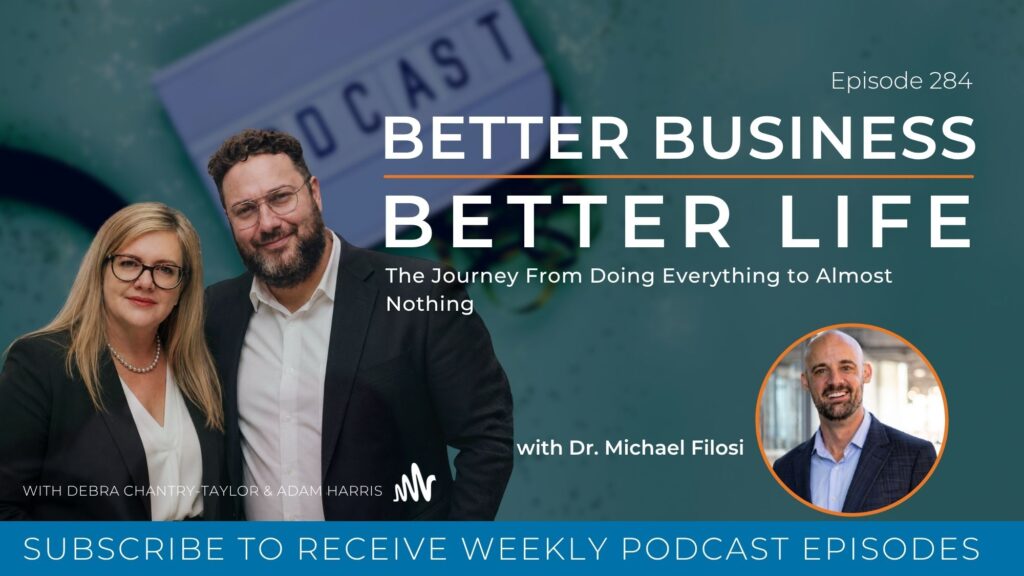
Hello, and welcome to another episode of Better business, better life. I’m your host, Debra Chantry-Taylor and I’m passionate about helping entrepreneurs lead their best life. I started this show back in 2020 with the idea of sharing the highs and lows of entrepreneurship and how people got to where they got to and how they created a better life by creating a better business. And so, the guests that I invite on the show. I tell them I want them to be completely open and honest about how their journey has gone. Today’s guest has done exactly that. So today’s guest purchased a two-chair dental practice with possums in the walls, carpet in one of the treatment rooms, no computers, and an autoclave in the kitchen. Nobody thought it had a future, but he managed to turn it around and sold that dental practice to private equity in a very rare, unique walk-in, walk-out deal. He is also an author, an aspiring politician, and loves removing teeth. And he has actually read his height in business books, which is no mean feat, given that he is six foot six. Today’s guest is Dr. Michael Felosi. He is now semi-retired and exploring other options, but he was the owner and founder of the Fullarton Park Dental before he sold it to private equity. Welcome to the show, Michael.
Dr. Michael Filosi 02:00
Looking forward to it.
Debra Chantry-Taylor 02:01
So am I. I mean, we had a bit of a chat offline before we came onto the podcast. I’ve learnt a few interesting things about you, so I’d love if you would for you to share with the listeners your journey because you’re a dentist by trade, but not anymore.
Dr. Michael Filosi 02:13
Correct. Yeah. So I got a dental degree from Adelaide University in 2006, and for the first 10 years of my working life, I I I did that. I drilled and filled teeth and and and fixed up people’s oral condition and liked doing it. But I think I recognised there was a bit of a ceiling on how far I was going to get with it. I realised that you know despite my best efforts and no matter how hard I was going to work, there were going to be other people who could do it better than what I could. And so I kind of pondered that a bit and you know where does that lead me? What do I do? And and this thing called business came up, and it felt like felt like a bigger game, you know. Like it felt like it was this really. I’ve always loved board games, you know, and strategy and things, and business felt like this multifaceted, really cool, interesting game to play. And I sort of thought to myself, you know, I probably can’t be the best dentist in my city, but I reckon I can have a really good crack at having the best dental practice. And in that moment, my mindset sort of shifted from being clinician and operator and dentist to being business owner, and then investing a whole lot of time, effort, and energy into getting better at business ownership and flipping the switch from being, you know, the dentist to the true business owner.
Debra Chantry-Taylor 03:16
It’s funny that you say it’s like a game because I always refer to business as being a game, and with every game, there are obviously rules. You know how to win. You know how you get penalties. You know all the things that. I think that’s interesting analogy. So I know that you got in contact with me to become to come on the podcast by sending me a photo of you against a whole pile of books, which I can see in the background there. So you have read your height in business books and some, and you’re not a small guy, right?
Dr. Michael Filosi 03:40
No, I’m sort of six foot six tall, so I’m I’m 198 centimetres. So I’m a big boy. So it’s generally pretty good being tall. But when you’re trying to read your height and something, it’s probably the one disadvantage because you kind of got an extra foot or so to go on on most people. So yeah, so I sell myself. I like you know trying to give myself challenges and things and and things that reward persistence, things that you can’t you know you you can’t fast forward your way to reading your heightened books. You just got to sit there and page by page doing it. So I set myself the goal from scratch. I’d read a whole stack of business books already, so it only kind of started when I set myself the goal. I didn’t count the ones I’d already read, and the first book I read was Traction by Gino Wickman, which I sort of thought was cool in the sense of also traction at the base of a pile, traction. You need grip, so that there’s a double meaning there as well. And yeah, over three years as a business owner, I gradually read my books. So for those watching, you can see the the stack behind me there. Yeah, and and and I think it’s about 100 books in the end. And yeah, on on business and development and and marketing and leadership and all those sorts of things. And learned an enormous amount, you know. Like I think that it’s business is something. It is a game, and games have rules, and it’s also a skill. And skills can be learned. So I think that reading the books certainly helped me enormously with that, with with my endeavours in business for sure.
Debra Chantry-Taylor 04:56
Did you actually start reading the books before you decided to build a practice? Or as you were doing it,
Dr. Michael Filosi 05:01
it’s such a good question. It’s funny, right? Like at school, I hated reading at school because you’re always told what to read, and I’m not a big fan of fiction, right? And like every bit that I had to read at school, it always it seemed boring to me. Like I was like, man, this is just I try and knock it out in a day or a couple of days. I’m a slow reader, and I hated it, right? So I think that when something I could read for myself and read what I wanted to read, you started to get taller than nonfiction, which is what I like to do. I’m a compulsive learner. I think I started to as soon as something becomes of importance to me, you know, in my life, I figure I want to learn more about it. So as soon as I, you know, I didn’t really care about finance and things until I started earning $1. I’m like, look, I better learn about this thing. You know, I’m earning money now. I’ve got a job. What I do with it, and then when I had a business, same thing. It’s like, look, so so I think that I started to I did a bit of business study initially, but I kind of realised that informal learning and and and that was going to take me further faster than actually structured learning, I suppose. So I did start to sort of toy with the idea. I thought if I am ever going to do this, I really had this thing where I wasn’t quite sure if I wanted to be a business owner in the first sense. So I thought I’ll try and learn as much as I can first, and I won’t make mistakes. And of course, that’s rubbish, right? Like you’re going to make mistakes no matter what you do. So I did start on that journey before buying a business, and start. But when I did buy the business, I was hammering into business books, and and I mean proper, like you know, physical books, not audio books. I say to you beforehand, I’m a slow reader, and I highlight as I go. And my wife can almost tell what I’m reading. She says because she can hear the highlighter lids popping on and off in the other room. So that’s her signal. When she hears that, she knows I must be reading in another room. So yeah, I started to really get into it when I own the business because I can see that there was going to be an enormous return on investment from learning. You know, like I figured that you think about the books that I’ve read and the return on investment. So they each cost 2530, bucks. They’re probably each worth you know a lot of money in terms of the actual like how much more it’s increased my net worth and business worth is is enormous. So it was a massive return on investment. So it was an easy decision to make.
Debra Chantry-Taylor 06:57
Perfect. So you decided that okay, I’m not going to be a dentist. I’m going to have a be the best. Well, I’m still going to be a dentist initially, but I’m going to have the best dental practice. Over time, you managed to remove yourself from the day to day of the business, and you shared with me some figures around that. So, by the time you sold, because you did sell the practice in the end, I did. So, by the time you sold, how much of the revenue was actually coming from you?
Dr. Michael Filosi 07:19
Yeah. So, my own two hands were generating 0.6% of the revenue. So that means that my my work as a dentist was a rounding error. You know, it was it was very very small. And that so the obvious question as well is is like, well, what was it at the start? It was about 40% So I was it was definitely dependent on me. You know, as a key person there. Where, and generally speaking, the principal dentist is is the main producer in a dental practice, you know, and it also creates a lot of key person dependency, and also the enterprise value when you go to sell is is less because there’s a risk there for the buyer of saying, look, you know, you’re generating all the money, you know, the business is you. You need to stick around at least afterwards for us to get that money back. So I made a decision for a number of reasons to gradually wean myself off being the clinician and being the provider of the services, so I went from a course of four years. Then, what is it gradually? I went from four days a week to three to two, then to zero. Then transitioned all my patients to other clinicians, and then greased the wheels for that to make sure they were well looked after. Which is something a lot of people think they can’t do, and I and I disagree completely. Like it absolutely is possible to do. A lot of people, I think, you know, we we have this thing of like no one can do it as well as us. No one, you know, our patients or our clients won’t like it. And I’m sorry, but I couldn’t disagree more. You know, and I think that there’s there’s better clinical dentists than me. So someone wanted to say to me, “Oh, Michael, I think I’m better clinically than you. Yeah, quite possibly, right? Like I wouldn’t argue the toss, but in terms of I knew how to build my own book. I knew how to grow by patient base. There, I was very popular. I have 400 plus five star Google reviews with my name on them, saying how much they like me. So if I can do it, anyone can do it. It’s it’s just a matter of committing to it and then going about and and setting a goal, being long term about it, but having a plan. Like how am I going to execute on this? Not just waking up and deciding to do it, but if I’m going to transition off the tools and I’m going to you know build the business while my personal you know, my own exertion from the business doesn’t create the the revenue. You got to have a plan. You got to work to that. Be really clear on that. What that looks like, but it is it’s absolutely possible.
Debra Chantry-Taylor 09:10
Yeah, I’m going to come back to that plan in a moment because I think that’s going to be one of my real key questions. But I just want to talk about because you did actually exit. You did sell the business to private private equity, and you had quite a unique situation. And I think this ties in with what you just said. If you can completely remove yourself from the business, it means the sale can be very, very different, right?
Dr. Michael Filosi 09:28
100% Yeah, absolutely. So I think that any business ultimately, you you know, it’s like, do you have a high-paying job or do you have an enterprise value there that you can actually sell at the end? And obviously, that the latter is preferable. You know, so you want both ideally. So if you’re earning money, but in the end you’ve got something to sell, that’s that’s great. I think that you know anyone who’s going to buy your business, it’s basically a multiple times by the the likelihood of of future earnings. Now, if those future earnings are tied to one person, there’s a risk they’re they’re taking. So as the risk goes up, the multiple goes. Down they go. Look, it all hinges on you, champ. I can’t pay you that much because if you go down, the whole thing goes to to nothing. So, being strategic about it, the more you reduce your risk, the more you reduce your key person dependency. So, when I sold, no one billed more than 17% of the revenue. So, and so it was very very broad basic clinicians all contributing something to the revenue, but no one person, including myself, it didn’t hinge on any of us. Which meant that when it came time for me to sell, ordinarily in a service-based industry, certainly in dentistry, you when you go to sell, there’s always you know 70% and then 30% you know there’s clawbacks and earnouts and handcuffs, 100% the golden handcuffs, and I was super clear. I was like, I’m either all in or all out. There was no way I ever wanted to work for someone else after building the whole thing myself. The only way I can engineer that and make a case to potential buyers to say, look, this is on a walk-in, walk-out basis. I know that’s rare, but here’s why: was if I can prove and demonstrate that the business did not hinge on me and my own personal exertion to run. So I created a true turnkey business that didn’t rely on me to run it, didn’t rely on my own, my own hands, my own name and reputation in order for patients to return. Which meant that when you put that proposal to possible buyers, the the risk is a lot less for them because it doesn’t rely on me. And I also I joked with them. We also, you know, I met with a number of buyers and sat in my office, and I said to them, “I said, look, you know, I know ordinarily you have people stick around, but I said, you know, my terms will be for me outset that it’s a walk in, walk out. I said, and and frankly, I said, you don’t want me sticking around because, like, someone that can turn what it was into this, like, I’m always going to think I know better than you guys, and you don’t want that. Like, if you’re buying it, you want a clear run of it. You want clear oxygen. You don’t want me there meddling. You don’t want me there thinking I know better. You want me long gone. I said I said it with a joke, but I meant it seriously as well. And I do think both ways it played out. I was very clear. It’s like I’m. I don’t want to be here. Like when it’s not mine, I’m gone. But also, I think it is in their interest too. Absolutely, that having the big guy stick around, the guy who turned practice with possums in the walls that was that nobody thought had a future, quite literally, into a practice with 10 chairs and 35 plus staff and and and a very very thriving practice, is is someone who’s going to be potentially a thorn in the side of the new owner. So I was keen to to make it a walk in, walk out, and design it as such, and pitch it as such.
Debra Chantry-Taylor 12:23
Perfect. So you’ve made mention of the fact that you know you knew that you needed to remove yourself to make it a really saleable business. So if that was the the end in mind, if you like, what was the first thing you had to do? Because I think for a lot of us listening in, you know, we have started life in the technician role. It’s something that we know, that we love, that we’re great at-and then we might decide. I’m a biochemist by trade. I didn’t actually do much with that, but yeah. But you know, but we have that sort of that thing. And then you kind of go, “Actually, no, I much prefer the business side of it. But where did you start?
Dr. Michael Filosi 12:53
Totally, it’s a really good question, Debra. I think there’s a couple of things here, right? So there’s an awful lot of dentists who don’t like dentistry, right? But the thing is, the technical skill you do have the golden handcuffs to to keep doing it because if you want to retrain, you’ve got to go back to zero. If you’re a lawyer, you can do you know politics, you can do consulting, you can do advocacy, you can do all sorts of things. If you’re a dentist, you don’t do dentistry. Either do it or you teach it. That’s it. So a lot of people stick with it, even if they don’t like it. For me, I think the key thing is right. It’s like one thing: are you running from the darkness, or you’re running towards the light? What I mean by that is, for me, I was quite happy doing dentistry. I wasn’t brilliant at it, but it was fine. Like it was all good. I was running towards something. I was running towards the light of this thing called business, as opposed to running away from the darkness of oh, I just hate doing clinical dentistry. So be clear on your reason why. Is there something that’s attracting you, or is there something that’s repelling you to trying to get away? Is that a bit of key thing? Be clear on that. There’s no right answer. Both are perfectly acceptable reasons, but know what it is there. Okay, I think as well, it’s about having a plan, so being really strategic about it. So when I figured that out, it’s interesting how I kind of arrived at that. I so I’ve got a daughter who you met before we started the podcast, and she was young, and I was spending a lot of time at work. I was basically working on the tools during the week, working on the business on the weekend, and going in, and and we didn’t have a super strong relationship. And I realised there was an Easter weekend of four days where I spent at home, and each day she was more fond of me than I was there. And I said to my wife, “It’s like she’s a different girl, but she wasn’t. I was. She was just giving back. The fact that she had four days with me, I was getting back. And I went to work the next day, and I said to my team, basically, you know, I’ve got three glasses here as a parent, as a business owner, as a dentist, but only enough water for two. So I didn’t want to give up being a parent. You know, I can’t have someone else do that. I didn’t want to give up being a business owner. The dentist part, I could have other people do that for me, whereas I couldn’t have other people be the business owner or the dentist. So I realised I need to get off being a dentist and fill the cup of the the business owner and and dad, and have other people do the dentistry. So we set about with a plan of how to do that. So to go from four days, then to. Three into two and then to zero. How to communicate that to staff? How to communicate that to team? How do we do our handovers? And we lost very very few patients from that. So I think you’ve got to execute with a plan. Don’t just you know you need to be really really clear what you’re trying to do. The other thing I’d say with it as well is, you know, what’s the saying? You’ve got to you know if you’ve got to be a want to be a butterfly so much that you can’t stand being a caterpillar anymore, and you can’t go backwards, or you know you can’t have a foot on first base and second base at once.
Dr. Michael Filosi 15:25
So when you go for it, so many people turn around and go back to first base. I’m going to not too hard, or a few things didn’t go well. Go back. You got to commit and commit fully, and know your numbers as well, so you can you know make sure that your income doesn’t an enormous hit. So, but make a plan, map it out, speak to your key team members. Explain to them why you’re doing it, and map out a plan to do it.
Debra Chantry-Taylor 15:45
Now I know that you’ve read Rocket Fuel as well, and Rocket Fuel talks about the two types of entrepreneurs that are required to run a business. You’ve got the visionary, and you’ve got the integrator. Is that a concept that you introduced into your practice?
Dr. Michael Filosi 15:56
Yeah, it’s interesting, very much so. So it’s something that I was very much the visionary, so I had the the big ideas, and I could tell where the juicy fruit were. I had a really clear vision, and this is where we need to get to. But I wasn’t quite so good, or wasn’t as good at getting people along for the ride necessarily. And I could demonstrate the behaviour that I wanted them to to to to emulate, but I needed an integrator to help achieve that, and I found one, and I found an exceptional one. So I had someone who was the the into the yang or the the integrator to my visionary, who absolutely was brilliant at doing that. So she helped put my vision into action. She helped. She was able to get the team on board and get them all climbing up the ladders and picking those juicy fruit that I knew where they were. So absolutely, that was very much something, and it was a paradigm and a model that her and I we didn’t so much communicate to the team, but her and I were very familiar with, very comfortable with. We both understood that we understood what we were both very good at in those roles, and also what our not so strong suits were in that role as well. So, and there was no ego around it. I I didn’t, you know, I never went to her. Oh, gee, you’re not very great with ideas, and she wasn’t. Oh, well, you’re not very good with this. Like we’re very, and and she was. We both. There was overlap there, but clearly our roles were well defined of what they were, and we both, yeah, it was for harmonised and and worked extraordinarily successfully together to achieve big things in exactly those two, in that that those roles.
Debra Chantry-Taylor 17:19
I think the way that Mark and Juno describe it in that book is like puzzle pieces. You know, you need to actually fit together. And yes, there’ll be a little bit of overlap, but really, the the strengths and weaknesses need to balance each other. I actually use the analogy because I’m a bit of a musician, and I use the analogy of conductor versus composer. So the composer has the grand idea of the music and writes the music and knows how it should sound, but if you actually put them in charge of employing the orchestra, holding the orchestra accountable, making sure they were playing at the right time at the right level, this wouldn’t happen. And and you know the the conductor people don’t realise, but they actually do. They’re the general manager of the orchestra. They they they they employ people, they fire people, they hold them all accountable. Yeah, that
Dr. Michael Filosi 18:00
that’s I love that. I haven’t heard that before, but that’s brilliant. Yeah. So, so the composer and the conductor. So, and I’m just thinking about that. That applies perfectly to the relationship I had with Julia, who was the integrator. Yeah, she was the conductor. She got the band in. She organised who was playing what pieces and when, and got them all. You know, playing to a baton. You know, like she was the one actually conducting them. Absolutely, I think that’s so true. I think another model, you know, like I think that the model of the first follower. There’s a great YouTube click on, you know, on the the dancing guy at a it’s yeah yeah, and you know the first person out there, the the crazy dancing guy, which was me. It’s like that’s not a movement. That’s one guy dancing in a crowd, looking silly, right? But it’s actually the first follower who’s the one who actually gives power to that movement, and because they validate that first individual dancing guy, and then the people don’t end up following the first guy; they follow the follower, they follow that first follower, so they actually have the power, and they’re the ones that people are emulating, not the first person. So I think that’s another model that I found really helpful. Was I was the crazy guy dancing on my own at this concert, and then she was the one who comes up, you know, follows my lead, demonstrates, hey, it’s cool to do this too. And then the crowd follow her. The crowd follow that second person up. They’re not following the first guy. And I think that was definitely the model that that that worked there. So I love all that though. That the conductor and the the composer. It’s a great. I love that. That’s such a cool way of putting it. So I’m definitely going to use that too. So there’s a few different ways to look at it, but you definitely the puzzle pieces as well is you’ve got to complement each other really well, and that’s what we did. And and yeah, of course, there’s a bit of overlap, but chiefly we knew what our roles were. We’re very very comfortable in our own skin and with each other as well there, and it worked really well.
Debra Chantry-Taylor 19:41
I always say it’ll be like a marriage too. Like you want to complement each other, but you also you want to have a little bit of tension. It’s kind of you know it’s good that you’re not always exactly on the the same page, and you have challenging each other. I suppose you always get on the same page, but you’re challenging each other’s beliefs and whatnot. Okay, so you’ve talked about you know having well first of all knowing your why, which is you know. Super important, and like you said, there’s no right or wrong. But if you know why you’re doing it, it means you’re going to develop the right sort of end goal and plan. You talked about having sort of an end goal, and I always say if you don’t know where you’re going, any road will get you there. So knowing where you’re headed is really important. But then you develop a plan, and you had the plan to go from four to three to two to one to zero kind of days. Did you share that with the whole team?
Dr. Michael Filosi 20:20
The senior team definitely, and then the senior team communicated to everyone else. So I think you’ve got to go to build a coalition of of people who are on board. And I think that I’m always big on in my view. You know, if you’re at the top of the organisation, I didn’t want to have to convince a whole group of people all at once. You know, I didn’t want to unionise workforce all disagreeing or coming back. People are naturally going to push back against change. So I wanted to break it down and do it one at a time or two at a time, and get people on board individually. Because I was quite sure if I sit in a room with them one on one or one on two, that I was going to be able to explain why I’m doing it and have them leave understanding that versus trying to explain stuff to a whole group of people. Everyone sitting there, their arms crossed. There’s a whole lot of negative energy. It doesn’t work. So explained it to my senior team initially, and they were totally on board for it. They understood that why I was doing that, and then we from there it was conveyed to the the broader team as well as to why. And I think when they understand why as well, that was really important. It was just yeah, I need my weekends back. Basically, you know, I couldn’t be coming into work. I really liked going into work on the weekends. It was it was quiet. I was on my own. I got just to knuckle down and do work without patients, without staff. It was great, but it wasn’t sustainable as a father and and as a person, it wasn’t. I you know I realised I wasn’t wasn’t a great father during that period. So yeah, communicate to the senior team, then communicate it to everyone else, and and and yeah, again having the integrator as to like here’s how we’re going to do it, here’s how we’re going to organise it. In dentistry, you book your patient six months in advance. Everything’s got a six-month lag phase. Any plan, it’s going to take six months for it to start to bear itself out. So, you know, but from there we went right. Are we going to mark off the books in six months? Is only working three days, and then two days a year after that, then zero days after.
Debra Chantry-Taylor 21:53
It’s actually yeah, sort of quite structured way of looking at it, isn’t it? Okay, and so and the one thing I wanted to ask you as well, because I know that sometimes people hesitate to kind of share the bigger picture with the team because sometimes it is personal motivators, and they hesitate they hesitate to share financials and stuff too because they’re sort of worried that the team will maybe not understand them. But in my experience, I see the more that you share, the more vulnerable you are, the more you’re open you are, the more people actually buy into what you’re trying to do, and of course, it has a positive impact on them too, doesn’t it? So, what’s the what was the what’s in it for them, for you creating that?
Dr. Michael Filosi 22:26
It’s interesting on this, and I have some fairly robust discussions with some good friends of mine who are business owners about to what extent you share the information. So, I was very keen to share a lot of the reasons why we’re doing things. I didn’t share the financials, and I and I have this. I was never someone who was keen to do that. I thought that I knew everything within each of its life. I knew I had spreadsheets upon spreadsheets upon spreadsheets, and I tracked it all. But I didn’t want the thing is with dentistry. It’s big money in, big money out, and it’s easy to look at some of those figures and think, “Oh, gee, Michael’s making a mint, but it’s harder to convey the reality of how much goes out the door too, and I felt that if I was to share some of those figures coming, that it would seem it would be difficult to convey the fact that that money doesn’t land in my bank. Sorry, it does land in my bank account, but then you’ve got masses of money going out as well. So in the end, I didn’t share a whole lot of that, to be honest. What I did do, and what I found with my integrator is I had all these spreadsheets and I hadn’t fully shared a lot of the details with her for a long period, so it kind of meant she was playing chess with half the chessboard, right? Coven, you know, and so she could make good decisions, but she also couldn’t see everything. And a few years in, I realised, look, you know, if you really want her to help you, and like you said, if I’m vulnerable about it, the more open and honest, I was with her. The stronger our relationship, and the better we perform together as one, the more she could help me. So there was a point where I’m like, “Hey, I’ve got all this data and all this information. She sort of said jokingly, “But actually, you know, this would have been helpful, Michael Turk, like everything she’s done. But you know, then she had it there, so I was like, “Right, I have cards on the table here, and I was super duper transparent with everything. It’s like here it all is. Or if I was having a trouble with something, it’s like the more I could be open and honest with her, the more that she could help me. If I’m like, this is exactly where I’m getting stuck. This is exactly where I don’t know what to do. This is exactly where I’m struggling. Then she could assist me with that there. And likewise with the figures as well. It was suddenly all out in the open, and and she could see very very clearly, and she had a really good business head, so she understood. She actually was uniquely placed to know that the big number of the revenue does not translate to profit, right? She understood all the costs, so I wasn’t coy about sharing that because she also understood the nature of the business, how much money flies out the door. So she did the payroll for starter, so she knew when they go out how much was was was doing there. So that worked really well, definitely. So my view is, I think you’ve got to be selective in who you share that information with. I think it’s too easy nowadays. You know, having owning a business is a bit like having a being a parent. That unless you’ve done it, you don’t really know what you’re doing. You know, and you wouldn’t take parents. Advice or someone without kids, you’re like, look, I’m sorry, I just aren’t interested in what you have to say. And frankly, business ownership is the same. So I was very mindful of people who, in the team included, who don’t have a business, who think they can do better or think this or think that, and they just don’t understand it, right?
Dr. Michael Filosi 25:14
So I didn’t see a reason to, a compelling reason to share all the figures with them because I didn’t feel like it was an accurate representation. Feel like it was they were going to get any value from it, except for one person who was very high level, very much across these things, very much understood both sides of the ledger rather than just focusing on one number, and that that served me well. Debra, I was I was perfectly comfortable with that.
Debra Chantry-Taylor 25:38
I have a slightly different view. I’m going to share it just for yeah. Go for it. I have a 600 business owners throughout my kind of coaching career, and also owned a few businesses myself. I think that you can’t just share numbers without context for sure, because otherwise they they always think they just look at the revenue figure and go, “Oh my goodness, you’re turning over 20 million, making $20 million. No, that’s revenue. So you have to go through an education process to share, and we always get our clients to share the high level revenue and either a net or a gross profit figure, but we teach people about net and gross profit and what that means. And I suppose my my thing is, I think that you’re right. They think you’re earning more than you are. Totally. So in actual fact, if you leave a vacuum, they will fill it with whatever they think. Whereas if you actually give them those real things, sure, you have to spend some time teaching them about that, but they will then start to understand that actually that’s not the money going into your bank account. So I’ve seen it work in businesses. I understand the nervousness around it, and I think you have to do it with context. Otherwise, it’s just it’s not. They don’t understand it.
Dr. Michael Filosi 26:33
I think you make a really good point, and it’s quite possible I just never figured out a way to do it well. You know, and and then that’s uncomfortable with that too. It’s definitely a bias of mine. Like I came into it as someone who, you know, I’ve I’ve not been someone. I think money, you know, any skill becomes a weakness if you take it too far. So I understand finance very well, but also there’s some you know shark music and and and hot button issues there, which probably prevent me from some of these things that you talked about 100% So I think that that that that’s fair, and and it makes gives me pause for thought. It’s certainly something I was never able to figure out a way that I felt comfortable doing that. But that’s very different to saying it can’t be done, which I would not say that at all. And I think what you’ve said in Illustrator is a really good point. That if you can explain both sides of it and communicate that and the difference between these things and give context, which is exactly what you said, then you’re better at it than I am. And go for it. Yeah, do it. I can think it makes a lot of sense.
Debra Chantry-Taylor 27:21
You said that running a business like being a parent. We we said that too. It absolutely is. Which means you know you have to have a set of rules. You have to repeat yourself several times, otherwise kids don’t say. So I think you know we always say you actually have to repeat something 32 times now before somebody really hears it for the first time. So in the beginning you’re sharing numbers they won’t get it. It’s 32 times later they’ll finally get it. So it takes a lot of effort. If you want to add two more books to your list, there’s two that I would highly recommend. One of them is Maverick, written back in the 1970s by a guy called Ricardo Semler, and he had a completely open book policy. He ran a freighting company, I think it was, and he had a completely open book policy, including right the way down to everybody saw everybody else’s salaries. It was
Dr. Michael Filosi 27:58
wow,
Debra Chantry-Taylor 27:58
phenomenal. I personally would not be able to go that far. That doesn’t sit well with me. But really, really interesting book to kind of open your mind to it. And the other one, I don’t know if I can see it in there, is a is a book called Profit Work. No, is it? No, where is it? Okay, I’ll put it right here because I was reading it the other day. That’s right. Yeah, no, Profit Works. So Profit Works is is a book that talks about how you can share numbers with people and create incentive plans that are based on profitability rather than just results, because I think a lot of people do. Oh, you know, but I’ve done my job and I should get a reward. It’s like, well, no, you should. We need to actually make profit for you to get that as well. Yeah,
Dr. Michael Filosi 28:32
I think that’s really valid. I’ve written those two down, Debra. I think, yeah, it is interesting. I’ve kind of always held the view that you know you’re not paid to do your job; you’re paid to do it well, right? That’s the first thing. So, oh, do my job well. It’s worked great, you know. And you get paid 100% of your wage for 100% of your effort, you know. So, like, it’s like you know, saying, “Oh, I try really hard. Well, I hope you try really hard. Like, that’s kind of the point of it. I think that you know, incentive structures are something which is interesting. That’s something we did with success as well. And I think, yeah, you’re right. They do work. I think you just got perverse incentives there where it can be gamed or something like that. But 100% I’ve seen them work super well for everyone. Right, where person getting the bonus is super happy, and then I was super happy doing that too, because you you got to make sure the right person is incentivized as well, because not everyone can move those levers that you know you need. But also, yeah, you just got to make sure you marry up, so you’re both super happy when it happens. You know, when you see the money leaving your bank account, you’re like, I’m never more happy than to pay this out because you’ve earned it, you deserve it, and it means I’m winning.
Debra Chantry-Taylor 29:31
We’re both winning. We’re both winning the game, yeah. And and your thing about the the wages thing, I use the term fair exchange, right? So it’s like a fair fair exchange. I pay you a fair amount of salary to be here in exchange. I expect you to actually do your job, and then we pay for for performance and rewards above that. Hey, you didn’t mention you didn’t mention that you have the right people. Did you ever have any wrong people in your business, and what effect did they have?
Dr. Michael Filosi 29:55
Absolutely, like enormously so. So I use I’ve got this. Thing they come up with, you know, flags and flagpoles. So, so flags are the team members who, you know, go whichever way the wind’s going, right? And on a warm, sunny day, they’re up and everyone’s looking at them and they’re happy. So, when the business is going well, they’re great. But as soon as the rain comes or the wind comes, suddenly they, you know, they’re they’re they’re moping and they’re down and they’re not getting attention. They’re unhappy. They’re looking for another flagpole to align themselves with, so you got your flag to just go whichever way the wind is going. Then you got your flagpoles. Now they’re the really valuable team members, but like a flagpole, they’re kind of unremarkable sometimes. No one goes and looks and goes, “That’s a heck of a flagpole, you know. So the flagpole, the flags are the ones that want all the attention, and they’re the ones buzzing about and look at me, look at me. But the flagpoles are doing the heavy lifting. So without a flagpole, the flag is just a dirty rag, right? It’s going to be on the ground, nothing supporting it there. So you know the flagpole, rain hail or shine. It’s upright, strong, pointing straight up. It doesn’t matter which way the wind’s going. It’s it’s robust and dependable there. So you know I’ve worked with flags, I’ve worked with flagpoles, and I prefer flagpoles, of course. And you’ve got to try and find surrounding yourself with the people who are the flagpoles there, who aren’t waiting to see which way the wind’s going or what everyone else thinks, they can form independent decisions and have the courage to to communicate those as well. So we absolutely had some. I think if you’ve got a hiring success rate of 50% I think that’s amazing. You know, like I genuinely think that I don’t think ours was any higher than that. I mean, we absolutely employed some people who who weren’t great, you know. We we went through a very tough period there. We had a couple of senior people who were, you know, undermining myself and and and another senior team member, and it was really hard, you know, because you literally had not just people who weren’t on board, but people who were flipping the script, and yeah, that was enormously difficult on a personal level, on a business level, you know, business owners, you’ve got a lot of your own capital invested in the business, taking out significant loans. Dental practices are very much infrastructure and capital expensive. All those dental chairs, you know, having 10 of them and surgeries and X-ray equipment and things like it’s a lot, a lot of money that you’ve invested in it. So when things turn it against you, it’s particularly the team. Yeah, it’s absolutely enormously frustrating, disappointing, disappointing, and and heartbreaking because you just yeah, it’s it’s really difficult. And yep, we had that happen. And yeah, it’s it’s just you know in some ways you feel like you you know disappointed in in new and interesting ways each day about how you know people can occasionally do the wrong thing now. There’s a whole lot of other people who are the flagpoles. Who you know they they Morgan Housel has this idea right on money. He writes on the psychology of money, and he talks about the fact that 10% of people they never need help investing and with money. They just leave the womb understanding compound interest and saving and those things. 10% of people can’t be helped, no matter what you do. They’re just going to always be losing a lot, never saving? And I think with team members, it’s a bit the same. 10% of people save, you can bring in, and they don’t need any supervision. They don’t need accountability structures. They’re always going to do the right thing, whether anyone’s watching them or not. 10% of people, no matter what you do, you could sit there and watch them like a whore, and they’ll still like have a land. And you’re like, are you serious? Like I’m right here, and you oh oh so, and I think then there’s the 80% in between. So I think that kind of resonates with me a bit as well.
Dr. Michael Filosi 33:06
You’ve got the 10% who’ll do the right thing no matter what, which is your flagpoles. You know that there it doesn’t they they don’t need that constant. They just and it’s you’ve also sort of make sure you do pay them attention. A bit like a flagpole, they’re easy to overlook, but you got to make sure you go. You know what? They turn up every day. They do the right thing. They’re doing their job. Sometimes the flags get too much attention. Certainly, in my case, they did, as opposed to the flagpoles.
Debra Chantry-Taylor 33:29
First of all, in terms of recruitment, how do you look for the right person? How do you sort? Because you, you’re right. You can’t always get it right, but there’s certain things you can do to try and improve your chances.
Dr. Michael Filosi 33:39
Yeah. Look, what I would do, the key thing I’d say around recruitment is is what I and you learn from experience, Debra. I found when I was younger, an employee dentist. I had a nurse who accused me of saying, “Oh, look, Michael, you know, we had a bit of a bust up. You know, I don’t know what to expect if you’re always changing the goalposts. And and she was right. She was right, and that was a lesson for me to go. You know, you’ve got to make expectations clear, Michael, right from the start. You know, you can’t have someone expect to keep moving if you keep moving the goalposts, or there’s a perception of that. So that taught me that lesson very early on. So when I’m recruiting, I would front end everything, right? So front end expectations, because what can sometimes happen is someone joins, they do something. Oh, sorry, you got to do it. Okay, sure. Oh, sorry, got to the oh sure. And six months, and you’re like, you know what? I thought it was me. It’s actually them. But you’re six months in. You’ve trained them. You’re like, what do I do? So I’d front end everything. We had very clear systems. We had our intranet, and they could read through every requirement of them for each of their roles. And I would have them read it before they started, right? So I wanted them on board, understanding that. And I would have we had for every single role for the business, we had the golden rules of Fullarton Park Dental, which is the business owner, and then we also had the golden rules of X, which is the role. And I would have them, I’d sit them in my office, and I’d have them read through those, right? And I’d have them opt in. So I think with recruiting, you don’t want to get into an arm wrestle or try to convince people to work a certain way, to work your way. So what I learned, and a big thing with recruiting, I. Literally, before we would offer them a job or a contract, they’d say, “Look, here’s the gold rules for your position. Here’s the expectations. Right? Have a read through these at your leisure. If you’re on board for this, fantastic. We’d love to have you here. If not, I totally get it. Like, I’m not everyone’s cup of tea. This isn’t everyone’s cup of tea. Like, I’m happy to shake your hand and wish you well. But if you’re working here, you have to actively opt in to this, and then that way it made expectations clear from the start. There wasn’t any talk afterwards. Well, I didn’t think, I didn’t realise, I didn’t know. So I’d say big key with retention is to front end all those discussions. Get over the fluffy stuff of oh, I’m really excited. Yeah, really excited. You know, is make those things really clear. Front end it. Give them the document. Like here’s what we need from you. Are you actively willing to commit to this? Because once you sign that contract, I’m expecting you to do that. And if you don’t want to, tell me now. Don’t take the job. You know you can withdraw your labour any time you want. It’s not compulsory to work here. But if you can’t do it, I can’t employ you. So that would be the tip around recruitment. Is you know sometimes we get caught up in the fuzzy wuzzies and so, and instead, just make it crystal clear on what you expect from someone. And people like goalposts. We found we get a lot of positive feedback around that. To go, I am so happy because I know exactly what you need from me, Michael. You know, they knew exactly where the goalposts were. Take a kick of goal and know that when they went home, they didn’t have to worry about whether I’d be happy with their performance. They knew it was documented, and and and but so I think that would be a really really key thing, Debra, with recruitment is to make expectations clear, front end that discussion. I call
Debra Chantry-Taylor 36:30
it the scare them away speech. Scare them away. It’s like, and the same even with your advertising and whatnot as well. It’s like you don’t want to make it a bed of roses and make it all sound beautiful and and fairy fairy lights and unicorns. It’s kind of like actually now this is the reality, but there’s some fun stuff as well. But this is what we expect, and again, rules of the game. Can I
Dr. Michael Filosi 36:46
jump in on that? So, just what you said is really interesting, right? And I think it was Zappos, Tony Shay, where they’d get through the interview, and then I think after a month, they’d offer someone money to leave, and basically, they’re like, you know, it’s all the scare off. I’ve heard another thing of saying here’s the reasons not to take the job, you know. Like, yeah, we have high expectations. Like, if you want to, and we’d make that clear too. We are a busy practice. If you want to sit around and just, we had someone who was really a dental assistant who was experienced, and she did a day of of a trial, and we offered her the job, and she said no. We’re like, oh, why? She said it’s like NASA here, like everything’s so well organised. It was too much for her. I’m like, oh, oh, okay, and it was kind of like it was. I’m glad she told us, right? And and but yeah, she’s like, yeah, it’s like it’s like NASA. Everything’s so so. I’m like, well, if that’s not you, you bag. So I like that, you know, to scare them off speech. And and I think we do that with saying we are busy. You will be busy. If you don’t like being busy, don’t take the job. You know. So I think it’s a really good way of of putting it, of of yeah, but that that sort of thing of saying, you know, we have we’d say talk about our way of doing things. That we need you to commit to this. Like, if you, we don’t want to come in with, we don’t need a white night. We don’t need to save you. We need someone to tell us how to do our jobs. Like, we’re not that business. We’re going really well. We need people to buy in. So if you’re coming in thinking you know better, it ain’t gonna work. Just like jump in, buy in, happy days,
Debra Chantry-Taylor 38:01
yeah, beautiful. I love it. Okay, but as as we said before, sometimes yeah, with all the best intentions and everything else, we still get somebody who kind of gets through that. Even if you’ve offered, even if you’ve offered them the payout at the end of the month, and they still stay because some people, let’s be honest, stay because they want the pay the pay paycheck, they want the the the title, not necessarily the actual roles. So, what do you do in that situation? What have you had to do?
Dr. Michael Filosi 38:24
A lot of tough conversations, you know, and no one enjoys having those, and I certainly didn’t. And we would, you know, war game beforehand how it’s going to go. Everything from if they get up and shout and walk out, how we’re going to respond to, you know, if they disagree with everything, how they’re going to respond. If they accept it, so we we tried to war game, you know every possibility for how they were going to respond to what we were going to come to them with. But yeah, you know, like I think that you know some of the things it’s terrible, right? Like, and I think that as a business owner, you know, when you are when someone lets you down, you’ve got to have those conversations when someone’s not performing. It’s it’s not fun. It’s even worse if it’s willful as well. So, but I think that you know you’ve got to hold people accountable, and I think that particularly your managers as well, and I think even more so because the other team members will look to to them. We had a team member who was a senior team member, and he, you know, he said he was off sick with you know had a bung ankle, right? And he sent me a phone. Oh, I’m so sorry, I can’t move, Ryder. Okay, sure. I could hear the team members in the lunchroom saying that he’d gone to the gym that morning when he was sick, and I was like, “Hang on a chick, like if you’ve got a bad ankle, you’ve got a desk job. If you can go to the gym, you can be at work. And I called him and said, “Like, what’s going on? You know, when was the last time you had gym? You’d gone the last two days. I’m like, ‘You’re a big guy. You’re lifting heavy weights. Like, how are you doing that on a bad ankle Stuff and it just undermines the whole, you know, like it undermines everything, right? Because the team members are going, if he can crack a sick day with the so-called bung ankle, but still be going to the gym, like you’re having a lens. So, you know, these sorts of things are really disappointing, and you’ve got to have those yeah tough conversations and and figure out, you know, why and and remedy it and find better people, basically. So. I think that I was fairly unwavering in my standards, and I think that that was pretty well known by people I work with. But if I was to go again, Debra, I’d be even more so. Like I’d be even less accepting, I think, of of aberrant behaviour. And I wasn’t accepting of aberrant behaviour, but I actually think I’d even double down on that in terms of standards and just be so crystal clear on that and call it out even earlier, to be honest.
Debra Chantry-Taylor 40:22
And having your team kind of call it out as well. But it’s yeah, I can’t remember what the actual saying is, but it’s kind of like the stuff that you walk past is the behaviour you accept.
Dr. Michael Filosi 40:29
Yeah, the standard you walk past is the standard you accept. That’s it.
Debra Chantry-Taylor 40:31
Yeah. And as goes the leadership team, so goes the rest of the team, right? So if the if the leadership team can’t do what, it’s like it’s like I used to. I’ve got it. I’ve got over it now. But I used to always be late for meetings, you know, and we’d say how important it was to be on time for meetings, and I was never on time for meetings. So it’s like, well, deb, come on, if you’re saying it’s really important and you don’t even bother, then why? Why should we? And so you know, you have to look at your own behaviour as a parent and say, am I actually walking the talk?
Dr. Michael Filosi 40:56
I think that’s really accurate, and I’ve had that. You know, these things are like painful but not hurtful, you know, in the sense of it’s not hurtful because no one’s trying to actively bring you down. But it’s hurt. It’s painful to hear them, and I had that happen too. I had team members come to me, singing team members, who had my best interest at heart, but they’d critique things that I was doing, and it was really hard to hear. I was like, man, that hurts so. But I knew they they were giving me a chance to do better, right? So they weren’t just jumping out the door. They weren’t white anting me. They were coming to me, and it took bravery for them to say that too. Much like calling out the boss for turning up late to meetings, it takes you know because they’ve got to go to and go, hey, look, you know what, we’ve got these standards, and you’re not meeting them. So, you know, kudos to them for that. And I and I hated hearing it right, but they were right, and they meant it with good intentions too. They wanted to give me a shot at doing better, and I needed to, and they were right, and I did do better. But you’ve got to-you’re exactly right. You can’t, you know, you can’t possibly expect things from people that they’re. I think that’s a really huge thing for anyone listening, right? You know, you just-we’re all social creatures, and we model ourselves on, you know, on the leaders and what they do, so you’ve got to act in a way that is in line with your expectations of others. And if you don’t, you should not be the least bit surprised when others don’t do that. You know, and and I think that in anything, you know, in your dress, in your how you deal with people, and how you talk about others is a classic one, right? You can’t ask for respect and then be bad mouthing a team member. I used to work for a boss, and he’d always bad mouth the former team members. And I was like, “That’s gonna be me one day, right? Like he might be nice to me now, but there’s a a model here of what he’s showing in terms of behaviour. So you have to be so clear on that and above board that you’re beyond your approach. You know, otherwise you can’t possibly ask someone to do something. And you can say inferior, but I’m the boss. But it’s like it doesn’t matter. Like if you’re not demonstrating that, no one else could, and no one else should.
Debra Chantry-Taylor 42:47
I completely agree, and it’s interesting. I had so my integra the other day actually called me out on my behaviour in our. We have a level 10 weekly meeting, and she called me out on my behaviour in that, and it was really hard because she told me I was getting defensive, which of course immediately made me defensive. And so yeah. So when we had the conversation, and and and the time I was like, “Oh, this is so, this is not, this is not fair. Then it’s like, actually, isn’t it brilliant that I have a team that is actually willing to have those difficult conversations with me? Because as the boss, we can often be a bit scary, a bit you know unapproachable. We can’t talk to them at Debra about that because she’s the owner. But actually, yeah, you want that environment. You want them to challenge everything with each other and with ourselves.
Dr. Michael Filosi 43:27
You bang on, and you want them to drive those high standards, including with you. Like it’s funny. I had I had two team members, senior team members, and it was like good cop, bad cop, a little bit. And I did it kind of over the course of a week, and and like and it was I think the aircon wasn’t working, so it literally felt I was like wow it’s hot in here like as they’re talking to me I was thinking and they were right they were so right like every single thing they said was accurate so and I as I said it was so painful to hear but it wasn’t hurt because I knew these two people really cared about me they cared about the business they wanted to give me a shot at getting better so I couldn’t possibly hang it on them oh but you’d be it’s like they were right, and they did it the right way. They were critiquing behaviour, not personality. Or like these are the behaviours we like, you, Michael, but these behaviours are not in line. Like you are the bottleneck in the organisation at the moment for these reasons. Until you address those, we’re not going to get to those things you want to do. And be over the course of a few days. But I just remember the aircon wasn’t working, and feeling like it was the good cop, bad cop under the a harsh light. Now, like, wow, this is hard to hear, you know. But, but like you said, like it would have been so hard for them knocking on my door and coming in and being like, we need to talk to you, Michael, about you, you know. And and that takes enormous courage, right, to say to the boss, “Hey, you’re not doing good enough on these things, and full respect to doing that, because the easy thing is to talk to everyone else about it, but not the boss. Easy thing to do is to go find another job, but instead to go, you know, we want to give you a crack at trying to get better at this thing. And yep, I might, you know, like in theory, you know, I could be aggro or you know treat them badly, whatever else. So they’re risking their thing, but didn’t happen, of course. And that builds a relationship too when you do actually accept. And you’re like, you know what? I was able to approach the guy, and he actually, you know, he didn’t love hearing it clearly, but he didn’t shout me down. He didn’t snub me afterwards. He still said good morning the next morning, and those things. And it kind of you build.
Debra Chantry-Taylor 45:12
Yeah, it’s the elephant in the room, and I think it’s you know it’s really important as as a team, you have to be vulnerable as the owner in order for them to actually also have the same vulnerability, but as you said, you have to be open to. There’s going to be times when you’re going to get called out too, and and that’s okay. Hey, we’ve talked about some of the really good things, and obviously you’ve done an amazing job in terms of building the practice, selling it, moving on. But I know because we spoke before the podcast, you know, it wasn’t all a bed of roses, right? It wasn’t that beautiful classic hockey stick growth where nothing went wrong. We hear these stories of people who sit on a laptop on a beach operating a business. Is is that how it was for you, Michael? It’s so
Dr. Michael Filosi 45:52
easy, you know, like the passive income business. I didn’t really do much, and you know, I never really got stressed and things. It was just, you know, so just be like me, everyone. If you’re listening, it’s super easy, you know. If you’re finding it hard at all, just now. Of course, I’m speaking in jest, right? So it was enormously difficult, and this is a thing. I quite enjoy things like that because it is. I won. I succeeded. I got to the top of Everest, and my goodness, it was hard. All right. So if you’re listening to this, you’re going, I find this so challenging and so difficult. I feel like my guts is torn up every day. Then I hear you, and that’s from someone who’s done it and done it well. So I want to be really honest about how hard business ownership is. It is a slog at times. You know, the line in one of my favourite movies called *The Princess Bride* and they’re they’re doing their sword fight, and one of the guys just goes, “Get used to disappointment. And I kind of come back to that sometimes because I feel sometimes as a business owner, it’s like, “Yeah, get used to disappointment. You’re disappointed in new and interesting ways every day. Like, I didn’t even know you could do that or find that. Like, how am I? You know, how have I been let down in that way? So it is enormously difficult. I found it enormously challenging. I was saying, like, you know, when the team, when I had these couple of bad apples in the senior team, and and you know, there was this really bad mood across the practice, and I couldn’t figure out. Like, I just it took a lot of, and thankfully my integrator helped enormously with that, but yeah, I was thinking, am I going to lose the whole lot here? You know, like you know, you’ve got millions and millions of dollars of loans here that you’re personal guarantor for, and you know, I was throwing up into the toilet at three in the morning, you know, several nights a week, and my wife’s come in to check if I’m okay, and it’s just the stress of it all. So to those listening, right, like yeah, it’s it’s it is enormously difficult, and that was actually a precursor to part of the reason why I thought, you know, I had a conversation with a colleague when it became really clear. He’s like, I can’t, you know, this is not good, you know, I need to, I can’t keep going on like this year. So it is enormously difficult being a business owner, you know. And I think, you know, the reward you’ve got to make banks, you’ve got to find a way to. And I get the purpose of the meeting, all these other things. But people who say I don’t care about the money. I’m like, look, you know, you can have none of those other things, but if you’re making money, you have a business. If you have all those other fluffy things and you’re not making money, you got a hobby, right? So you must. It’s just not worth it, right? The risk versus return is just not worth it unless you’re getting an outsized return, and you’ve got to drive that. And I’m really, really big on this. And I think there’s a lot of people in business who don’t drive that hard enough, and I think it’s it’s just you know the amount of time, effort, and heartache that you put in, you you ought you just must be finding a way and and and having a business and learning about business to make sure the very least the bottom line is healthy and you’re making yourself money because otherwise you might as well work for someone else, you know. So if because you can get rid of all that risk, you can clock off and be done with it there, and if you’re, you know, earning four fists what you would as a business, I take that. That’s so you’ve got to actually be able to find a way and and and drive that really hard because that’s the payoff, right, for all the other heartache that comes with it because it is enormously difficult. And I found it super duper challenging, and I did it well.
Dr. Michael Filosi 48:36
Like I I I was very good at it, but I still found it really difficult, you know. And I, you know, I make no no secret of that, and yeah, it was it was very very it was very very rewarding. The the the benefits were very very high, but the cost was super high too. So I think that, and when that kind of flipped, was part of the reason why I thought, you know what, now it just feels like I no longer feel like I’m building anything. I’m just fixing things now, and the building is super fun, building things, building a culture, building a team, building a business. You know, building intranets. We did two significant renovations on the property. That’s all really cool stuff. But just sitting in your office waiting things to break. Once you kind of reach the top, and you’re like just waiting for slap to ping or an email to land, or someone to come into it, and not getting on with someone. Like fixing things isn’t anywhere near as fun and and engaging as what building cool things is. It
Debra Chantry-Taylor 49:25
is interesting. Geno Wickman in his book The Year as Life talks about the 10 year cycle of business as well, and he says that you know for every 10 years you get two amazing years where you think the world is your oyster and everything’s fantastic. You get sort of two years that will almost kill you, almost take you down, and then six kind of average years, and that’s how it happens. And so, yeah, business can be easy for a couple of years, but in general terms, you’re always going to go through cycles where there’s some ups and downs, and and you know whether you like it or not. Sometimes your really good people leave for good reason, and then that leaves a hole, and you’re going back through it. It’s just you know, I mean. Economic downturn. I don’t believe that’s actually an excuse. I think it’s an excuse rather than actual reason. But a lot of people don’t plan for it, and so they they do suffer because they haven’t actually thought about have we got money put aside for when we have the two bad years. Yeah,
Dr. Michael Filosi 50:13
I think that’s really well said. And I think you know our cumulative cumulative average growth rate, so compounding rate, was 18% for 10 years, right? Which is in was very high for our industry. Yeah, when you’ve got certain constraints, of physical constraints and things like that, there. But but it wasn’t 18 on 18 on 18 every year, right? But I think that, and we had some years, and we were sailing. Like we were just like, wow, the wind was in our sails, and it was just taking off, which was enormous. So yeah, it’s very much you know, it’s it’s the ups and the downs, and it’s you do have some very good years and some very bad years. And I think that what’s interesting is right. It’s funny having a rainy day money pot is is super important and super helpful. And it’s funny. I notice this very very clearly in the dental industry. There’s a dental practice owners forum right on Facebook, and and there’s a fair bit of like you know, oh, I’m everyone’s trumpeting how good they are. Yeah, great, whatever. COVID hits, it’s amazing. The same people who were trumpeting there, they’re doing all these fine dynamos. Surely saying, and then the bones of their backside, and I’m like, hang on a tick. Like two months beforehand, you’re saying, and it’s like, oh, how could we predicted COVID? How could this? How could that? And you’re like, you know what? You’re right. You could not have predicted the exact circumstances, but here’s the thing: what you should have predicted is the fact that stuff can go wrong, and no matter what that is, having something in you know your back pocket is going to be helpful, right? So people said, “Oh, I couldn’t have predicted COVID. It doesn’t matter that you didn’t predict the exact origin of what the disturbance was. The fact that you ought to have a rainy day money fund, right, and that’s good planning. That’s good business, you know. So, you know, because if you go to zero, you’ve lost, right? So you need that protection along the way. There, again, that gentleman Morgan Houser talks about the fact that you know the world breaks every 10 years. So you had the Gulf War in you know you know September 11, 2001. Then the GFC 2008, 2010, then you had COVID 2020. So almost on script, every 10 years, the world breaks, right, and things, you know, things happen. So the fact that you can go, I didn’t, you know, who could have predicted September? Yeah, exactly right. It’s like, well, of course not. Like no one can, you know, predict it. But it’s it’s not the point. The the point is to have optionality, and optionality is about have significant resources of your health. Because no matter what happens, being mentally and physically healthy is going to be an asset, right? Having strong social connections, no matter what happens, having strong social connections is going to be helpful, and and having a degree of capital behind you because no matter what happens, going I don’t know where I’m going to eat is not a nice feeling. So having some degree of capital behind you is those three assets. No matter what happens, are going to be helpful too. So I absolutely agree. It’s funny seeing this dentist thing from the fine dining dentists blowing enormous amounts of money on dinner to suddenly, not very long after preaching they couldn’t make money and saying their stuff are not going to pay them and things. It was just hilarious, right? It was frankly, you know, it was it was nonsensical. So, make bank put money away, plan for a rainy day. You know, don’t worry about looking rich, just get rich, right? So forget about what things look like. Oh, gee, are they this? Who cares? Just I’d rather have the money and assets high performing assets that no one can see and if everyone doesn’t know how well you know if I’m poor or rich or whatever else I couldn’t care less but no go to bed knowing that you’ve got those that capital behind you
Debra Chantry-Taylor 53:13
yeah absolutely I always liken it because I’m a bit of a car girl but also a bit of a I love my animals too I’ve got my dogs and my cat and it’s like you know you shouldn’t actually have an expensive car if you can’t afford to fix it when it breaks. You shouldn’t have dogs and cats and probably children if you can’t afford to look after them when they get sick because they’re bloody expensive when they get sick. And it’s some of the business, you know. But also, I believe that you should be. And you talked about war gaming some stuff earlier. I think you should always be thinking about worst case scenario while you’re in the good space because when you do it, when you’re in the good space, you’ve got a clear mind. You can think about the plan B, the plan C, and you can put that thing away in a bottom drawer somewhere until something happens. But when something happens, you pull it out, and it’s been made with a clear mind rather than a oh shit, the world’s falling apart. What am I going to do? Mind?
Dr. Michael Filosi 53:57
I think the whole thing is yeah. The time to prepare the roof is when the sun is shining, right? So you might not be having rain coming in. You go, you know, what difference does it make? Yeah, it doesn’t make any difference now, but you don’t want to be repairing it when the water’s pissing in from everywhere, right? Like repair it when the sun’s shining, when things are going well, when happy day. So you know, have that plan for when things do go badly. is is absolutely imperative there, or at least know in the back of your mind. And when we’re sailing, it’s like, look, let’s just hang on, and it ain’t gonna last forever. And we’ve got to, if we’re if we’re investing and and living like we think it will, we’re gonna get a big kick up the backside when it turns, and it will turn because it always does.
Debra Chantry-Taylor 54:32
Cool. Hey, look, we could talk for hours because we’ve got so much, but we’ve covered the good sides. We’ve covered kind of the bad sides. I always love for the listeners to take something away that they can actually work on. So you’ve got a huge amount of experience. I’m looking at the picture of you next to your books. You’ve got a huge amount of knowledge for those books and things. What would be the three top tips or tools that you would suggest to people who are listening in?
Dr. Michael Filosi 54:51
So I’ll just refer to my notes here because I did actually think about this because I was prepped on this question and I was trying to think of of the answers there. So I’m looking down. It’s just I want to make sure I. So I. I think the three things reduce key person dependence is one. So we kind of touched on that early. I think that you know having a business that’s dependent on any single person, whether it be you or someone else, that is a significant risk. Okay, because they might leave, they might get sick. You might want to leave and still want to sell your business for something, but you can’t because it’s all dependent on you. So, as much as is possible, try and reduce key person dependency. Have a next in line to to follow up because if it depends on one person or a couple of people, then that is an inherent risk, and you need to manage risk. And you manage risk by reducing them. Okay, so that’s number one. Number two, look, I found this very helpful. Is is is if you can buy your own rooms or buy your own business practice or buy your own premises, I think that’s terrific, right? You’re investing in yourself. It gives you a goal to you know you’re paying yourself rent rather than the landlord, and I understand there’s a whole lot of reasons why. And it’s a bit of one of those things where you’re too busy running the business to look for the oh, but you know I’ve got all these other things. I get it, but I certainly did that, and that has worked out tremendously. While I sold the business, but still get the rent each month now. And I just think it’s a no-brainer. I think if you can invest in yourself, invest in your own commercial property or industrial property, if that’s what you’re in, I think it makes a lot of sense to do. Do it early on, and then it will pay off when you go to sell, because then you’ve got an asset there, you know. And I think that’s really important. So that would be the second one, the final thing of the three is to to what I say is iterate quickly, and what I mean by that is, you know, people like I feel like I was 10 years in business ownership, but the thing is, people say they’re experienced, right? Oh, I’ve got 30 years experience. You go, do you have 30 years experience, or do you have one year experience 30 times over? You know, and you see that often, right? So, whereas I think that I had 10 years, but on warp speed because I would constantly be learning and growing and failing and learning and growing and failing. So, it might be 10 years, but I reckon I crammed 100 years of business ownership into that and all those books and things. So, I think iterate quickly, learn quickly, constantly be testing, trying, figure things out, do little experiments for what’s working, what’s not, and the faster you go through that learning cycle, you end up, you know, you learn, you grow, you go down a little bit, learn, grow, go down a bit, learn, grow, go down a little bit, and you constantly, it’s it’s an upward trend, right? So, whereas if you do that, the slower you do that, the the less progress you make. So, I’d encourage all the listeners to iterate quickly, figure out what doesn’t doesn’t work. Constantly be testing, be trying. You know, you know, make small bets that if they fail, it does. It’s okay. Like you go back a little bit, right? But then from that, you then learn something new. You get a new data point from which you can grow and learn again. I think the faster you can go through that cycle, the better.
Dr. Michael Filosi 57:36
And the faster you can go through that cycle, the more you will learn, and you will accelerate your growth because you’ve made you basically compressed your learning, and who doesn’t want to do that? You know, like if you can compress that learning of 100 years into 10, do it. You know, rather than not actually iterating fast, not learning, not growing, not finding out what does and doesn’t work, and then building on that, then you’re going to be a whole lot slower getting
Debra Chantry-Taylor 57:57
it. I love it. I love it. One of our values is actually grow or die, and I have a I have a tattoo that is a Chinese symbol that translates into sometimes a mentor, always a student, and I think that’s for me that is my mantra for life. It’s like actually you know we’ve we always learn and failure is not failure. It’s only fail if you haven’t learned from it. If you take something from it, then it’s as you said another data point that you can then take into the future.
Dr. Michael Filosi 58:19
I love both of those, 100% So yeah, no, they’re they’re very well put. I think yeah, constant learning. I think I’m obsessed with learning, obsessed with getting better, and yeah, the failure is such an interesting topic. And and and I think that you know how you how you you know if you take the lesson, then you grow and you move on from that. Failure,
Debra Chantry-Taylor 58:35
yeah,
Dr. Michael Filosi 58:35
yeah, failure.
Debra Chantry-Taylor 58:36
Cool. Hey, look, I know that you’re very very generous with your time and your learning, so people want to get in contact with you. What’s the best way to do that, Michael?
Dr. Michael Filosi 58:42
So LinkedIn. So Dr. Michael Felosi, F-I-L-O-S-I, and I’ve just set up my website too. I need to build it out a bit, but yeah, michaelfolosi.com.au. I’ll link to everything I’ve written there. I write a lot on business, and all the podcasts I’ve done, including this one, will be up there as well. So yeah, if you want to find out more, there’s a whole lot of stuff there that I’ve done, that I’ve said, that I’ve written about that the listeners can enjoy.
Debra Chantry-Taylor 59:02
Yeah, perfect. And I’m going to ask you to finish off. You talked. We’ve talked about the sort of three things because you’re you’re kind of semi-retired at the moment. So we talked about the three things that you you love, and one of them was writing. So tell us a little bit about the writing and the other two.
Dr. Michael Filosi 59:14
Sure. So so basically, we’re chatting. So I’m I’m almost 11 months removed from selling my business, and the conversation came up of well, what next? And the answer is, well, I don’t quite know. But basically, had what you might call a quarter-life crisis early on after graduating, when I wasn’t sure on to keep doing dentistry or not, and I started to pitch ideas to editors of magazines and websites. So when I was 25, you know, I’ve written for a whole bunch of prominent newspapers, websites, and things. So I like to write, and now I kind of scratch that itch online on LinkedIn and write a lot on on that and on business and life. So basically, I was thinking about you know what what do I do next? And the three things I look at hard, interesting, meaningful things, and and the three things that kind of tick those boxes that I can come up with are probably three things that nobody else has any interest in or. People don’t have an interest in, but I do. So one is taking out teeth. I quite like that. You know, the other artistic areas of dentistry not so much. But if there was a nominal fee to of you know $50 to take out 10 teeth, they’d probably pay X. It’s good fun, right? Writing is another. So I really like to get my stuff out there into the universe. You know, I like the idea of increasing your surface area of luck. So unless you put it out there, no one’s going to read it. No one’s going to see it. You never know what’s going to jive for someone to go. Hey, that’s really cool. I might touch base with him. So I try and write on LinkedIn. I’ve set myself to goal for 50 posts for the year, and I’m already up to 40. So I might try and crunch out 100 for the year. But I enjoy writing. I enjoy writing a lot. And the final one is politics. So you know, I’m quite interested in that. Quite passionate about that. I think we’ve got to do better, you know. Here in Australia, I think that you know the people leading our nation are ill-equipped to do so, and and and not, you know, I wouldn’t hire our prime minister to to run a McDonald’s store if I knowed it, let alone run the nation, you know. So I think we need a higher calibre of people, and people aren’t career politicians, people who’ve actually done and achieved big things outside of outside of politics, to contribute in a meaningful way, and I’m in a fortunate position. Yep, I’m semi-retired or thereabouts. You know, I can pick and choose what I want to do next. So anything I do, I’ll be doing because I actively want to do it, not because I necessarily need the paycheck. So, but they’re the three things that I think I, in theory, pay to do is take out teeth, right, and and politics. So that’s kind of where I’ve landed at that. After, and they’re three things that most people, you know, would be.
Debra Chantry-Taylor 1:01:22
Yeah, I’m sitting here going, trying to think. Well, issue writing, I do love, but the rest not so much, especially not politics. I think you’d be very braided to do that. But I’m with you. I actually believe that we do need people who have got experience in because if you, I don’t know, I always think like running a country is a little bit like running a business because it’s about it’s about people. It’s about making sure you’ve got the right people that they’re on the journey, that they’re wanting to achieve the same things that you want to do, and it’s about running it. I believe you can have social capitalism, where you, if you run a really, really strong business, you support people who need the support.
Dr. Michael Filosi 1:01:53
I completely agree. Look, I quite like the idea of you know, in theory at least, in a business a bit like this, of a benevolent benevolent dictatorship. Right? Is like you’ve got one person who ultimately has the say, but if they’re a good person, that tends to work out pretty well, and that’s how I like to think. I liked having the final say in my business, but I was very consultative and I cared about the people I worked with. I wanted what’s best for them too, so it wasn’t a straight out dictatorship. There, it wasn’t a flat democracy either. Everyone gets an equal say because it’s my, you know, it’s my my livelihood on the line, 100% So I like that idea as well. I think that you know, having had a broad experience as a healthcare practitioner, as a business owner, and done you know very well from both, you have a broad lens through which to look at, look at, and then be able to apply that to to politics and the betterment of society. So I absolutely agree with you. You know that the politics needs more people who have done things outside of politics, we can then turn their eye to that. I think you know people have only ever worked as you know political staff, a political staff, a union official, politician. It’s just like like you know how you’ve got no lived experience of actually what the real world is like. How do you represent workers if you’ve never been one, right? And politics is a very small, you know, it’s it’s not a real job, right? It’s not like the rest of the world. So how do you hope to represent people who work if you’ve never actually worked a proper job in your life? There, so I think that’s kind of my view on it, and we’ll see where that leads. But it’s certainly something I’m very passionate about, and who knows, maybe we’ll look back at this in in a few years and reflect.
Debra Chantry-Taylor 1:03:14
We shall look for. I should look forward to. I should follow with interest. But in the in the meantime, yeah, much rather you than me. But good on you, Ample. Somebody’s actually doing it. Yeah, thank you. Thank you so much for your time. Thank you for sharing so openly and sharing all your wisdom. Really appreciate it.
Dr. Michael Filosi 1:03:27
Thank you very much, Debra. It’s been a pleasure. Thank you for having me on.
=======================================================================================================================================================
Debra Chantry-Taylor
Certified EOS Implementer | Entrepreneurial Leadership & Business Coach | Business Owner
#betterbusinessbetterlife #entrepreneur #leadership #eosimplementer #professionaleosimplementer #entrepreneurialbusinesscoach
Certified EOS Implementer New Zealand
Certified EOS Implementer Australia
Certified EOS Implementer UK
Certified EOS Implementer NZ