
Top Tips from Nick Erickson:
1. Make your website about the customer, not yourself:
“Stop treating your website like a company brochure or a “bad dating profile”. Focus on the customer’s problems, use “you” language, explain how you can help, and be clear about who you are and aren’t for.”
2. Answer your buyers’ questions before they contact you:
“Identify the top 20 questions your ideal buyers are likely to ask and create useful content that answers them. Be genuinely curious about your industry and publish helpful, trustworthy thought leadership rather than forcing keywords into generic content.”
3. Make your sales process work for the customer:
“Your CRM and sales process should reduce confusion internally and reduce friction for buyers. Make your calls to action specific, explain exactly what happens next and how long it will take, and design the sales process around the customer’s buying journey, not just your internal process.”
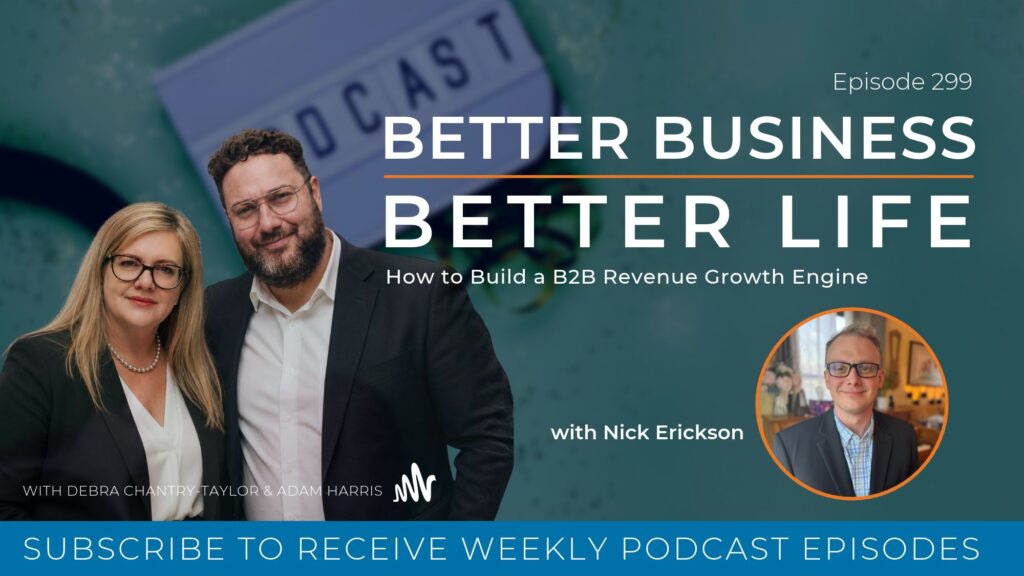
Nick Erickson 00:00
The equation goes story plus strategy times system equals revenue. System is the CRM; it’s your sales processes, and it’s a multiplier because if you don’t have good sales processes, if you don’t have good customer service processes, those customers aren’t going to grow. CRM should really do two things: it should resolve confusion internally within yourselves, and it should reduce friction or add force to a sales process. You should just be curious about your industry and want to publish about it. Like that is also good marketing. Like you should almost run it like a newsroom.
Debra Chantry-Taylor 00:37
I’m your host Debra Chantry-Taylor and I’m passionate about helping entrepreneurs lead a better life by creating a better business. Started the show almost six years ago to help business owners understand that the problems they’re facing, many many other people are facing, and they are able to overcome them. I either bring on board entrepreneurs who’ve been there, done that, got the T-shirt, or experts who can help with you getting to where you want to be? And in today’s case, I’ve actually got somebody who’s both of those. So today’s guest used to be a CRM strategy account director. He worked for a business where he generated $6.6 million in qualified inbound leads for a manufacturing B 2b business. He’s just written a book called Revenue by Design, which was a lifetime goal for him. Today, he’s going to share with you how to make your website do the early sales work. Because did you know that buyers make first contact about 80% of the time after doing their own research, and it’s important that your website actually helps to take that interest and convert it into a warm lead for the sales department. Nick Erickson is the owner and principal strategist of Narrative Brand Labs. Welcome to the show, Nick. Great to have you here.
Nick Erickson 01:52
Thanks for having me. Glad to be here.
Debra Chantry-Taylor 01:54
Absolute pleasure. So we’ve had a chat as we always do just before the podcast to get to know you a little bit. Why don’t you share your story with the listeners and tell us who you are and how you got to be where you are today.
Nick Erickson 02:06
I grew up in Minnesota, still live in Minnesota, and I like to think my career kind of started when I was about 17 years old, and I took a job selling lawnmowers at Sears, which dates me a little bit. You don’t see many seers around anymore. And what’s interesting is I actually never mowed the lawn at the time, so I had no working knowledge of lawnmowers. And but I got a job selling them, and it was really interesting. I like got kind of obsessed about just learning everything about them, and then like kind of just got thrown out there under the sales floor. And I remember my first like sales pitch, and it was I was just really nervous. Obviously, like you know, customer kind of comes at you, and you like all this like knowledge that you’re trying to like conceptualise, and like you know, I’m a little bit of a competitor. I think anyone that kind of gets into sales is to a certain extent, so just bundle of like nervousness, but then I just kind of like I don’t know somewhere along the line I just kind of calmed down a little bit and just realised that someone was just kind of trying to make a purchase, and like all I was really doing is just trying to help them make the purchase. So it just kind of got streamlined to me, and and suddenly like without me kind of knowing it, I formed this kind of like conception of sales, which is just like I’m just trying to help them make the best purchase. And I really just kind of focused in on that. Like I just kind of let the the winning or losing all fade away, and I just wanted to be like a concierge kind of. So that was my first sales job. Fast forward a little bit. I went right into college, took a little bit of a veer. That sounds like I just that was my beginning of my sales journey, and like I would just ride off ride off into the sunset. But I actually studied journalism in college with the intention of being a sports writer. Actually, I just love sports, and I kind of like had this knack for writing, and I just kind of wanted to follow this like breadcrumb trail of like, I think I can be a writer, and I just liked the idea of being a writer. Like there was something kind of romantic about being a writer, even though it was sports writing and it was you know kind of low stakes. Like you’re not writing like important novels or anything. And then I picked up a second major, kind of following this writing trail, and I started studying rhetoric, and I started tutoring writing, and I kept doing that all throughout college while I was also blogging and writing for the student newspaper, which was like my content creating career. Then I got back into B 2b sales, kind of held basically every role within sales and marketing. I made cold calls to start my B 2b sales career. Kind of cut my teeth that way. Eventually, kind of like got into like email marketing, and then I kind of, I kind of hopped all around. Got into a closing role, which was like at a CRM consultancy, which. Not only tell me about like closing pretty complex like B 2b deals where there was lots of stakeholders, but also got really good knowledge of like CRM, DevOps, like what a bunch of different companies were doing from sales process and like sales technology standpoint. So like over 15 years, I just kind of gathered all of these like sales, marketing, rev ops type roles, and about six months ago, kind of finally decided to just kind of take all of that knowledge and and founded Narrative Brand Labs, which is a fractional go-to-market and rev op rev ops agency for mid-market B 2b companies, and that’s where I am today.
Debra Chantry-Taylor 05:40
Perfect. And you’ve just finished, or I don’t know, when just you’ve got a book out, right?
Nick Erickson 05:45
I literally actually just finished it. Yeah, actually, so funny that we’re just finalising like the cover right now. My wife is a amazing graphic designer, and she’s doing the cover, and so we’re finalising the cover like tomorrow. So yes, just finished. Comes out December 8, and it really kind of just covers my my perspective from sales and marketing, like what I’ve seen from a bunch of different companies doing things, like how I’ve had success doing, and it really kind of gets summarised into kind of an equation on how B 2b companies specifically, but really any company can can kind of formulate kind of a growth strategy, which the equation goes: story plus strategy times system equals revenue. And so, basically, story is what you say. It’s your website. It’s your content. It’s you know the the message that you’re putting out, that you’re positioning. Essentially, it’s how can you help? It’s it’s going back to that Sears story. It’s it’s helping someone decide. They’re trying to decide not only you but also like they’re looking for other people. Of course, like they’re looking at other vendors, and you just want to tell them about you and how you can help them. And you just hope they pick you. Like that, you can’t win them all, right? Like we know that as salespeople, and so your story is really just authentically saying how you can help and how you uniquely solve problems. And strategy is really who you’re saying that to and where you’re saying it to. It’s this is channel strategy. This is even things like it’s kind of I get so much pushback on the word strategy and how I use it, but like it’s it means a lot of things. It’s really anytime you’re engaging, and it’s that moment that the story stops when they click on your CTA, and then all of a sudden they’re going to start thinking analytically about like, okay, does this fit? Do the can they really solve my problem? Is the price right? Is my CFO going to look at me like I’m crazy? Like they’re thinking strategically too. They’re thinking analytically. They resonate with your story, but they don’t know whether like the partnership is going to work between you two. And so it’s kind of a feeling out stage. Like you’re both kind of feeling out whether they’re good for you as a customer. Like whether you can actually solve their problem. And and likewise, they have a bunch of things to figure out them with themselves too. They have to typically in a B 2b sales cycle. There’s about six to 10 people that collectively come together to make these decisions. So they they can’t make it by themselves, and they’re having these analytical conversations within the organisation. And you don’t get invited to those. So this is another element where story really carries you through this process because if you really name your story really well, it’s going to be a lot easier for that committee to kind of reach a consensus around you. So that’s story and strategy. And then system is is the CRM. It’s your sales processes, and it’s a multiplier because if you don’t have good sales processes, if you don’t have good customer service processes, those customers aren’t going to grow, and they’re probably not going to leave a good reputation. They’re not going to talk good about you in the system. And so, if even if you do a really good job creating demand with story and strategy and closing deals, you can totally nullify it if you don’t have good operational background, and you can’t ultimately make your customers happy. I mean,
Debra Chantry-Taylor 09:00
it fits in really perfectly with the whole EOS model. I’m just sitting here listening as you’re going through that. In terms of you know the the the market, the marketing strategy, which is not your typical marketing strategy, but you know who is your ideal target audience? How do you solve their problem with the three uniques and whatnot? And then, as you said, systems and processes. And I I know that working with businesses, I know I know even in our business, let’s be honest. We’re actually really quite good, I think, at the story and possibly the strategy, but not so much at the processes at the moment. And so we’re we’re working through that. It’s a tough part.
Nick Erickson 09:29
Yeah, and I think it does fit well with EOS too, because I mean, it’s it’s also just the system layer being able to measure. Like, it’s also doubling down on what works too. Like, and it relates to the story and the strategy level, it’s like in the story level, like you can have a really good website, but like, are you getting traffic? Do you know your traffic? Like, do you know how well that traffic is converting? Like, there’s there’s data layers to the story, and same with the system, like your close rate, like you know whether you’re targeting the right people, like there are quantifiable elements to that, and if you. Can’t measure them, can’t prove it, and that’s kind of the EOS model too.
Debra Chantry-Taylor 10:04
Well, it is, and it’s part of the reason the scorecard exists. I think it’s really interesting. I come from a marketing background, so for me, it is natural to think of these things. I’m just reflecting whether we do it very well in our own business. I think maybe not as well as we could do, but it is interesting in terms of you know, a lot of people see marketing as just being the fluffy, coloured crayon department that just spends a shitload of money on stuff and doesn’t necessarily you know think about and and and often in organisations you know you got sales and marketing and they’re they’re they’re very separate, which doesn’t make any sense to me. It’s sort of like because it’s like that because sales blames marketing for not having enough leads, and then marketing kind of blames sales for not converting, and it just becomes really challenging. How do you see it working in in terms of if we looked at EOS and kind of the accountability chart and and the the functions of sales and marketing? How do you see them working?
Nick Erickson 10:54
I think marketing really is sales. Like you’re selling to kind of like you know a target audience like you’re kind of like it’s you’re not selling directly like in a direct sense like a salesperson like where you’re trying to actually close a deal, but you really are trying to convince somebody, and not only that, but like attract them to your website. So there’s like almost like kind of like this more open endedness to marketing. So like I think marketing is really doing the same thing though, like I talk about this in the book. What your website is is essentially trying to model agreement, and so like if you can kind of agree on a problem that you’re this is a story element. Like if you can say like, hey, we solve this problem, and you make that the forefront like of your website, that is much easier to agree on and to determine that it’s valuable rather than someone that is trying to like. I think to your point, a lot of people think marketing is just saying that you’re the best at everything. I would actually agree that it’s the opposite. Like I think good marketing admits limitations and puts them up front, like because that’s you’re putting sales in a bad position, and it’s hard for that lead to flow from marketing into sales if there’s you know promises that aren’t being kept or like you know kind of exaggerating language that you just like, and and kind of gobbledygook too. Like I see a lot of people like on their website say like something to the effect of like we’re best in class solutions provider or something like that like and what they’re trying to do is demonstrate value but like you end up kind of just saying nothing with it and so like saying that you solve this problem and then saying who you’re not for is actually a pretty powerful marketing strategy and it also like builds trust on the early end, which is marketing’s true job is to build trust enough to submit that contact form and start talking to sales.
Debra Chantry-Taylor 12:49
Yeah, it is interesting the work that I do with clients around the three uniques. They often come with very sort of generic things. It’s like this isn’t you know this is not going to make somebody go wow I want to work with you. And you’re absolutely right. It should it should repel as much as it attracts. In fact, I think the more it repels, the better, because then you actually you know you’re getting the right people actually coming through the funnel. But I am I’m intrigued because you know I know that people get told by SEO agencies that they have to have certain keywords, and so you know we we write content to actually create this so we can be found. So best EOS implementer, you know, et cetera, et cetera. When we know that it’s not that doesn’t actually that’s not even solving a pain point at all. But we know people search on that, so we get taught to create content like that. What’s your view on that?
Nick Erickson 13:31
What people don’t search is best in class, you know, da da da da da. Like what they search is questions, and I talk about this in the book. Like another one of marketing’s jobs is really to like take away as many questions and like answer as many questions as they might have. Because the more you can answer questions about their buying process, again, going back to my Sears story, and this is kind of like what like I led my whole sales career with is like all you’re trying to do is help them make a purchase, and so is your website. And so, like, if you’re answering key buyer questions that they might be thinking of as they’re trying to vet and look for a partner, you’re going to stand out because you’re being forwardly helpful, and that’s a great keyword strategy. Answering buyer questions that they’re going to search into, like they might be switching vendors, and they might be typing in some kind of like I’m frustrated with X Y Z vendor, or like I have this problem, and you want to show up for that search. They’re not going to be searching. I want the best blah blah blah blah. Like I, they’re going to search questions, and you got to kind of think about it from their end and what they’re going to type into that search box or AI now, and anticipate that, and just answer it on the front end, and offer it, like create the offer of help.
Debra Chantry-Taylor 14:47
And another question for you, because I’ve been thinking about this a lot, is that you know websites were always the place people went to find things, but now with the way that Google has changed and everything comes up with AI answers, what does that mean? Websites going forward.
Nick Erickson 15:01
I preach this all the time. SEO is a good GEO strategy. It’s a good AI strategy. The same principles apply. They actually work pretty similarly. The way Google’s search engines work is essentially they have search engine crawlers all the time, just kind of go across the internet and see what’s out there, and essentially how it understands keywords is not just keywords like, like traditionally, like where just one keyword kind of lands you on one page. Like it really tries to understand topics, and so it’s going to kind of group keywords into certain topics. And then when someone searches for something, it’s going to say like, okay, I know that this website has published a lot about this topic, and it has these keywords, and I trust them because there’s backlinks and like there’s all these kind of parameters that search engines are going to use to judge whether or not you’re worthwhile to suggest to that query, basically, because it’s just trying to be a matchmaker. It’s just trying to say, like, this is a trustworthy website. I think they have the right answer that you want, and for this search inquiry, and it’s just trying to make that match. So, given that, like, you just publish trustworthy content that covers topics, and you cover a certain amount of topical depth. This is kind of like thought leadership. Like I talk about in my book, like you should just be curious about your industry and want to publish about it. Like that is also good marketing. Like you should almost run it like a newsroom because that’s just you putting out there. You’re answering buyer questions. You’re being curious about your industry, which is just something that’s admirable and people want to work with in general. Like there’s really good statistics about how B 2b buyers want to choose someone who publishes thought leadership content, and I think there’s just something just kind of magnetic about. So being curious, publishing a lot, and then keywords will just kind of follow from that. So will trust for not only from the search engines but from the people.
Debra Chantry-Taylor 16:59
So I think what you’re saying, don’t force it, but just be very curious about your industry. Publish thought leadership pieces, and it will come naturally because that’s what you’re talking about. Yeah,
Nick Erickson 17:07
yeah, and care a little bit too. You know, like care about your own business, kind of, and and the problems that you solve. I think there’s kind of that human element too, where if you see someone just publishing stuff and just trying to help people, like you know, that are in this like searching for this kind of thing. You’re creating a lot of goodwill that way.
Debra Chantry-Taylor 17:26
Okay, I noticed that you know in the bio that you sent through to me, you were talking about a particular company that built $6.6 million in qualified inbound pipeline. Can we talk about that?
Nick Erickson 17:36
For sure. Yeah, it was it was a manufacturer, and when I came to the company, they kind of had that website that we were talking about earlier. Like it was a very like I call them like a bad dating profile or like a brochure type of website where it’s like all about me, me, me kind of thing. And and it was very like you know we’re the best in class you know service provider type of thing, and it was outdated, and they’re an old company. So, like at the time, so I’m just
Debra Chantry-Taylor 18:05
giggling to myself because I’m I’m single at the moment, and I’ve been on like dating websites, and it’s so obvious when you see those kind of profiles. Yes, yes, and that’s
Nick Erickson 18:12
why this, yeah, that’s why the metaphor just kind of resonates because like it’s it’s the it’s the just current age. I mean, it’s and they’re talking about themselves, and it’s they’re not talking about like a partnership, right? It’s what you want to see on those dating profiles is like someone that cares about like the other person that’s looking at your dating profile, like a thought for you know the the audience kind of. And so what we did was we first started with a rebrand, and we rebranded the company that they had a name that was like.
Debra Chantry-Taylor 18:42
So I’m just curious. I’m going to ask. I’m probably jumping a little bit too quickly, but I’m just wondering. There is a perception that every time a new marketer comes in, they want to rebrand, and it’s just because they want to kind of build their own. They want to build their own ego, and I just wanted. I was curious. Like, why did you need to go through a rebrand? Was my first question.
Nick Erickson 18:58
It was not my decision. It was. I was hired. This was a job actually, and I was just part of the rebrand. So this chief revenue officer kind of came in, and he wanted to do it. So I guess that stereotype still holds because I didn’t do it, but he did. But it was just very necessary because they had a name that 55 other companies had a very close variation of, or the exact same name. So, like, they actually had a very tangible problem where a rerun was entirely necessary because they were getting wrong inquiries for like the wrong company name, and like it was just confusing. And there’s like a kind of like a ownership of the name kind of property to it as well. So I would say in this case that it was pretty warranted just because of the confusion that it was causing.
Debra Chantry-Taylor 19:50
Perfect. Okay, makes perfect sense.
Nick Erickson 19:52
But it was also just an exercise to like kind of relaunch the company a little bit, like take a step back and just start doing things a little bit smarter. And it was a. Fascinating, like role for me because I kind of just he gave me a lot of licence to just like yeah you want to instal a new CRM like do it like I I was kind of his like second in command I just kind of got like a lot of licence to kind of just build a whole new go to market system and so we did the rebrand and we built a new website and we really kind of focused on trust. Like that was the the kind of we asked ourselves in a strategy session. Like, what do we want this website to do? And I said, they just need to trust us first because like they’re a manufacturer and like if you can imagine like especially a medical device, they’re handing over IP, like intellectual property in the form of like CAD files, and like they won’t do that if they don’t trust you. So like that was the whole website. It was not conversion or anything like that. We just said we just want people to trust us, and that was kind of like the inception moment. And from that, we kind of like this was me kind of figuring it out on the fly, where this like you know answering buyer questions like kind of all came naturally, like just as like a natural extension of that like kind of aha moment that the website should just make people trust us, and we started just answering every buyer question that we could possibly imagine. Like we just anticipated whatever someone might be curious about with our type of manufacturing, and we just posted pages, which is a great SEO strategy. Like page count matters as long as they’re not like worthless pages, and they were all helpful. And we basically published like 305 pages for the course of like one and a half years, and they were all like pretty substantial, like pages about like plastic types and like why choose this plastic over that one, like what types? If like I wanted this type of component for a medical device, like here’s what you should choose for that, and we just published a bunch about thought leadership and helping them make that buying decision. Right, just being a good partner, and what that led to was in 2025 we had 29 sales qualified deals across the year, which is about 2.4 deals coming in a month. Actually, nine out of 12 months we had inbound leads, which is great. Like coming in, like only three months where none came in, and it amounted to 6.6 million. And one of those deals was a very large $3 million deal, and we didn’t end up winning that one, but it was still like we got that deal because of organic search and like because they landed on these pages wasn’t a fit, but we still converted 1.75 of that 6.6, and we grew organic search by 164% over that year. And again, it was just because we were just trying to help whoever was landing on our website.
Debra Chantry-Taylor 22:44
I think that’s a really important distinction. I think that a lot of people are nervous of sales because they sort of feel like you know, oh, but selling nobody likes somebody who cold calls. But if you approach it with I’m just here to help you, and see what I can do to help you, I think it changes the whole mindset and the way that you actually deal with people, which is awesome
Nick Erickson 23:01
for the caller too. I think honestly, like I think if you go into if you’re nervous about making cold calls, like I would just say like just go into it with the mindset of you just want to help the person, see if you can help them, and just be a little bit curious. But like I think I can help you. I think that you might deal with this problem. How’s my kind of thing? And then like you can be polite, and you don’t like. I almost think like the nervousness can make the other person kind of like take a step back and kind of get nervous too, because they don’t feel like you’re going to help them.
Debra Chantry-Taylor 23:32
Yeah, sure. Okay, and I know that in again in the stuff that you sent through to me, you talked about that sort of buyers make first contact about 80% of the time, after doing their own research, and that’s why marketing sales have to work together, right? Because they they they’ve got to be able to find you, feel that you’re the right fit, have all their questions answered, know that that you’re there to help before it kind of leads into an inquiry. Tell me about where people go wrong. We’ve talked a little bit about the fact that they make the website all about me, me, me, me. Where else do they go wrong? Do you think
Nick Erickson 24:05
one of the biggest ones is the call to action? And I see a couple like just the best practices for call to action is be as specific as possible as to like what the like so like as opposed to contact us. Like if it’s more specific to say get a quote, I would do that. Another kind of like CTA is like best practice is to tell people what’s going to happen when they do the CTA. Like if I if I click this button and I fill out these forms, what happens next? Like people just kind of like drop that part and they don’t fill people in like just a simple process. Yeah, like, and I would just do 123. Like that’s kind of the Donald Miller story brand kind of best practices is just like 1233 steps to get started. You submit the form as step one, then we’re gonna review your thing, and then we’re gonna give you a quote or call you or something like that. Like just that, and then tell them how long. It’s going to take for those three things to take, and that just kind of lowers the risk. I kind of compare it in the book to that CTA is like a request. It’s a it’s a request, and it’s it’s kind of a the first of many agreements too. Like it’s it’s the first, and I think it’s where the strategy kind of side starts is because it’s the first agreement where it’s like, okay, I’m game. Like, I’ll submit this form. But like, it’s you know, to to form a good partnership, you should let them know what’s about to happen when they do that. Just like when you’re closing a deal, like you’re gonna want to say like, you know, review the contract before. Like, you don’t want them to be confused about the contract, so it’s kind of the first contract that you’re signing with the customer on the front end before you know the sales gets involved. And so, just offering a little bit of context into what goes on after they click those buttons is goes a long way, and it helps sales a lot too.
Debra Chantry-Taylor 25:58
I think the timing aspect is really important too. I work with a doctor, specialist doctor, sleep and lung doctor, who who published their kind of proven process to the to anybody who came to the website. And one of the things was they said that you know when you contact us, there’s going to be this amount of time before we get back to you. And I think it was something like a couple of days. And I remember thinking, gosh, so to me that feels like such a long time. But if you see it and you know it, then you’re not expecting an immediate call. You’re not expecting them to kind of immediately get back to you, which I think was really clever because they they physically couldn’t do it any faster. There’s no point pretending that they could, and so they were just really upfront. It’s going to take this amount of time. Then we’re going to be in contact with you. Then this is one of the things that’s going to happen. And it was just a really nice way to make people go, okay, I know what’s going to happen.
Nick Erickson 26:40
You’re demonstrating reliability, yeah, and that you can be relied upon. And which in a B 2b context, when that’s really all about partnerships, like it’s not like B 2c where I buy a thing and I put it in my pocket and I go home. Like we got to keep dealing with each other. We got to rely on each other. And so, just that little bit of context to show that I’m thoughtful enough, because you might be thinking this, wondering this yourself, just like the marketing, just kind of like trying to answer and anticipate every question you might have. It just shows that you care and that you want them to be informed, and that that’s part of the partnership is being informed on both sides.
Debra Chantry-Taylor 27:14
I love it. I know that in some of the businesses that I work with, they’re they’re smaller teams. You know, they’ve got sort of 20 to a several 100 staff, and they don’t always have a full time sort of marketing person, or they have a marketing execution person who does does the stuff, but doesn’t necessarily understand the go to market, the strategy, and the systems and processes. The salespeople they have, I’d say, often dismiss marketing as not being sort of anything that’s really really important. How would you expect them to work with that? What would you what would you recommend with a company maybe can’t afford a full time? Would you say hey you know because they often have the choice of either we have a full time strategic marketer and then they haven’t got the the resources to have somebody who does the stuff which means you’ve then got a very senior person trying to execute which is never a great thing, in my opinion. Or they go for the junior, but then they haven’t got the senior person to actually guide it all.
Nick Erickson 28:07
Call me. No, I’m just kidding. I would say that you know, well, you’re a fractional,
Debra Chantry-Taylor 28:17
right?
Nick Erickson 28:18
I am a fractional. I made that. I had to make that joke to say, “Call me.” That’s a great situation for me to plug into. But more seriously, I think you know, as someone that kind of like moseyed on to the marketing side from sales, like I really think sales has a pretty tapped-in knowledge for what marketing is, even though they might be jaded. Like, I would maybe say that, like, you know, a salesperson loves inbound leads, right? Like, that’s kind of like the gold standard. Like, to if a bluebird, like, kind of just blue chip customer, just kind of falls out of the sky and says, like, “Hey, let’s do this,” and I’m ready to buy right now. Everybody loves that, and so like, you can’t have that without good marketing, and so like, I think if you have the right mentality for it, salespeople can be really good marketers because like there’s a certain kind of like drive that I think that can like make them really good at marketing. Like I think one thing that marketing pure marketing people can kind of fall into is like yeah, get a little too like there’s kind of this like thing like where it’s like oh we published a blog like you know like just doing stuff is good marketing which I I disagree with like I think a sales mentality of of helping the customer can be a sneaky good marketing strategy if you just learn some of the kind of finer nuances of like how to like do things and then maybe some other specialists too. If you have the budget for it, like an SEO person and just answering buyer questions is like a great one to punch, like on a shoestring budget to to just expand your website, make it helpful for customers, and make it SEO optimised and make it show up in searches.
Debra Chantry-Taylor 29:58
I I love. I love the fractional model. We we have a sister company that’s fractional executives, and I think it is really it’s a really great way to get experienced people in without having to pay the full cost of having somebody in there. And I also think bringing somebody in externally. I you know I’ve done it myself when I used to work in corporate many many many many years ago. You know you often get you get blinkered. You can’t see the wood for the trees because you’re so involved in in what is going on, and so having somebody come in externally and actually challenge you a little bit and and you know challenge things like you know best in class and saying this and it’s all about me. There’s just a really. It’s often we we just don’t see it because it’s the way we’ve always done it. This is just how things are, and so you don’t you don’t know what what’s not working.
Nick Erickson 30:39
Yeah, the fine line is like the you just have to like compliment sandwiches. Like I really go back to like my tutoring days where like when you’re trying to help someone with their writing and they might be like a non-native English speaker or something like that. Like you can’t just tell them that it’s bad. So you gotta kind of like do compliment sandwiches. You know, like where it’s just like I like where you’re going with this. We could change this just a little bit. Like you can’t just say like this site is ugly. Like even though I might think that, and I had to kind of train myself of like people don’t want to hear that, Nick. Like want to hear that they have a problem. They just want to hear that things could be better. Just like the person like tried their best at writing that paper. Like they’re just trying their best, and that was was one of the golden lessons that I’ve learned throughout this process. Is like everyone’s just trying their best, and you know. But an outside perspective can help, but it can be a little bit jarring sometimes too, just because like you are trying to recommend change, and sometimes people like where things are at, and like don’t want things change.
Debra Chantry-Taylor 31:43
Yeah, I mean, I’m probably not as subtle as you. I’m not so good on the complementary stuff, but my whole thing is calling out the elephant in the room, and it’s like at the end of the day, it’s for the it’s for the greater good, right? We’re we’re looking to make sure that everything performs in the best possible way, and obviously, working with businesses, you want that entire customer journey, buyer journey to be really, really smooth, which means you have to analyse it all the way through it and go, you know, where where is it working? Where isn’t it working? Where are the issues? What can we do better? We’ve just been doing some of that work ourselves, and like
Nick Erickson 32:11
we say, it’s all it’s business, right? That’s like a shorthand for saying that, like, don’t get emotional about it, which I think is interesting because, like, I think not many people would say they don’t care and they don’t have any emotional capacity towards their like their their work life, but at the same time, it is business. Like there’s a truth to that. Like you just gotta kind of like disconnect yourself from it a little bit and think of it from your customer’s perspective for sure.
Debra Chantry-Taylor 32:37
Yeah. So I’m curious. I know I asked you this off camera, but why did you decide to write the book?
Nick Erickson 32:43
This and the business are just kind of things that happen kind of organically. 12 months ago, I was thinking about this today. I was I was just thinking of myself 12 months ago, and remembering how I wanted to start a business and I wanted to write a book, but they just felt like things that weren’t going to happen in my lifetime. And essentially, the job I was working just like had one of those bosses that I just couldn’t live with. Like it was kind of one of those nightmare bosses where I was just like, “Wow, this person’s very rude,” and I just can’t be around this. Like, and I was the only job in my like kind of professional career that I just like up and quit without anything else kind of going on. And so, before I kind of knew it, I just like went from that to doing my own business, and then all of a sudden I was writing a book, and it was almost like I was unconscious as all of it was happening because like I look up and I’m like, my God! Like somehow I just like from this kind of like negative experience, kind of just made my dreams come true. And it felt like a grind when I was doing it. I was just kind of so focused on making sure that it worked because like it was like a little bit of like the hurt that kind of came off that experience where I was like I had something to prove, and I’m expecting my first child in January, so like that was like news that happened, and like, and before I knew it, like three of my life’s goals like were just like in process, and then all of a sudden I blinked again, and they’re all done, and it was just like following a breadcrumb trail of like passion and like kind of running away from the corporate world a little bit too. Like there was like a certain amount of like I don’t want ever want to do this again. Like that was one of my big whys was just like I don’t want a boss like that again, and I want to be a better boss on top of that. Like I want not only want to not have a boss like that, but I’m gonna be a boss and I’m gonna do it really good. And so, kind of all those things happen, and here I am.
Debra Chantry-Taylor 34:40
That’s great. And look, I think we’ve all had those those boss moments where they haven’t been the best. But I think it’s really more about it’s about fit, right? I’m sure that for some people that they might be the best boss in the world. For other people, not so much. I’ve I’ve had one that I just really struggled with, but it doesn’t make them a bad person. It means you’re not the right person. And
Nick Erickson 34:57
it led me to here. So it’s it’s really. Like I’m a person that is kind of all like a water under the bridge type of person. Like I I don’t hold on to grudges. I just I’m much more keen to forgive and let go. And it gave me the best chapter of my life. So yeah, it’s the blessing underneath it all is, and it was the fire that kind of pushed me along too. Like it it helped me kind of no, no going back kind of thing, which was necessary because it’s scary. It was, it was like the journey sounds from entrepreneurs like you can just tell it as if it’s like all one, you know, honey and wine and like it’s all great and it was it’s hard. It’s hard. Like there was tears that along the way. Like there was moments where I really doubted if I was doing the right thing, and and it was kind of that experience that I was, you know, I didn’t want to go back to. I didn’t want to go back to the corporate life that like kept me going in those hard moments. So, you know, it was very necessary.
Debra Chantry-Taylor 35:54
And I think it’s wonderful for you being able to take all those experiences and put them into a book and share those things where other people can get the value from it as well. So, yeah, looking forward, looking forward to to seeing more of that. So, if people are listening at the moment and they’ve gone, you know, this because what I’ve what I’ve loved about this conversation is you have taken marketing and sales, you’ve simplified it down, you’ve taken away all the bullshit terminology and things that people use, and just gone. Actually, it’s about helping people. How do we best help people? How do we build relationships? How do we work in partnership with people? So people are listening to that and they’re going, “That’s all sounds great, but what what do I need to do now? What are my first steps? What are the sort of top tips you would give
Nick Erickson 36:30
them?” Yeah, I would say three things. Take a look at your website and ask yourself, “Are you talking about yourself?” Kind of going back to that dating profile thing. Like, are you talking only about me, me, me. I’m the best, like and no one’s better than me, kind of thing. Like you got you got a little bit of an egotism thing going on with your website, or are you trying to help? Are you using you language on your website? So that’s like the first check. Then I would just get a piece of paper, or like you can even use AI. AI is really great for this, and just ask it. Like, if you’re using AI, like, what are your buyers’ top 20 questions, and do we have anything on our site that answers those? And then I would take a look at your sales process, and I would say, what does this is my sales process about me and all the things that I gotta do, or is it about me and my customer and all the things that we gotta do to create something together? So those three things. So like, look at your website. Is it talking about you or your customer? And I forgot my second one. I was yeah, 20 questions. Like, are you talking about those things? Are you answering those things? And then, and as you’re engaging with your customer, trying to close a deal, like how much of it is about them? Like how much are you asking about their process? Like how much of your sales process is trying to meet their buying process?
Debra Chantry-Taylor 37:52
Yeah, interesting. We talk about sales process. Obviously, CRM kind of falls into that. A lot of people have CRM, but don’t really use it to its maximum capacity. What do you think are the biggest? And I know I know you’re a HubSpot user, but so what do you think are the biggest challenges in CRM for people?
Nick Erickson 38:11
I would say that, and this is coming from like CRM consulting. So like I’ve seen like bad implementations. I would say the biggest thing that goes wrong is when they get implemented top down, and it kind of goes back to that helpful thing. Like, if you’re implementing a CRM for only management to get value out of it, you’re kind of doing it the wrong way because ultimately, for management to get value out of it, you’re requiring a bunch of data to be entered reliably on time, you know, by people. And so, if that system is really giving them nothing back, like if there’s no tools that make their life easier, like I always say, like CRM should really do two things: it should resolve confusion internally within yourselves, and it should make reduce friction or add force to a sales process. So things like call recordings, or you know, automations can like save time. All add value to the people that are interacting with and ultimately entering the data.
Debra Chantry-Taylor 39:10
Yeah, it is interesting. I’m I’m I’m very fortunate. I was in sales. I’m I think I’m a bit older than you, but I’ve been in sales for a long, long, long, long time, and then into marketing. And I remember back in the really, really early days, the CRM. Everybody thought it was like a policing tool. It was you know monitoring what you were doing, and I actually I saw it quite differently. Well, it can be, but but it’s a bit like the scorecard in the US as well. Like you can use it as a policing tool, or you can actually use it to motivate and inspire, and actually get the best results from people. And what I did with my CRM was I kind of went, hey, this is actually really cool because I was actually selling drugs into doctor legal drugs into legal doctors, and you know I I worked out very very early on in my career that the doctor wasn’t the most important person in that in that practice. The most important person really was the person at the front desk who was going to either let you get into the doctor or not. And so I took the time to get to know all of these practice. Receptionists, whatever, and you know, I’d ask them about their family, and I’d ask them about what they do, and I’d ask them what coffee they had. And so, when I turn up to an appointment, I’d always you know turn up with a flat white and go, “Hey, I brought you your flat white.” Like they go, “Oh my goodness, how did you remember that?” And it’s like, “I didn’t,” but yeah. And I just saw CRM as really strengthening the human connection by helping me and my terrible sieve of a brain to remember things that were really important, and then it also I use it for what’s the next step? What’s the next step? And it would remind me what I had to do all the time. And so, as a salesperson, I thought this was the best thing ever. But most other salespeople were really scared of CRM because they just saw it as being a a policing tool.
Nick Erickson 40:37
Yeah, and I think another way that you can kind of demystify that policing is just tell people why. That’s such a huge thing. Like, why does management want this? Why is it important? Like, if they don’t have that, it’s hard for them to conceptualise. Like, it’s just a field. Like, it’s super easy to neglect. But if they know why it’s important and like what they’re going to use with it, like, just say like the difference between these two statements. Fill out this field, or fill out this field because here’s what we’re gonna do with it. We’re gonna like do market analysis, and then we think that’s gonna make us more successful over the long term because we can measure these things. Now all of a sudden, now I’m kind of bought in for the why, you know. Like now I kind of like now I get it versus just flatly telling me that I got to do it. Now it feels like a policing thing. Now it feels like you’re just kind of bullying me into this, or you know, there’s something, there’s a reason that we’re all collectively rallying around this, and it also makes it easier when you do need to do a little bit of policing. Like, hey, remember why we’re doing this? It’s important. We’re using this data. Please do it.
Debra Chantry-Taylor 41:35
Which kind of ties back into the whole point of EOS and the VTO, right? Is like sharing your vision with people and bringing them on the journey gives them context, and I think as humans, you know, I don’t know about you, I always ask the question whenever I do any kind of keynote speaking. I ask people to say, “How many of you like being told what to do?” And not surprisingly, no no hands go up, right? And then I say, “But as but as leaders, we often do this. We tell people this is what you need to do,” without actually allowing them to have any input or come on the journey, or have context, and it’s like actually, like the example I always use is that when somebody asked a cleaner working in NASA what his role was, he didn’t say I clean toilets. He said I was helping. He was helping put people on the moon, and that that is the difference between context and being brought into it, as opposed to just being told to clean the toilets.
Nick Erickson 42:23
Absolutely, yeah. There’s a there’s a why behind it. Yeah, I’ve been really obsessed with this quote lately. It’s attributed to many different people, but like, he who has a why can survive anyhow, and it’s just kind of that same thing. It’s just like if we know why we’re doing it, all of a sudden the the hows become just a little bit easier because we’re all kind of rolling in the same direction.
Debra Chantry-Taylor 42:46
I love it. I’m writing that down. That’s going to be used in premium. Yeah, it’s just it’s just kind
Nick Erickson 42:50
of rattled around in my brain a little bit, and like I, it’s one of those things where like kind of synchronistically, I kind of saw it a couple times. Like it just showed up like in my algorithm feed a couple times. Like maybe that’s just the algorithm trying to like whisper something to me or something. But, but yeah, it just kind of stuck with me, and I’ve been I’ve been kind of just chewing on that for a while, and I kind of yeah speaks to that.
Debra Chantry-Taylor 43:12
Love it. Okay, great. Well, hey, look. So a few things. Just quick recap. Yeah, things to take away. Look, take a look at your website. Make sure you are not a a bad dating profile. You’re not talking all about yourself, but you’re talking about using you language. Talking about your customers. Get a piece of paper. Use AI. Whatever it takes. Get your top 20 questions that your buyer is likely to ask, and then answer them. And use that to create content for the website. And then make sure the sales process is just as much about the end customer and what they’re doing as it is about you, so that we actually have a really smooth process throughout. And I think we’ll go back to the beginning. You said you know it was story plus strategy, time system equals revenue, and that is all covered in your book, right? So the book is Revenue by Design, coming out in early December. Yeah, and how will people get hold of that book, Nick?
Nick Erickson 44:03
Amazon, yeah. And soon I am starting recording on the audio book as well. So probably more in the January, February will be available on Audible as well. And if you want, I’m on LinkedIn and YouTube as well. So you can find me on those platforms. We should put some
Debra Chantry-Taylor 44:19
some links to that in the show notes as well as they can actually find you. Hey Nick, it’s been an absolute pleasure to chat to you this morning. Thank you very much. Yes,
Nick Erickson 44:26
likewise.
Debra Chantry-Taylor 44:27
And yeah, get in contact with Nick if you need some help. Thank you.
Nick Erickson 44:30
Thank you.
=======================================================================================================================================================
Debra Chantry-Taylor
Certified EOS Implementer | Entrepreneurial Leadership & Business Coach | Business Owner
#betterbusinessbetterlife #entrepreneur #leadership #eosimplementer #professionaleosimplementer #entrepreneurialbusinesscoach
Certified EOS Implementer New Zealand
Certified EOS Implementer Australia
Certified EOS Implementer UK
Certified EOS Implementer NZ